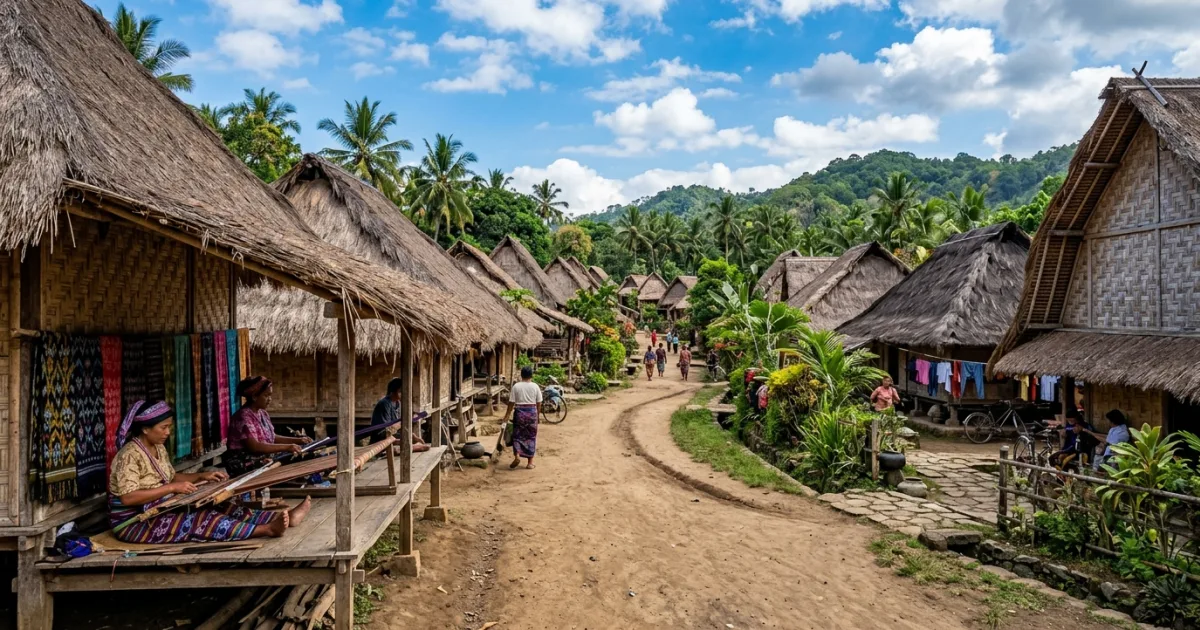
Sade Village (Desa Sade) is one of the most prominent traditional Sasak villages in Lombok, Indonesia. Home to around 700 residents who all belong to the same extended family, the village has fiercely preserved its ancestral customs despite the rapid modernization of the surrounding island. The architecture is the most striking feature; the houses, known as 'Bale Tani', are constructed entirely from natural materials, featuring woven bamboo walls and steep roofs made of dried alang-alang grass.
Beyond its architecture, Sade is a hub for traditional Sasak weaving. Women in the village learn to weave from a young age, and the intricate, colorful ikat fabrics they produce are renowned throughout Indonesia. Visitors can watch the meticulous weaving process on traditional wooden looms and purchase these textiles as meaningful souvenirs. The village also occasionally hosts cultural performances, including the Gendang Beleq (big drum) dance and Peresean, a traditional martial art involving rattan sticks and buffalo skin shields.
Reasons to Visit
- Experience authentic Sasak culture and architecture firsthand.
- Support local female artisans by purchasing beautiful, hand-woven ikat textiles.
- Learn about unique traditional practices, such as the cow dung floor treatment.
- Witness thrilling cultural performances like Peresean stick fighting.
- Enjoy a highly photogenic and culturally immersive environment.
Things to Avoid
- Avoid taking photos of the locals, especially the elderly, without asking for permission first.
- Do not enter a traditional house unless invited by the owner or your local guide.
- Avoid showing frustration if vendors become persistent; a polite refusal is best.
- Do not wear overly revealing clothing; dressing modestly shows respect for the local culture.
Local Transportation Tips
Sade Village is located in Rembitan, Pujut, Central Lombok, about a 20-minute drive from Lombok International Airport and 30 minutes from the popular tourist hub of Kuta, Lombok. The most convenient way to reach the village is by renting a scooter or hiring a private car with a driver for the day. Public transportation (bemos) is available but can be infrequent and difficult to navigate for tourists. Once inside the village, exploration is done entirely on foot.
Travel Etiquette
- Dress modestly, covering shoulders and knees, as a sign of respect for the local Muslim culture.
- Always use your right hand when giving or receiving items, as the left hand is considered unclean.
- Leave a reasonable donation in the guestbook at the entrance to support the village's upkeep.
- Ask for permission before taking close-up portraits of the villagers.
Recommended Age Group
Sade Village offers a fascinating cultural experience, though its rustic nature means it is better suited for some age groups than others.
- Babies (0-2 years): Neutral. The dirt paths are uneven and not stroller-friendly, so a baby carrier is essential. The tropical heat can also be intense.
- Kids (3-12 years): Recommended. Children will be fascinated by the unique houses, the weaving process, and the open-air environment.
- Teens (13-19 years): Recommended. A great educational experience and highly photogenic for teens interested in culture and photography.
- Adults (20-64 years): Recommended. Adults will deeply appreciate the cultural preservation, history, and the opportunity to buy authentic crafts.
- Seniors (65+ years): Recommended. The village is small and can be explored at a slow pace, though seniors should be mindful of uneven ground and steps into the houses.
Accessibility Level: Medium
- The pathways in Sade Village are made of uneven dirt and stone, which can be challenging for wheelchair users or those with mobility issues.
- Traditional houses have raised thresholds and steps, making them inaccessible to wheelchairs.
- There are no specific barrier-free facilities or accessible restrooms within the traditional village itself.
- Visitors with limited mobility may still enjoy the entrance area and watching the weaving demonstrations, but full exploration will be difficult.
Did You Know?
In traditional Sasak culture, a woman is historically not allowed to marry until she has mastered the art of weaving. This tradition ensures that the intricate skills required to create ikat textiles are passed down through generations of women in Sade Village.
Cool Statistics
- Sade Village is home to approximately 150 traditional houses (Bale Tani).
- The village population consists of around 700 people, all of whom are related.
- The alang-alang grass roofs of the houses typically need to be replaced every 7 to 10 years.
- Sade Village has been standing and preserving its culture for over 15 generations.






Buy a compatible power adapter for your trip