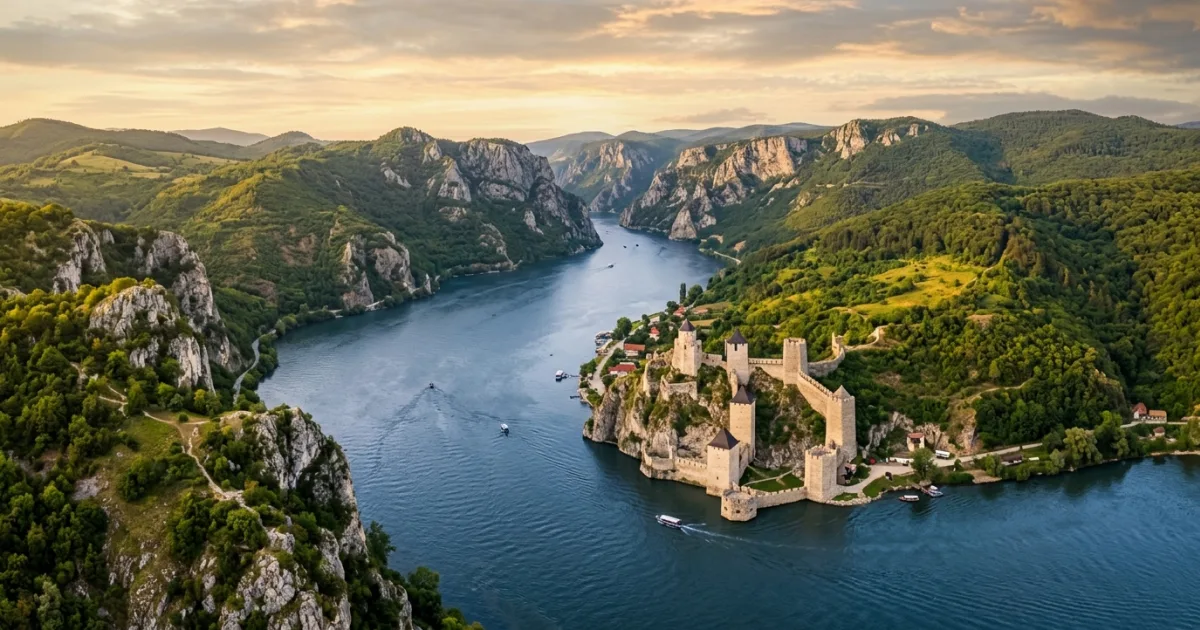
Eastern Serbia occupies the frontier where Central Europe's Pannonian Plain meets the dramatic Wallachian and Balkan mountain systems. Anchored along the southern edge of the blue Danube, this territory forms Serbia's border with Romania, defined by the sheer limestone walls of the Đerdap Gorge—the deepest and longest water gap in Europe. The landscape shifts rapidly from the massive river corridor into dense beech forests, karstic plateaus, subterranean crystal caverns, and pastoral mountain massifs like Rtanj and Homolje.
Historically a strategic crossroads of imperial empires, the region contains an astonishing archaeological timeline. At Lepenski Vir, visitors witness stone-age river settlements from 7000 BCE featuring fish-like anthropomorphic sculptures. Upriver, the Roman Emperor Trajan carved his road and bridge piers directly into the river cliffs, while late Roman Emperor Galerius constructed the UNESCO-listed imperial palace of Felix Romuliana near Zaječar. Complementing these ancient roots are medieval fortresses like Golubac and Fetislam, centuries-old stone wine villages (pimnice), and vibrant folkloric enclaves preserved within Vlach communities.
Reasons to Visit
- Đerdap National Park and the Iron Gates: Marvel at Europe's most dramatic river gorge from river speedboats or clifftop view points like Ploče.
- Monumental Fortresses: Explore the restored medieval towers of Golubac perched directly over the Danube and the vast Ottoman battlements of Fetislam in Kladovo.
- Cradle of European Prehistory: Inspect 9,000-year-old architectural remains and stone carvings preserved in situ at Lepenski Vir.
- Rajačke & Rogljevačke Pimnice: Step into unique 18th-century stone villages built purely for wine storage, offering rare indigenous varietals like Crna Tamjanika.
- Spectacular Karst Geology: Trek the rim of Lazar's Canyon, descend into the crystalline chambers of Rajko's and Resava caves, and photograph the turquoise waters of Krupaj Spring.
Things to Avoid
- Do not attempt to hike remote trails in Đerdap or Lazar's Canyon in flimsy sneakers; sharp limestone rocks and steep gradients require genuine hiking footwear.
- Avoid relying on public transportation to link rural attractions, as infrequent rural bus schedules will severely restrict your daily movement.
- Do not head into remote mountain areas in the Homolje or Kučaj mountains without a full fuel tank, as petrol stations are sparse outside main arterial roads.
- Avoid assuming all establishments accept credit cards; keep physical Serbian Dinars on hand for small-scale local operators.
Local Transportation Tips
A private or rental vehicle is the standard and most effective method for exploring Eastern Serbia. Major routes like the Đerdap Highway (Route 34) running along the Danube are well-paved and scenic, although mountain branch roads across Kučaj and Miroč can feature narrow switchbacks and unpaved sections. Intercity buses connect Belgrade with major hubs such as Golubac, Kladovo, and Zaječar multiple times daily, but local taxis or pre-arranged private drivers are required to reach trailheads and caves from these municipal centers.
Travel Etiquette
- Hospitality is deeply ingrained; if welcomed into a village household or wine cellar, accepting offered rakija (fruit brandy) or coffee is considered polite.
- Dress modestly when stepping into Serbian Orthodox monasteries such as Tumane or Gornjak, ensuring shoulders and knees are fully covered.
- Respect local customs surrounding Vlach folklore; while locals are friendly, avoid treating traditional beliefs as staged tourist entertainment.
- Tip roughly 10% in sit-down restaurants and konobas for attentive service, paid in cash directly to your server.
Recommended Age Group
Eastern Serbia is an adventurous landscape best suited for independent travelers, active families, and mature explorers who appreciate nature and archaeological history.
- Babies (0-2 years): Not Recommended. Mountain trail access, uneven stone fortress steps, and long rural drives over winding roads are logistically challenging with strollers.
- Kids (3-12 years): Neutral. Children will love the fairy-tale towers of Golubac Fortress and cavern excursions, though driving distances between sights require patience.
- Teens (13-19 years): Recommended. Excellent opportunities for canyon hiking, Danube river kayaking, cave spelunking, and exploring historic military ruins.
- Adults (20-64 years): Recommended. Perfect demographic for road trips, scenic wine tasting at the pimnice, archaeological deep-dives, and nature photography.
- Seniors (65+ years): Neutral. Ideal for those interested in slow scenic river drives and UNESCO heritage sites, though some canyon trails and fortress battlements involve steep stone stairways.
Accessibility Level: Medium
- The main exhibition pavilion at Lepenski Vir is modern, sheltered, and largely wheelchair-accessible with ramps and level pathways.
- Golubac Fortress offers step-free access to its visitor center, lower courtyard, and museum displays (Green Zone), though upper battlements are strictly accessible via steep stone staircases.
- Natural karst trails, including Lazar's Canyon rim and Krupaj Spring, feature unpaved dirt and rocky surfaces that are not wheelchair or stroller compliant.
- Danube cruise catamarans and speedboats operating from Tekija and Kladovo generally require stepping down onto floating docks and narrow boarding planks.
Did You Know?
At the narrowest stretch of the Danube gorge, known as the Kazan ('The Cauldron'), the river narrows to roughly 150 meters while dropping to depths exceeding 80 meters, making the riverbed sit well below the level of the Black Sea.
Cool Statistics
- 8,000+ years: Age of the prehistoric archaeological settlement at Lepenski Vir, Europe's earliest planned architectural community.
- 100 kilometers: Length of the Đerdap Gorge along the Danube River, making it the longest water gap in Europe.
- 270+ stone cellars: Historic two-century-old stone wine storage houses still standing in the Rajačke Pimnice complex.






Buy a compatible power adapter for your trip