Covering an area of approximately 147 square kilometers, Lantau Island is nearly double the size of Hong Kong Island, yet it remains one of the territory's least developed landscapes. Over half of Lantau is preserved within protected country parks, safeguarding biodiversity that ranges from wild orchids to rare amphibian species. The island balances tranquil rural traditions against cutting-edge modern engineering, sitting adjacent to Hong Kong International Airport and the expansive Hong Kong-Zhuhai-Macao Bridge.
For centuries, Lantau served primarily as an enclave for Buddhist monasteries, salt pans, and coastal fishing fleets. The opening of the Tian Tan Buddha in 1993 and the Ngong Ping 360 aerial ropeway in 2006 transformed the central plateau into an international pilgrimage site. Today, Lantau offers a diverse travel spectrum: adventurers conquer the 70-kilometer Lantau Trail, culture seekers wander the stilt houses of Tai O, and families unwind along the relaxed beachfronts of Lower Cheung Sha and Pui O.
Reasons to Visit
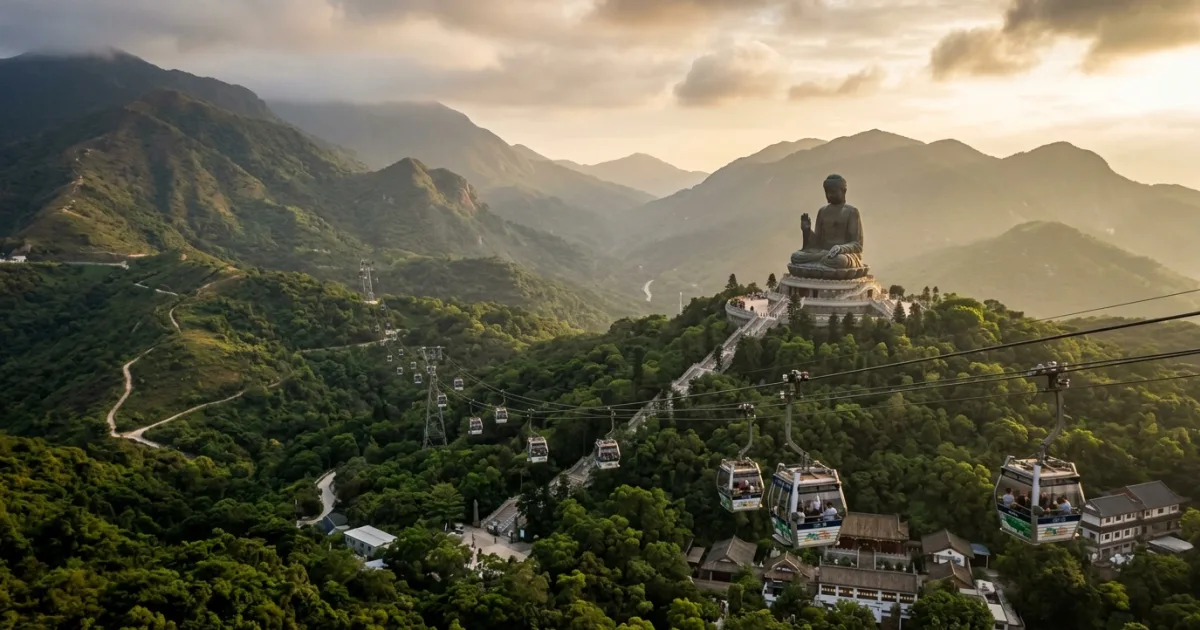
- Tian Tan Buddha & Po Lin Monastery: Gaze upon the majestic 34-meter bronze outdoor Buddha statue and explore tranquil Zen gardens with ornate monastic halls.
- Ngong Ping 360 Cable Car: Experience one of Asia's most spectacular aerial tram rides, sweeping across Tung Chung Bay and verdant mountain slopes.
- Tai O Stilt Village: Discover the 'Venice of Hong Kong', showcasing stilt houses (pang uk), seafood drying racks, and historic maritime shrines.
- Challenging Mountain Ridges: Ascend Sunset Peak and Lantau Peak to witness sea-of-clouds phenomena and panoramic sunrises over outlying archipelagos.
- Cheung Sha & Pui O Beaches: Relax on Hong Kong's longest stretches of soft sand, offering water sports, seaside bistros, and coastal camping.
Things to Avoid
- Avoid attempting Sunset Peak or Lantau Peak during high noon in the summer months without adequate hydration, as exposed ridges offer zero shade.
- Do not rely exclusively on taxis during Sunday afternoons in rural areas like Tai O or Ngong Ping, as vehicle queues can be extensive; prioritize scheduled New Lantao buses instead.
- Avoid touching or feeding the wild water buffalo roaming Pui O and Cheung Sha beaches, as well as feral boars in the uplands.
- Do not wear revealing beachwear when touring the religious compounds of Po Lin Monastery.
- Avoid visiting Ngong Ping on public holidays without pre-booking cable car tickets online to bypass lengthy ticket queues.
Local Transportation Tips
Lantau Island features an efficient multi-modal transport network. The northern fringe connects directly to Kowloon and Hong Kong Island via the MTR Tung Chung Line and Airport Express. To explore the mountainous south and west, travelers rely on the New Lantao Bus (NLB) company, which operates punctual routes linking Tung Chung, Mui Wo, Ngong Ping, and Tai O. First Ferry operates frequent regular and fast ferry services between Central Pier 3 and Mui Wo. Blue Lantau Taxis operate strictly within the island boundaries, though availability can be limited during peak weekend rush hours. The Ngong Ping 360 cable car provides direct aerial passage between Tung Chung and the Ngong Ping plateau.
Travel Etiquette
- Keep your voice lowered and refrain from photography inside active prayer halls at Po Lin Monastery.
- Always give up priority seats on New Lantao buses to elderly passengers and young children, especially along steep, winding mountain roads.
- Step aside and yield right-of-way to ascending hikers when descending narrow mountain staircases.
- Respect the privacy of local residents in Tai O; avoid pointing cameras directly into private stilt-house living rooms.
- Practice 'Leave No Trace' principles along country park trails by packing out all personal trash and plastic bottles.
Recommended Age Group
Lantau Island accommodates a wide range of travel styles, but its varied topography requires realistic planning depending on mobility and endurance.
- Babies (0-2 years): Neutral. Ngong Ping Village and the cable car facilities are stroller accessible, but the steep 268-step staircase of the Big Buddha and uneven wooden walkways in Tai O present logistical challenges.
- Kids (3-12 years): Recommended. Children thoroughly enjoy the glass-bottomed Ngong Ping 360 cable car ride, boat spotting for pink dolphins in Tai O, and gentle beach play along Cheung Sha.
- Teens (13-19 years): Recommended. High-energy teenagers will appreciate strenuous mountain ridge hikes, coastal water sports like sea kayaking and paddleboarding, and dramatic photography vantage points.
- Adults (20-64 years): Recommended. Exceptional hiking networks, profound cultural history, seaside craft breweries, and diverse culinary offerings make Lantau an optimal escape for adults.
- Seniors (65+ years): Neutral. Paved plateau areas, temple grounds, and scenic bus tours are easily enjoyed, but long stair climbs and uneven village surfaces demand steady mobility and frequent rest stops.
Accessibility Level: Medium
- Ngong Ping 360 cable car stations are fully barrier-free, offering ramp access, accessible elevators, and wheelchair boarding assistance.
- Ngong Ping Village paths and the lower courtyard of Po Lin Monastery are flat and paved for wheelchair navigation.
- Ascending to the platform of the Tian Tan Buddha requires climbing 268 steep stone steps; however, visitors with limited mobility can request vehicular access to the rear entrance with prior monastery approval.
- New Lantao Bus operates low-floor, wheelchair-accessible buses on select primary routes including Route B6 and Route 38; check current schedules in advance for Route 11 and 23.
- Tai O fishing village features narrow alleyways and occasional raised wooden thresholds, making full wheelchair navigation difficult along residential stilt walkways.
Did You Know?
Despite its peaceful, rural character today, Lantau Island was once a strategic maritime battleground and pirate stronghold. During the early 19th century, the notorious pirate confederacy led by Cheung Po Tsai commanded hundreds of armed junks throughout the waters and hidden bays surrounding Lantau, prompting the Qing Dynasty to construct the Tung Chung Fort in 1832 to defend the coast and suppress the salt smuggling trade.
Cool Statistics
- 147.16 sq km: Lantau's land area, making it roughly double the size of Hong Kong Island.
- 934 meters: Height of Lantau Peak (Fung Wong Shan), the second-highest peak in all of Hong Kong.
- 268 steps: The exact number of granite stairs required to reach the base of the Tian Tan Buddha statue.
- 5.7 kilometers: The continuous length of the Ngong Ping 360 bi-cable ropeway system.
- 70 kilometers: The total length of the 12-section Lantau Trail circuit traversing the island.






Buy a compatible power adapter for your trip