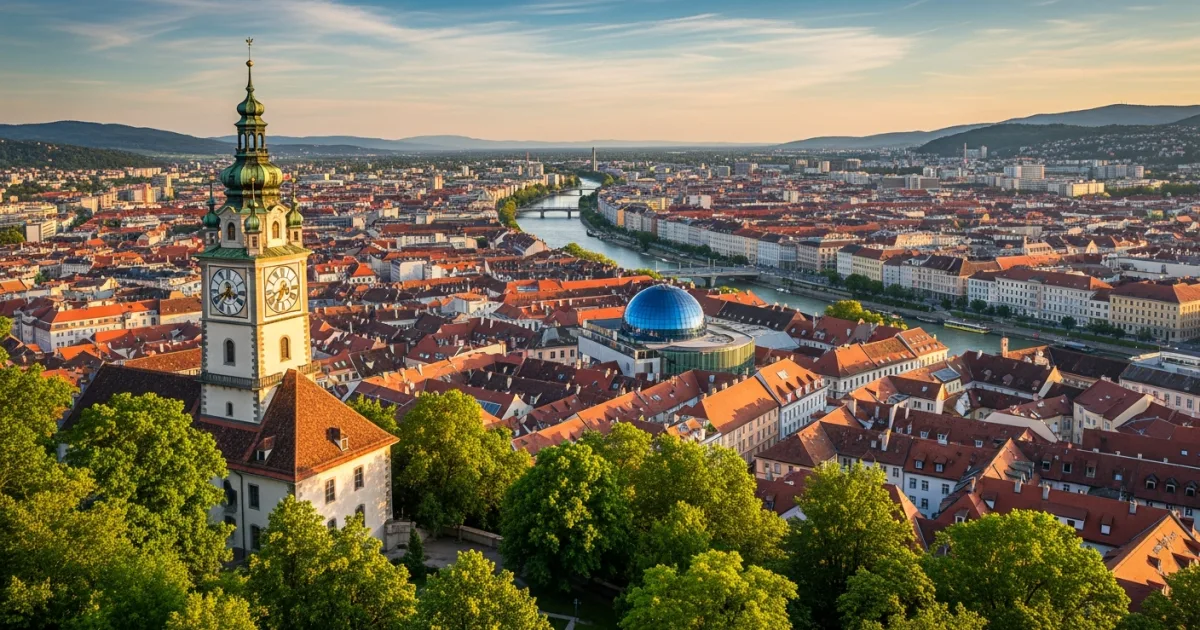
Graz functions as the economic and cultural hub of southeastern Austria, generating over 20% of Styria's gross regional product. The city spans 127.56 square kilometers and is bisected by the Mur River, which flows from north to south. Historical records first mention Graz in 1128, and it later served as the residence of the Inner Austrian branch of the Habsburgs from 1379 to 1619. The architectural landscape reflects this history, featuring a blend of Gothic, Renaissance, and Baroque styles, particularly evident in the well-preserved Altstadt (Old Town).
Modern developments, such as the 2003 European Capital of Culture initiatives, introduced contemporary landmarks like the Kunsthaus and the Murinsel, an artificial floating platform in the river. The city's commitment to preserving its historical assets while fostering modern design led to its designation as a UNESCO City of Design in 2011, complementing its existing World Heritage status.
Reasons to Visit
- Styrian Armoury (Landeszeughaus): Contains approximately 32,000 pieces of weaponry and armor, making it the world's largest historic armory preserved in its original 17th-century state.
- Schlossberg and Uhrturm: A tree-clad hill in the city center rising 473 meters above sea level, offering panoramic views alongside the iconic 16th-century Clock Tower.
- Kunsthaus Graz: Designed by Colin Fournier and Peter Cook, this museum showcases contemporary art within a biomorphic structure locally dubbed the 'Friendly Alien.'
- Eggenberg Palace: Located in the western district, this Baroque palace features 365 windows, 31 rooms on each floor, and 24 state rooms, symbolizing the calendar and time.
- Culinary Heritage: The local culinary scene heavily features Styrian pumpkin seed oil (Kürbiskernöl), a protected geographical indication product integral to regional dishes.
Things to Avoid
- Driving in the City Center: Driving is highly restricted due to extensive pedestrian zones and limited, expensive parking facilities. Public transit is far more efficient.
- Relying Solely on Cards: Many smaller cafes, market stalls, and traditional Gasthäuser (inns) operate on a cash-only basis.
- Monday Museum Visits: The majority of cultural institutions, including the Universalmuseum Joanneum branches, are closed on Mondays.
- Underestimating Weather Variations: The proximity to the Alps means sudden rain showers can occur even during warm summer months; carrying an umbrella is advised.
Local Transportation Tips
Public transportation in Graz is managed by Holding Graz Linien, operating a network of 6 tram lines and over 20 bus routes. The Altstadt-Bim initiative allows passengers to travel for free on trams within the city center, specifically between Jakominiplatz, Hauptplatz, and a few surrounding stops. Tickets for the broader network can be purchased at automated machines located at major stops, inside the trams, or directly via the GrazMobil smartphone application.
Bicycling represents a significant mode of transport, supported by over 120 kilometers of dedicated cycle paths and numerous rental stations throughout the urban area. The central train station, Graz Hauptbahnhof, serves as the primary hub for regional and international rail connections, linking the city to Vienna in approximately 2.5 hours.
Travel Etiquette
- Greetings: Greeting shopkeepers with 'Grüß Gott' or 'Guten Tag' upon entering and 'Auf Wiedersehen' upon leaving is standard social practice.
- Tipping: Tipping in restaurants typically involves rounding up the bill by 5 to 10 percent, handed directly to the server rather than left on the table.
- Punctuality: Punctuality is highly valued in Austrian culture; arriving on time for tours, reservations, and meetings is expected.
- Recycling: Recycling is strictly enforced, with color-coded bins provided for paper, plastic, glass, and organic waste in public spaces and accommodations.
Recommended Age Group
Graz offers a highly accessible and diverse urban environment suitable for all age demographics, supported by excellent public infrastructure and varied cultural attractions.
- Babies (0-2 years): Recommended. Graz offers extensive pedestrian zones, well-paved sidewalks suitable for strollers, and numerous public parks like the Stadtpark.
- Kids (3-12 years): Recommended. Attractions such as the FRida & freD Children's Museum and the fairy tale train (Märchenbahn) inside the Schlossberg provide dedicated interactive experiences.
- Teens (13-19 years): Recommended. The city's vibrant student culture, contemporary art scene at the Kunsthaus, and active shopping districts like Herrengasse appeal to younger demographics.
- Adults (20-64 years): Recommended. The combination of historic architecture, extensive culinary offerings, and vibrant nightlife in the university districts caters well to adult travelers.
- Seniors (65+ years): Recommended. Excellent public transportation, accessible museums, and the availability of elevators and funiculars to high-elevation sites like the Schlossberg ensure comfortable navigation.
Accessibility Level: Medium
- Public Transit: The majority of Graz's tram fleet consists of low-floor vehicles, ensuring wheelchair accessibility across the primary public transit network.
- Attraction Access: Key tourist attractions, including the Kunsthaus, Zeughaus, and Schloss Eggenberg, are equipped with elevators and ramps to accommodate visitors with mobility impairments.
- Visual Aids: Tactile paving and acoustic traffic signals are installed at major intersections throughout the city center to assist visually impaired pedestrians.
- Schlossberg Elevator: The Schlossberg is accessible via a glass elevator built directly into the mountain, providing a seamless alternative to the steep funicular or stairs.
Did You Know?
Graz was designated as the Cultural Capital of Europe in 2003, a catalyst for the construction of several modern architectural landmarks including the Murinsel. The city is also the birthplace of Arnold Schwarzenegger, who was born in the neighboring village of Thal, where a museum dedicated to his life now operates. Furthermore, Johannes Kepler, the renowned mathematician and astronomer, taught at the Protestant school in Graz from 1594 to 1600, developing his early astronomical theories during his tenure.
Cool Statistics
- Student Population: Graz hosts over 60,000 students across its 8 higher education institutions, making students roughly 20% of the total population.
- Historic Buildings: The historic city center encompasses over 1,000 buildings spanning architectural styles from Gothic to contemporary.
- Schlossbergbahn Incline: The funicular railway, operating since 1894, transports passengers up a 60% incline to the top of the Schlossberg.
- Pumpkin Seed Oil Production: Styria produces approximately 2 million liters of pumpkin seed oil annually, with Graz serving as the primary commercial hub for this export.







Buy a compatible power adapter for your trip