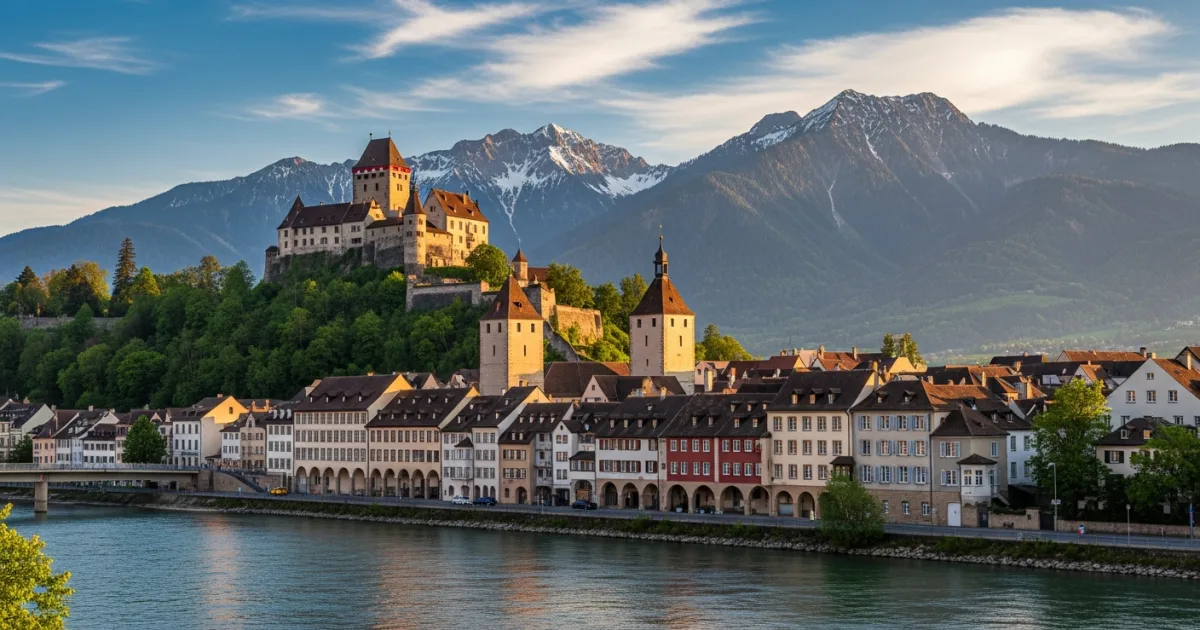
Feldkirch sits at an elevation of 458 meters above sea level, occupying a strategic position where the Ill River enters the Rhine Valley. The city's architectural landscape is defined by the Marktgasse, a central market street lined with arcaded houses dating back to the 15th and 16th centuries. Meteorological data indicates a temperate oceanic climate, with average July highs reaching 24°C (75°F) and January lows dropping to -2°C (28°F). The municipality encompasses several distinct districts, including Levis, Altenstadt, Gisingen, Nofels, Tosters, and Tisis, each contributing to the local administrative and residential infrastructure. Historical records show the city was heavily fortified, and remnants such as the Churer Tor (Chur Gate) and the Mühletor (Mill Gate) remain intact, providing structural evidence of medieval urban planning.
Reasons to Visit
- Schattenburg Castle: A 12th-century fortress featuring a museum with 18 historical rooms and a renowned restaurant serving traditional schnitzel.
- Medieval Architecture: The Altstadt (Old Town) preserves its original 1190 grid layout, complete with arcaded walkways and historic gates like the Churer Tor.
- Strategic Location: Situated within 30 minutes of the borders of Switzerland, Liechtenstein, and Germany, making it an optimal base for multi-country day trips.
- Katzenturm (Cats' Tower): An eight-story defensive tower built in 1491 that houses the 'Dies Irae,' the largest bell in Vorarlberg weighing 8,573 kg.
- Cultural Festivals: The annual Poolbar Festival transforms a former indoor public pool into a venue for contemporary music and art, drawing over 20,000 attendees.
Things to Avoid
- Driving in the Altstadt: The historic center features narrow, pedestrian-heavy streets and limited parking; utilizing the peripheral parking garages is more efficient.
- Assuming Sunday Operations: Retail stores and many supermarkets strictly close on Sundays due to Austrian labor laws, requiring advance purchase of necessities.
- Ignoring Border Regulations: While within the Schengen Area, random border checks occur frequently on trains and roads entering Switzerland or Liechtenstein.
- Underestimating Alpine Weather: Temperature fluctuations of 10-15°C can occur rapidly, making layered clothing necessary even during summer months.
Local Transportation Tips
The Feldkirch railway station processes over 15,000 passengers daily, serving as a critical hub for the ÖBB (Austrian Federal Railways) network with direct connections to Vienna, Zurich, and Munich. The Stadtbus Feldkirch system operates eight primary routes, utilizing a fleet of low-floor buses that connect the central station to all municipal districts. Regional Landbus services facilitate transport to surrounding Vorarlberg towns and ski resorts. Bicycle infrastructure is highly developed, with dedicated paths running along the Ill River and connecting to the broader Rhine Valley cycle network.
Travel Etiquette
- Greeting: Use 'Grüß Gott' (God greet you) when entering shops or hiking trails, as it is the standard formal greeting in Vorarlberg.
- Tipping: Round up the bill or add 5-10% in restaurants; hand the tip directly to the server when paying rather than leaving it on the table.
- Punctuality: Arrive exactly on time for scheduled tours, transport, or meetings, as Austrian culture highly values precise timekeeping.
- Recycling: Adhere strictly to the local waste separation system, dividing refuse into paper, plastic, glass, and biological waste.
Recommended Age Group
Feldkirch offers a balanced mix of historical sightseeing and outdoor accessibility suitable for various demographics.
- Babies (0-2 years): Neutral. The cobblestone streets in the Old Town can make stroller navigation bumpy, though public transport is highly accessible.
- Kids (3-12 years): Recommended. The Wildpark Feldkirch offers free entry to view over 140 alpine animals, and Schattenburg Castle provides engaging historical exhibits.
- Teens (13-19 years): Recommended. The city offers access to outdoor adventure sports, cycling routes, and the summer Poolbar Festival features youth-oriented music and art.
- Adults (20-64 years): Recommended. Excellent culinary options, historical architecture, and strategic positioning for cross-border alpine exploration appeal strongly to adult travelers.
- Seniors (65+ years): Recommended. The compact, walkable nature of the historic center, combined with efficient public transit and well-maintained cultural sites, ensures a comfortable visit.
Accessibility Level: Medium
- Public Transport: All Stadtbus Feldkirch vehicles are equipped with low-floor technology and ramps, ensuring wheelchair accessibility.
- Train Station: The main railway station features elevators to all platforms and tactile paving for visually impaired travelers.
- Old Town Navigation: While the Altstadt is relatively flat, the historic cobblestones may present minor challenges for manual wheelchair users.
- Schattenburg Castle: Due to its 12th-century construction, the castle museum has limited accessibility, with steep stairs and no elevator access to upper floors.
Did You Know?
James Bond's 'Quantum of Solace' (2008) filmed scenes in Feldkirch, specifically utilizing the city's medieval streets to represent a chase sequence, temporarily shutting down the historic center for production.
Cool Statistics
- Population: 35,000 residents, making it the second most populous city in Vorarlberg.
- Elevation: 458 meters (1,503 feet) above sea level.
- Bell Weight: The Katzenturm bell weighs exactly 8,573 kilograms.
- Founding Year: 1190, established by Count Hugo von Montfort.
- Border Proximity: Located less than 3 kilometers from the Liechtenstein border.






Buy a compatible power adapter for your trip