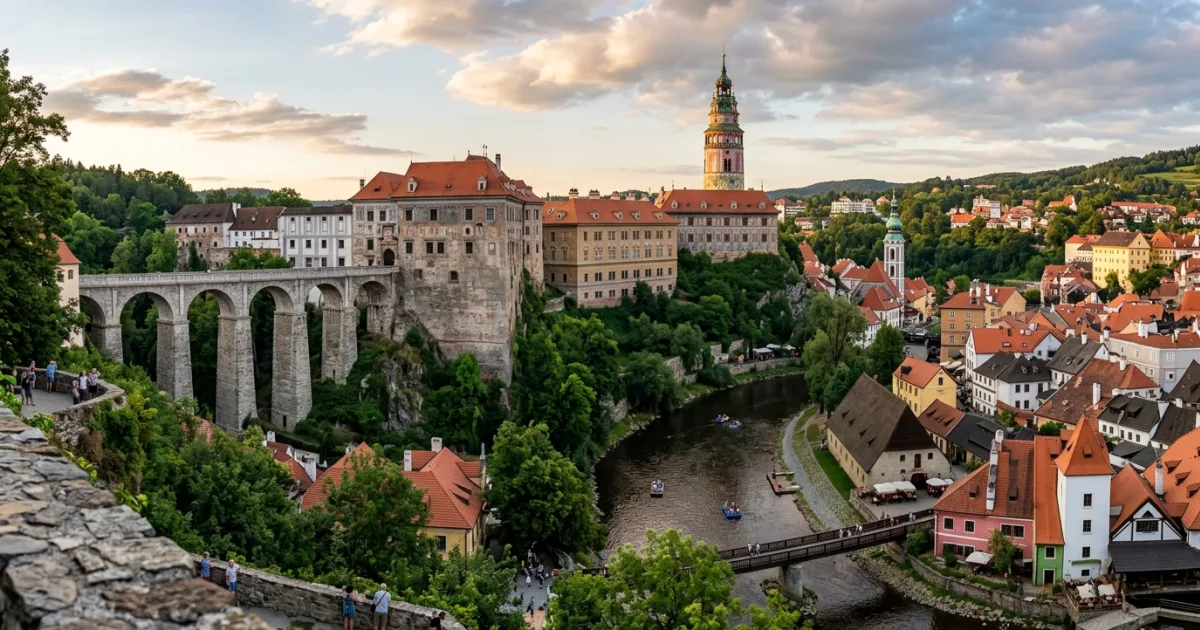
Cesky Krumlov Castle crowns a dramatic escarpment over the Vltava River in Southern Bohemia, standing as an enduring symbol of feudal grandeur. Originating as a Gothic stronghold founded by the Lords of Krumlov around 1250, the complex expanded dramatically under the powerful House of Rosenberg throughout the 14th to 16th centuries. The estate was gradually transformed into an extravagant Renaissance residence before the Eggenberg and Schwarzenberg families infused it with opulent Baroque and Rococo aesthetics. Covering over seven hectares, the complex ranks among the most extensive fortifications in Central Europe.
Today, visitors enter through the Red Gate into a progression of five courtyards, moving past historic stables, the moat, and the iconic pastel-painted Castle Tower. Highlights include the Golden Carriage of Eggenberg, the monumental five-tiered Cloak Bridge spanning a deep rock chasm, and the Baroque Castle Theatre, an exceptionally preserved theatrical monument. Whether admiring the manicured French parterres of the upper gardens or looking down upon the medieval roofscape below, the castle offers an unmatched perspective on Czech aristocratic history.
Reasons to Visit
- Tour one of the world's best-preserved 18th-century Baroque theatres, complete with original wooden machinery, stage props, and costumes.
- Climb the 162 steps of the iconic 13th-century cylindrical Castle Tower for unobstructed 360-degree vistas over South Bohemia.
- Cross the multi-tiered Cloak Bridge to capture signature photographs of the town's looping river bends.
- Admire authentic Renaissance sgraffito wall murals decorating the third and fourth courtyards.
- Stroll through eleven hectares of peaceful manicured castle gardens featuring a cascading Rococo fountain and revolving auditorium.
Things to Avoid
- Avoid arriving without advance reservations for guided interior tours and the Baroque Theatre during peak summer weekends, as entry slots sell out.
- Do not wear slick leather-soled shoes or high heels, as navigating the steep, cobblestoned paths requires reliable traction.
- Avoid planning your trip on Mondays between October and April, when interior exhibition spaces are strictly closed.
- Do not bring bulky suitcases or oversized rucksacks up to the ticket checkpoint, as interior bag allowances are tightly restricted.
Local Transportation Tips
Cesky Krumlov's compact historical center is predominantly pedestrianized, making walking the primary and most practical way to reach the castle. The main entrance sits directly adjacent to the historic Latran district, accessed via an uphill stone ramp. If arriving by regional bus at the Cesky Krumlov AN station, the castle is an easy 15-minute walk through town. Travelers arriving via the train station face an uphill 20-minute walk or can take a local taxi or town shuttle bus for roughly 100 to 150 CZK.
Travel Etiquette
- Maintain low noise levels and quiet speaking tones while walking through guided interior stateroom tours.
- Adhere strictly to no-photography signs inside sensitive historical spaces, particularly within the fragile Baroque Theatre.
- Do not touch historic tapestries, delicate gilded furniture, or ancient painted plaster surfaces along the tour corridors.
- Respect preservation barriers across the castle gardens and avoid walking on restored decorative flower beds.
Recommended Age Group
Cesky Krumlov Castle provides an engaging historic experience, though physical terrain and mobility requirements vary significantly across age profiles.
- Babies (0-2 years): Not Recommended. Cobblestone slopes and narrow historic staircases make strollers virtually unusable across the site; baby carriers are strictly necessary.
- Kids (3-12 years): Neutral. Older children often enjoy the castle moat bears and the tower climb, but long, quiet guided history tours can test younger attention spans.
- Teens (13-19 years): Recommended. High engagement through panoramic photography viewpoints, river valley views, and unique medieval fortifications.
- Adults (20-64 years): Recommended. Ideal for travelers interested in architectural history, heritage tours, and cultural photography.
- Seniors (65+ years): Neutral. While culturally enriching, the steep cobblestone approaches, long distances across courtyards, and lack of elevators present notable mobility hurdles.
Accessibility Level: Medium
- Physical accessibility is limited due to the historic preservation of steep stone inclines, uneven cobblestone alleys, and absence of elevators in historic buildings.
- The Castle Museum and Castle Tower do not have elevator access and require climbing multiple flights of narrow stairs.
- Accessible routes exist through parts of the fifth courtyard and the upper gardens, though navigating from the town center requires an uphill ascent on rough cobblestones.
- Standard accessible public restrooms are located in the first courtyard near the castle entrance.
Did You Know?
Bears have been kept in the castle moat between the first and second courtyards since the late 16th century, a tradition begun by the Rosenberg family who claimed mythical kinship with the noble Italian Orsini family, whose name derives from the Italian word for bear ('orso').
Cool Statistics
- Spans 5 connected courtyards and contains 40 distinct architectural structures.
- The entire castle complex covers an expansive area of over 7 hectares (17 acres).
- The Castle Tower rises to a height of 54.5 meters (179 feet) above the first courtyard level.
- Recognized globally as a UNESCO World Heritage site since 1992.




Buy a compatible power adapter for your trip