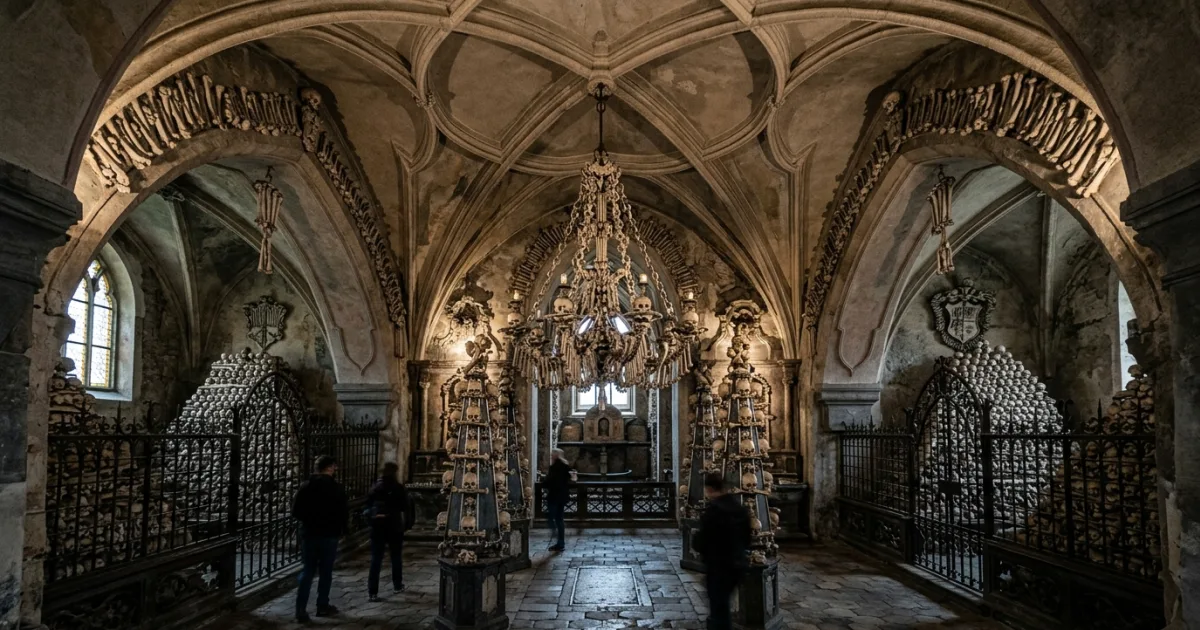
The Sedlec Ossuary stands as one of Europe's most compelling examples of sacred art born from tragedy. Situated in the Sedlec district of Kutná Hora, approximately 70 kilometers east of Prague, the site embodies centuries of Bohemian spiritual history. After the Cistercian monastery was founded in 1142, the adjacent cemetery grew into a prestigious final resting place. The sheer volume of internments caused by the 14th-century Black Death and the subsequent 15th-century Hussite skirmishes overwhelmed the cemetery grounds, necessitating the exhumation of skeletal remains when construction on the All Saints Church commenced.
A half-blind Cistercian monk reportedly began stacking the disinterred bones into orderly pyramidal mounds around 1511. It was not until 1870, under the direction of Czech woodcarver František Rint, that the bones were transformed into their current artistic configuration. Today, visitors step down into a quiet, temperature-controlled crypt where every chandelier, garland, and wall panel is rendered from human anatomy, prompting contemplative meditation on mortality, faith, and human continuity.
Reasons to Visit
- Witness the famous bone chandelier crafted from every skeletal bone type in the human body.
- Marvel at the heraldic coat of arms of the House of Schwarzenberg composed entirely of human bones.
- Experience a genuine UNESCO World Heritage site showcasing unique Baroque-Gothic architecture by Jan Santini Aichel.
- Enjoy a seamless, budget-friendly day trip reachable in under an hour from Prague.
- Combine your visit with Kutná Hora's historic silver mining legacy and the majestic Saint Barbara's Cathedral.
Things to Avoid
- Avoid touching the bone arrangements or disturbing the memorials; all structures are delicate and consecrated.
- Avoid attempting unauthorized flash photography or videography inside the lower crypt.
- Avoid speaking loudly or treating the crypt as an amusement park attraction; it remains a consecrated Roman Catholic burial ground.
- Avoid booking expensive bus tour packages when direct public trains run smoothly and cheaply every hour.
- Avoid rushing back to Prague immediately after the ossuary; Kutná Hora's medieval town center is well worth exploring.
Local Transportation Tips
Kutná Hora is linked to Prague by frequent regional trains operated by České dráhy. From the primary station (Kutná Hora hlavní nádraží), the ossuary is roughly 800 meters west, requiring a flat 10-minute walk along marked pedestrian paths. To travel between Sedlec and the historic town center (where Saint Barbara's Church is situated), visitors can board a local shuttle train to Kutná Hora město station, catch local bus line 1, or take a pleasant 35-minute walk along the marked tourist trail.
Travel Etiquette
- Maintain a quiet, respectful tone of voice while walking through the chapel crypt.
- Dress respectfully; remove hats upon entering and avoid overly revealing beachwear.
- Follow posted signage strictly regarding mobile phone usage and photography limitations.
- Keep to designated roped pathways and never lean against the bone stacks.
Recommended Age Group
Sedlec Ossuary is an educational and solemn historic monument, best experienced by older children, teenagers, and adults who can appreciate its architectural and historical gravity.
- Babies (0-2 years): Not Recommended. Narrow stone steps make the subterranean crypt inaccessible for strollers, and the solemn environment requires absolute quiet.
- Kids (3-12 years): Neutral. Some young children may find thousands of human skulls and bones frightening, though others view it with natural historical curiosity. Parental discretion is strongly advised.
- Teens (13-19 years): Recommended. The dark history, memento mori symbolism, and intricate visual displays make this fascinating for teenagers interested in history, art, and Gothic heritage.
- Adults (20-64 years): Recommended. A captivating historical and artistic immersion that pairs seamlessly with Bohemian cultural exploration.
- Seniors (65+ years): Recommended. A culturally rewarding visit, provided travelers are capable of navigating a short flight of stone steps down into the chapel.
Accessibility Level: Medium
- The Cemetery Church of All Saints is partially accessible, but entering the lower bone ossuary requires navigating steep stone stairs without elevator access.
- Paved pathways surround the church exterior and graveyard, making the exterior accessible for mobility devices.
- Information panels and audio guides are available in multiple languages for visitors with sensory interests.
- Visitors with severe mobility impairments should contact parish staff ahead of time to confirm support options.
Did You Know?
The signature of František Rint, the woodcarver who crafted the ossuary's macabre installations in 1870, is also meticulously spelled out in human arm and finger bones on the wall near the crypt entrance.
Cool Statistics
- Estimated number of skeletons inside: 40,000 to 70,000
- Year holy soil from Jerusalem was scattered: 1278
- Travel time by direct train from Prague: ~50 minutes
- Year František Rint created the bone arrangements: 1870






Buy a compatible power adapter for your trip