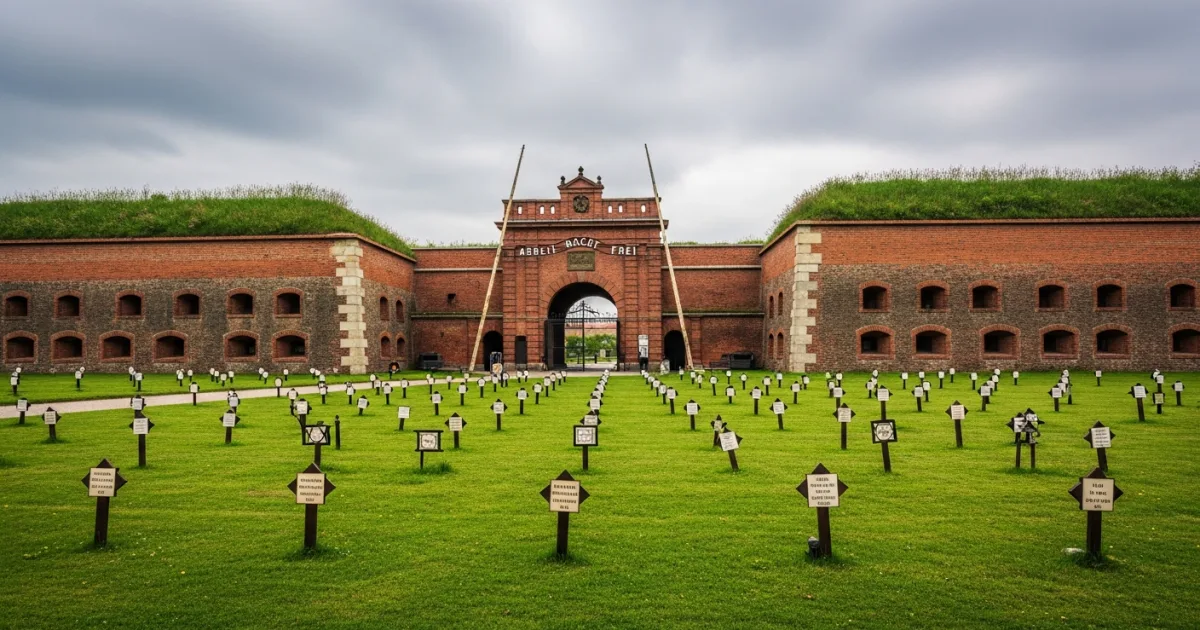
Terezin, known in German as Theresienstadt, stands as a stark reminder of the atrocities of the 20th century. Originally constructed as a massive star-shaped military fortress to protect Prague from Prussian invasions, its thick brick walls and deep moats were later utilized for far more sinister purposes. During World War II, the Gestapo transformed the main town into a Jewish ghetto and transit camp, while the adjacent Small Fortress became a brutal prison for political dissidents and resistance fighters. Today, the entire town functions as a living museum and memorial.
Walking through Terezin is a sobering experience. The Ghetto Museum, located in the former boys' school, provides a comprehensive and heartbreaking look into the daily lives, secret educational efforts, and remarkable artistic resilience of the Jewish inmates. The Magdeburg Barracks showcase reconstructed dormitories and highlight the vibrant cultural life—including music, theater, and lectures—that inmates maintained as a form of spiritual resistance. A visit here is not a typical vacation activity, but rather a profound pilgrimage that educates and honors the memory of those who perished.
Reasons to Visit
- To pay respects and honor the memory of the victims of the Holocaust at the National Cemetery.
- To gain a deep, educational understanding of WWII history and the specific role of the Theresienstadt ghetto.
- To witness the incredible artistic and cultural resilience of the inmates, showcased in the Ghetto Museum.
- To explore the imposing 18th-century military architecture of the Small Fortress.
- To experience a highly impactful and accessible day trip just an hour away from Prague.
Things to Avoid
- Avoid speaking loudly or acting disrespectfully; this is a site of mass tragedy and a cemetery.
- Do not take selfies or inappropriate photographs at the memorial sites or execution grounds.
- Avoid bringing young children who may be traumatized or unable to understand the gravity of the exhibits.
- Do not rely solely on finding a high-end meal in town; dining options are very basic.
- Avoid visiting on major national holidays without checking opening hours, as some facilities may be closed.
Local Transportation Tips
Terezin is a small town, and the best way to navigate between the main sites is on foot. The walk from the Ghetto Museum in the center of town to the Small Fortress takes about 15 to 20 minutes along a flat, well-marked path. If you arrive by public bus from Prague, it will drop you off near the town square, making it easy to start your walking tour. There is no local public transit system within Terezin itself, but taxis can be called if mobility is an issue.
Travel Etiquette
- Maintain a quiet and respectful demeanor at all times, especially in the cemeteries and execution areas.
- Dress modestly and appropriately for a memorial site; avoid overly revealing or offensive clothing.
- Follow all posted rules regarding photography, and never use flash inside the museum exhibits.
- Do not eat or drink inside the museum buildings or the Small Fortress cells.
- Listen attentively to tour guides and do not interrupt or block the pathways for other visitors.
Recommended Age Group
Visiting Terezin requires emotional maturity and an understanding of complex historical events.
- Babies (0-2 years): Not Recommended. The solemn atmosphere, extensive walking, and lack of facilities make it unsuitable for infants.
- Kids (3-12 years): Not Recommended. The historical context of the Holocaust and concentration camps is generally too graphic and emotionally heavy for young children.
- Teens (13-19 years): Recommended. Older teenagers can deeply benefit from the educational aspects and historical realities presented at the memorial.
- Adults (20-64 years): Recommended. Adults will find the site profoundly moving, historically significant, and thought-provoking.
- Seniors (65+ years): Recommended. The site is mostly flat and accessible, offering a meaningful experience for older visitors interested in WWII history, though some walking is required.
Accessibility Level: Medium
- The Ghetto Museum and Magdeburg Barracks are largely wheelchair accessible, with ramps and elevators available.
- The Small Fortress has uneven cobblestone paths, narrow doorways, and some steps, making it challenging for wheelchair users or those with limited mobility.
- Accessible restrooms are available at the main museum buildings.
- Visitors with mobility issues should plan for extra time to navigate the distances between the different memorial sites.
- Service animals are permitted, but it is advised to contact the memorial in advance to confirm specific accommodations.
Did You Know?
Did you know that during WWII, the Nazis used Terezin as a propaganda tool? In 1944, they orchestrated an elaborate hoax for the International Red Cross, temporarily beautifying the town, planting gardens, and staging cultural events to falsely present Theresienstadt as a 'spa town' where Jewish inmates were treated well. Shortly after the Red Cross visit, most of the participants in the hoax were deported to extermination camps.
Cool Statistics
- Over 150,000 Jewish people were sent to the Terezin ghetto during the Holocaust.
- Approximately 33,000 people died in Terezin itself due to malnutrition, disease, and brutal conditions.
- Nearly 88,000 inmates were deported from Terezin to extermination camps in the East; only a few thousand survived.
- The Small Fortress was originally built between 1780 and 1790 by Emperor Joseph II.
- The National Cemetery in front of the Small Fortress holds the remains of about 10,000 victims.







Buy a compatible power adapter for your trip