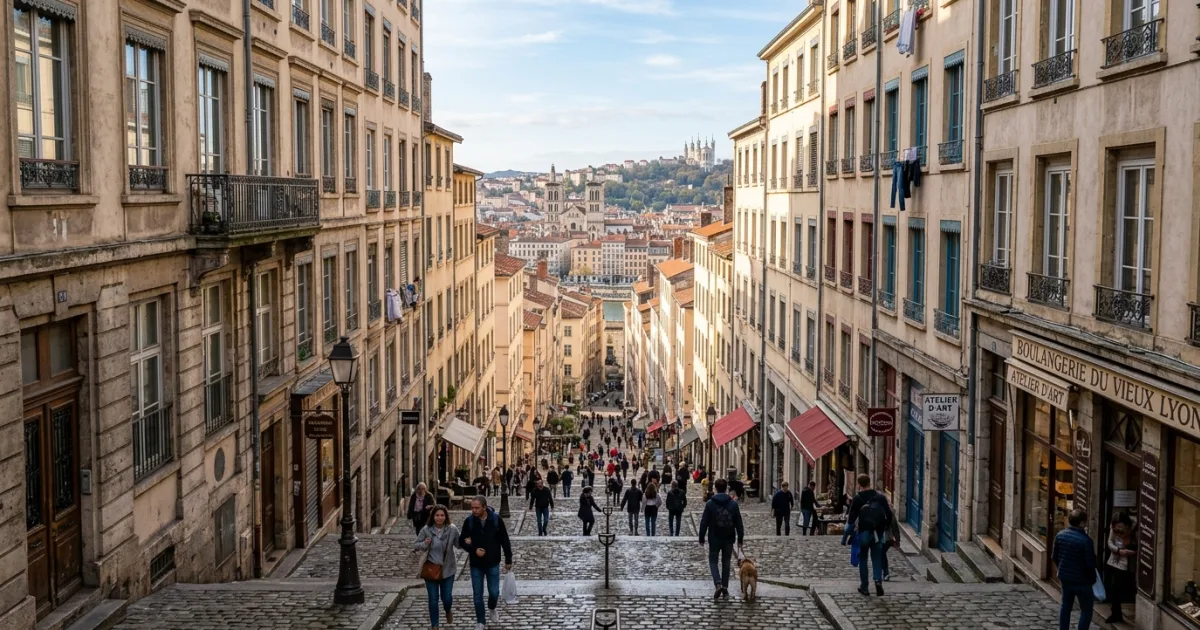
Croix-Rousse stands on a limestone hill rising above central Lyon, framed by the Saône and Rhône rivers. Known historically as 'the hill that works,' this neighborhood developed a distinct socio-industrial culture during the early 19th century when the invention of the motorized Jacquard loom centralized silk production. Master weavers erected tall stone residential blocks equipped with four-meter-high ceilings, reinforced floor beams, and immense multi-paned windows designed to maximize daylight on mechanical looms.
Today, the quarter retains an independent spirit, often described by residents as a village distinct from Lyon itself. Divided between the energetic, gradient-filled streets of Les Pentes and the flat, communal expanse of Le Plateau, Croix-Rousse features cooperative craft ateliers, contemporary mural art, independent microbreweries, and quiet squares where locals gather to play pétanque under plane trees.
Reasons to Visit
- Explore the legendary traboules, secret covered pedestrian passages engineered directly through residential tenements.
- Marvel at the Mur des Canuts, Europe's largest monumental trompe-l'œil wall mural depicting neighborhood life.
- Browse the vast Boulevard de la Croix-Rousse outdoor market, operating six mornings per week with world-class Lyonnais produce.
- Visit the Maison des Canuts to witness functional 19th-century Jacquard looms demonstrated by master silk weavers.
- Enjoy panoramic urban vistas across Lyon and toward the Alps from the Gros Caillou esplanade.
Things to Avoid
- Avoid attempting to push heavy strollers or roll wheeled luggage up the steep stairs of Montée de la Grande-Côte without checking transit routes.
- Avoid making noise or talking loudly when traversing open traboules, as these pass through active private residential courtyards.
- Avoid arriving late in the afternoon if visiting the outdoor food market, as vendors wrap up operations by 1:00 PM.
- Avoid wearing flat, smooth-soled leather shoes that lack grip on wet stone stairs and cobblestones.
Local Transportation Tips
Navigating Croix-Rousse relies heavily on TCL (Transports en Commun Lyonnais). Metro Line C operates as a specialized rack railway, connecting the Hôtel de Ville-Louis Pradel transit hub at the foot of the hill to the Croix-Rousse and Cuire stations on the Plateau. For traversing the steep slopes, electric midibuses (Lines S6 and S12) navigate the narrow streets. Walking remains the best method for exploring the traboules, though visitors with limited mobility should take the metro to the plateau and follow downhill paths.
Travel Etiquette
- Always maintain quiet whispers inside traboules and never prop open coded security doors.
- Greet shopkeepers with a polite 'Bonjour Madame' or 'Bonjour Monsieur' upon entering any store or market stall.
- Do not photograph residents in private courtyards without asking explicit permission.
- Keep to the right when walking up or down the public stairways to allow ascending commuter traffic to pass.
Recommended Age Group
Croix-Rousse provides rewarding cultural and historical encounters, though its extreme topographic elevation poses distinct challenges for select demographics.
- Babies (0-2 years): Not Recommended. Endless flights of steep stairs, narrow traboule doorways, and uneven cobblestones make standard strollers virtually unusable throughout Les Pentes.
- Kids (3-12 years): Neutral. Children enjoy the giant optical illusions of the Mur des Canuts and searching for secret passageways, but the sustained uphill climbs can cause early exhaustion.
- Teens (13-19 years): Recommended. Teenagers appreciate the thriving urban street art culture, vintage thrift shops, casual crêperies, and vibrant social energy along Montée de la Grande-Côte.
- Adults (20-64 years): Recommended. Ideal for independent exploration of architectural heritage, neighborhood wine bars, culinary traditions, and silk artisan studios.
- Seniors (65+ years): Neutral. The historical substance is immense, but the extensive physical exertion required to tackle steep slopes demands strict reliance on Metro Line C and flat walking paths around Le Plateau.
Accessibility Level: Medium
- The topography of Les Pentes features hundreds of continuous outdoor stone steps, presenting severe physical barriers for manual and motorized wheelchair users.
- Metro Line C stations at Croix-Rousse and Cuire provide elevator accessibility, allowing direct access to the level terrain of Le Plateau.
- Key attractions like the Maison des Canuts museum feature adapted ground-floor accessibility for mobility-impaired visitors.
- TCL Bus Line S6 provides step-free boarding options connecting downtown Lyon to higher terrace stops.
Did You Know?
The massive rounded boulder known as the 'Gros Caillou' perched on the Croix-Rousse plateau is an alpine glacial erratic. It was deposited in Lyon from the Haute-Savoie Alps during the Riss glaciation approximately 140,000 years ago and was uncovered in 1861 during the excavation of the funicular railway tunnel.
Cool Statistics
- 1,200 square meters: The total surface area of the Mur des Canuts, making it Europe's largest painted trompe-l'œil mural.
- 30,000 silk looms: Operated on the slopes and plateau of Croix-Rousse during the height of the industrial silk trade in the 1850s.
- 4 meters: The standard ceiling height of historical canut apartments, constructed specifically to accommodate large Jacquard weaving machinery.






Buy a compatible power adapter for your trip