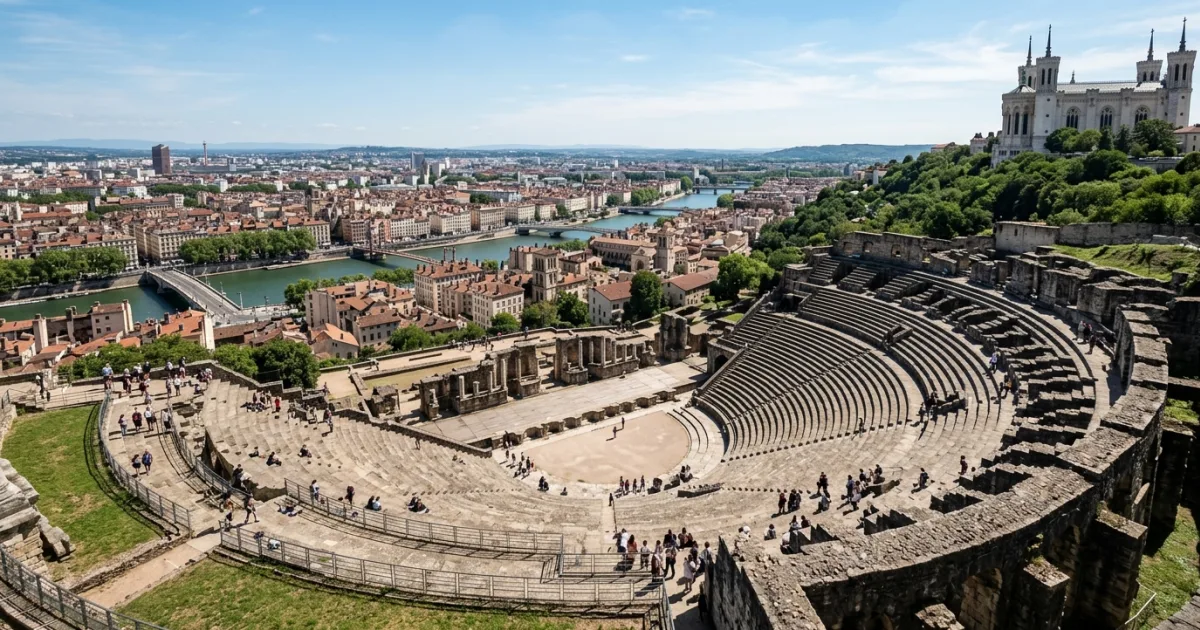
Lugdunum was established in 43 BCE by Lucius Munatius Plancus as a Roman colony on the strategic heights above the confluence of the Rhône and Saône rivers. The Grand Théâtre, constructed around 15 BCE, initially seated approximately 4,500 spectators before its expansion in the 2nd century CE under Emperor Hadrian to accommodate 10,000 people across three tiers of stone seating. Adjacent to it stands the Odéon, built in the early 2nd century CE, one of only a handful of preserved Roman odeons in Western Europe.
Today, the site seamlessly bridges two millennia of civic use. Visitors can walk unhindered through stone vomitoria, examine remnants of geometric marble floor mosaics in the orchestra pit of the Odéon, and absorb expansive views of Lyon stretching toward the distant French Alps on clear days.
Reasons to Visit
- Witness two of the most complete Roman performance structures standing in Gaul.
- Enjoy panoramic vistas across the historic Presqu'île and Vieux Lyon from the upper cavea tiers.
- Experience a zero-cost cultural landmark accessible easily via Lyon's heritage funicular network.
- Pair your exploration with the world-class subterranean Lugdunum Museum designed by Bernard Zehrfuss.
- Attend a live concert under open skies during the annual Nuits de Fourvière summer festival.
Things to Avoid
- Avoid wearing thin flip-flops, high heels, or slippery sandals on the ancient, uneven stone tiers.
- Avoid walking up the steep Montée du Gourguillon on foot in extreme summer heat; ride the funicular up instead and walk down.
- Do not climb onto marked fragile archaeological masonry or roped-off preservation areas.
- Avoid arriving without water during hot midday hours, as the open stone surfaces amplify the heat.
Local Transportation Tips
The site is situated near the crest of Fourvière Hill. The most convenient route is via Metro Line D to the Vieux Lyon station, where you can transfer directly to Funicular line F2 (direction Fourvière) and get off at the Minimes - Théâtres Romains stop. From the stop, the entrance is less than a two-minute walk. Alternatively, disembark at the Fourvière terminal station by the Basilica and enjoy an easy five-minute downhill stroll to the theatre gates.
Travel Etiquette
- Treat the ancient 2,000-year-old masonry with respect by keeping to designated pathways and steps.
- Dispose of all picnic packaging and drink containers in the waste receptacles positioned at park entrances.
- Keep noise levels moderate out of consideration for residents living on Fourvière Hill and other site visitors.
- Photography for personal use is freely permitted throughout the ruins.
Recommended Age Group
The Lugdunum Roman Theatres appeal across generations, providing an open-air historical playground and educational monument.
- Babies (0-2 years): Neutral. Baby strollers are very difficult to maneuver on ancient stone stairs and gravel; a baby carrier is essential for visiting.
- Kids (3-12 years): Recommended. Children love climbing the wide stone steps, exploring ancient corridors, and viewing ancient gladiator artifacts in the adjacent museum.
- Teens (13-19 years): Recommended. Offers excellent opportunities for photography, panoramic skyline views, and immersion in classical history.
- Adults (20-64 years): Recommended. Perfect balance of Roman architecture, scenic vistas, and cultural event programming.
- Seniors (65+ years): Recommended. Best experienced by arriving via the funicular to minimize steep uphill walking, though care is required on the steps.
Accessibility Level: Medium
- The outdoor archaeological ruins feature steep, rough stone staircases and gravel tracks that present major obstacles for manual and motorized wheelchairs.
- The adjacent Lugdunum Museum is fully wheelchair accessible via step-free ramps, automatic doors, and modern internal elevators.
- Panoramic visual access across both theatres can be enjoyed from the museum's floor-to-ceiling glass viewing galleries and accessible upper terrace perimeter.
- Accessible restrooms are located inside the Lugdunum Museum reception area.
Did You Know?
The Odéon at Lugdunum features an orchestra floor originally decorated with rare, imported luxury marbles including porphyry from Egypt, cipollino from Greece, and breccia from Asia Minor, demonstrating the immense wealth and imperial prestige of ancient Lyon.
Cool Statistics
- 15 BCE: The estimated construction date of the Grand Théâtre under Emperor Augustus.
- 10,000: Maximum spectator capacity of the Grand Théâtre after Hadrian's 2nd-century expansion.
- 108 meters: The diameter of the Grand Théâtre's semicircular auditorium (cavea).
- 2: The number of Roman theatres situated side-by-side on Fourvière Hill, a rare architectural grouping in the Roman world.






Buy a compatible power adapter for your trip