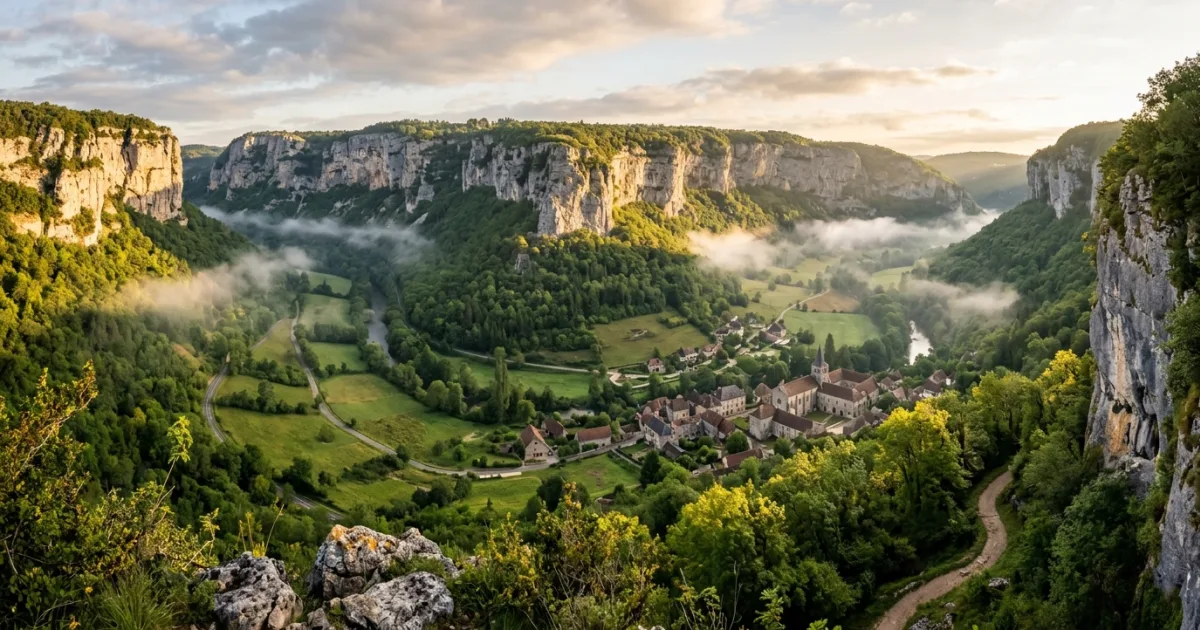
Jura is a department defined by geological drama, dominated by the Jura Mountain range that forms a natural boundary between France and Switzerland. Rather than sharp granite needles, Jura showcases rounded forested ridges, sprawling plateaus, and dramatic limestone gorges known as 'reculées'. These natural amphitheaters shelter secluded villages such as Baume-les-Messieurs, recognized as one of the most picturesque settlements in France.
Beyond its striking topography, Jura maintains a centuries-old dedication to artisanal agriculture and high-standard protected designations. Dairies across the countryside process milk from local Montbéliarde cows into wheels of Comté, while the rolling hills around Arbois and Château-Chalon produce distinctive, cellar-aged wines. For travelers seeking authentic countryside life without the crowds of standard tourist corridors, Jura offers genuine hospitality and untamed natural beauty.
Reasons to Visit
- Spectacular hiking through deep limestone box canyons and along cascading waterfalls.
- World-renowned gastronomic heritage featuring Comté cheese cellars and unique terroir wines.
- Pristine emerald and turquoise freshwater lakes offering sailing, kayaking, and wild swimming.
- Uncrowded Nordic ski trails and snowshoeing routes across high alpine plateaus in winter.
- Charming stone villages with historic abbeys, thermal spas, and traditional architecture.
Things to Avoid
- Avoid visiting without a private vehicle if your itinerary involves rural natural sites, as public transit is infrequent outside major rail hubs.
- Do not hike steep limestone trails during or immediately after torrential downpours, as wet mossy rock surfaces become treacherous.
- Avoid planning winery visits on Sundays or midday without checking opening hours, as rural businesses adhere to strict lunch closures.
- Do not ignore winter driving regulations; local police actively enforce snow equipment rules on mountain roads.
Local Transportation Tips
Regional TER trains run along select corridors connecting Dole, Lons-le-Saunier, and Saint-Claude with Dijon and Lyon. However, public bus services (Mobigo) linking rural villages are sparse and designed largely for school transit. Renting a car from Dole, Geneva, or Lyon is the most practical method for exploring the nature reserves, lakes, and fruitières scattered across the department.
Travel Etiquette
- Always greet shopkeepers and hosts with a clear 'Bonjour, Madame' or 'Bonjour, Monsieur' before asking questions.
- Respect marked private land boundaries when walking through alpine pastures, and always close pasture gates behind you.
- When participating in wine tastings (dégustations), showing genuine curiosity about the viticultural process is appreciated by local vignerons.
- Do not swim in protected natural cascade pools where swimming is explicitly prohibited to protect delicate aquatic ecosystems.
Recommended Age Group
Jura appeals broadly to travelers who enjoy natural spaces, active exploration, and authentic culinary traditions.
- Babies (0-2 years): Neutral. Village centers and main lake promenades are stroller-accessible, but rocky waterfall paths and limestone gorge trails are unsuitable for prams.
- Kids (3-12 years): Recommended. Children will love swimming in warm summer lakes, visiting interactive cheese dairies, and exploring subterranean caves.
- Teens (13-19 years): Recommended. Excellent opportunities for canyoning, mountain biking, paddleboarding, and introductory cross-country skiing.
- Adults (20-64 years): Recommended. Perfect balance of scenic road trips, historic wine tastings, fine regional dining, and tranquil nature walks.
- Seniors (65+ years): Recommended. Relaxing countryside drives, accessible lake view vantage points, thermal spa resorts, and rich historical abbeys offer great appeal.
Accessibility Level: Medium
- Major cultural attractions like the Grande Saline of Salins-les-Bains and regional cheese discovery centers provide adapted paths and elevators.
- Key lake access points at Lac de Vouglans feature designated accessible parking and paved waterfront promenades.
- Rugged waterfall routes (such as Cascades du Hérisson) and historic village centers feature uneven cobblestones, steep steps, and natural obstacles unsuited for standard wheelchairs.
Did You Know?
The Jurassic geological period was named directly after the Jura Mountains by German naturalist Alexander von Humboldt in 1795, due to the extensive limestone deposits from that epoch found throughout the region.
Cool Statistics
- Over 40% of the Jura department is covered by dense native forest.
- Lac de Vouglans is France's third-largest artificial reservoir, spanning over 35 kilometers in length.
- Over 65,000 tons of Comté cheese are produced annually across the Franche-Comté region, aged in vast underground cellars.






Buy a compatible power adapter for your trip