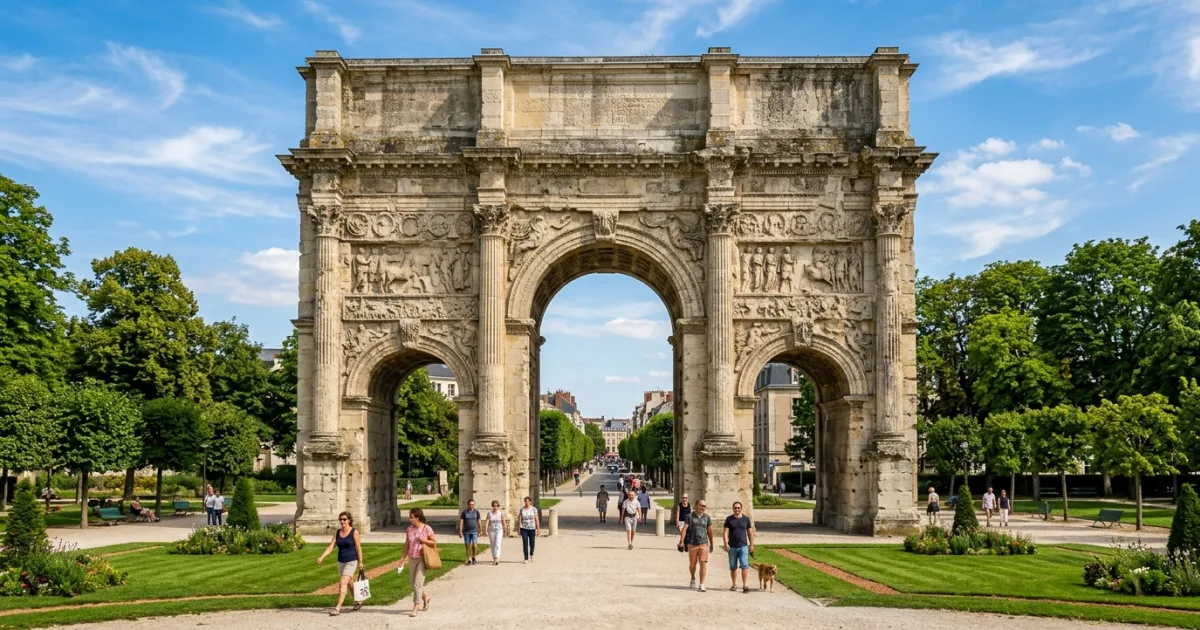
The Porte de Mars stands as the most significant remnant of Durocortorum, the Gallo-Roman city that preceded modern-day Reims. During the Roman era, Durocortorum was the capital of the province of Gallia Belgica and one of the most populous cities north of Rome. The arch was constructed in the 3rd century AD as a grand monumental gate, celebrating the peace and prosperity brought by the Roman Empire. Its name derives from a nearby temple dedicated to Mars, the Roman god of war. The structure is remarkable not only for its immense size—being the widest known arch in the Roman world—but also for its detailed interior soffits, which feature intricate carvings of a local harvesting calendar and mythological scenes, including Jupiter and Leda.
Interestingly, the survival of the Porte de Mars is largely due to its incorporation into the medieval castle of the Archbishops of Reims. When the castle was eventually demolished in the 16th century, the arch was rediscovered and left standing. Today, it serves as a majestic focal point in the Hautes Promenades, a recently revitalized park area that blends the city's ancient heritage with modern urban landscaping. The site provides a tangible connection to antiquity, offering visitors a quiet space to reflect on the layers of history that have shaped the Champagne region over millennia.
Reasons to Visit
- It is the widest triumphal arch in the entire Roman world, offering a unique glimpse into ancient architectural scale.
- The monument is completely free to visit and accessible 24/7 in a beautiful public park setting.
- It features rare, surviving Roman carvings depicting local agricultural life and classical mythology.
- Its location is highly convenient, situated just a short walk from the main train station and the historic city center.
Things to Avoid
- Avoid visiting late at night if you want to take detailed photographs, as the lighting may not highlight the intricate carvings effectively.
- Do not touch or lean heavily on the stone pillars, as the ancient limestone is fragile and subject to ongoing conservation efforts.
- Avoid driving directly to the monument, as parking in the immediate Place de la République can be difficult; use public transit or walk instead.
Local Transportation Tips
Reims boasts an excellent and easy-to-navigate public transportation system operated by Citura. The most convenient way to reach the Porte de Mars is by taking the city's colorful tramway (Lines A or B) and alighting at the 'Boulingrin' stop, which is just steps away from the monument. Alternatively, the site is highly pedestrian-friendly and is only a 5 to 10-minute walk from the Reims-Centre railway station. For those exploring the broader city, local buses also service the nearby Place de la République.
Travel Etiquette
- Respect the historical significance of the monument by not climbing on the ancient stones or leaving litter in the surrounding park.
- Keep noise levels reasonable, as the park is a place of relaxation for local residents.
- When taking photographs, be mindful of other visitors trying to enjoy the view or read the informational plaques.
Recommended Age Group
The Porte de Mars is an open-air monument situated in a spacious public park, making it an easy and enjoyable stop for visitors of all ages.
- Babies (0-2 years): Recommended. The surrounding park features flat, paved paths that are perfectly suited for strollers.
- Kids (3-12 years): Recommended. Children will enjoy the open space of the park, and the massive size of the arch can spark their imagination about ancient history.
- Teens (13-19 years): Recommended. The impressive architecture provides excellent photo opportunities, and its proximity to the city center makes it an easy addition to a broader itinerary.
- Adults (20-64 years): Recommended. History buffs and architecture enthusiasts will appreciate the deep historical context and the surviving Roman carvings.
- Seniors (65+ years): Recommended. The site is highly accessible with no stairs required, and there are benches nearby in the park for resting while admiring the view.
Accessibility Level: Medium
- The monument is located on flat terrain within a public park, making it fully accessible for wheelchair users and those with mobility impairments.
- Paved pathways lead directly up to and around the arch, ensuring a smooth surface for walking or rolling.
- There are no stairs or steep inclines required to view the structure from all angles.
- Accessible public transportation (trams) stops very close to the site at the Boulingrin station.
Did You Know?
The Porte de Mars was actually hidden from public view for several centuries. During the Middle Ages, it was walled up and integrated into the defensive structures of the Archbishop's castle. It wasn't until the castle was dismantled in 1544 that the arch was fully revealed again, which ironically protected it from weathering and destruction during that period.
Cool Statistics
- Length: 32 meters (105 feet), making it the widest Roman arch in the world.
- Height: 13 meters (43 feet).
- Construction Date: 3rd century AD.
- Number of Archways: 3 (a large central arch for chariots and two smaller side arches for pedestrians).







Buy a compatible power adapter for your trip