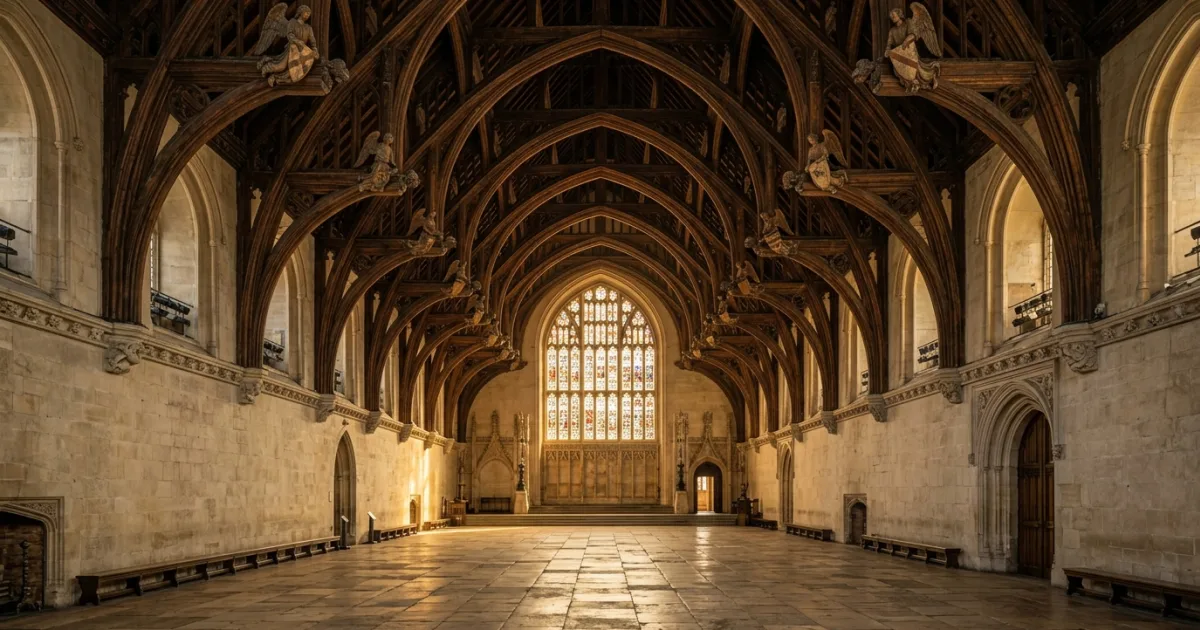
Westminster Hall forms the monumental core of the Palace of Westminster, escaping the devastating inferno of 1834 that destroyed most of the medieval legislative complex. The hall spans 73 meters in length and 20 meters in width, crowned by an awe-inspiring English oak hammerbeam roof designed by royal master carpenter Hugh Herland in the late 14th century. The timber framework stands without central pillars, transferring enormous loads directly onto thick Norman stone masonry.
Historically, the hall functioned as the central nexus of English public life. It housed the Courts of King's Bench, Common Pleas, and Chancery for centuries, establishing fundamental principles of common law. In modern statecraft, it serves as the backdrop for momentous addresses to joint sessions of Parliament by global figures such as Nelson Mandela and Barack Obama, as well as the solemn site for sovereign and royal lying-in-state observances.
Reasons to Visit
- Marvel at the 14th-century oak hammerbeam ceiling, an unrivaled masterpiece of medieval structural carpentry.
- Walk the actual flagstones where King Charles I was tried for treason and condemned to death in 1649.
- Experience one of the few surviving sections of the original 11th-century royal palace of the Anglo-Norman kings.
- Gain rare access inside the active parliamentary governance center of the United Kingdom.
Things to Avoid
- Do not bring oversized luggage, folding bicycles, or sharp pocket knives, as luggage storage does not exist and confiscated items will not be returned.
- Avoid filming or taking photos beyond the authorized boundary demarcations signaled by security guides.
- Do not lean on the ancient limestone walls or step over brass memorial plaques embedded within the stone flooring.
- Avoid peak midday arrival times without pre-booked tickets, as standby queues can take well over an hour during summer recess.
Local Transportation Tips
Westminster Hall is located directly opposite Westminster Underground Station, served by the Jubilee, District, and Circle lines. Exit towards Parliament Square for immediate access to the visitor entrance at Cromwell Green. Numerous London buses stop along Whitehall and Parliament Street, including routes 11, 24, 87, and 148. River bus services operated by Uber Boat by Thames Clippers dock at Westminster Pier, situated a short two-minute stroll across Bridge Street.
Travel Etiquette
- Maintain respectful silence when walking across commemorative plaques honoring state trials and lying-in-state ceremonies.
- Dress in smart-casual attire appropriate for entering working government premises.
- Cooperate calmly and swiftly with parliamentary security marshals during mandatory screening procedures.
- Switch mobile phones to silent mode immediately upon clearing security.
Recommended Age Group
Westminster Hall offers a world-class educational journey, though its formal setting requires calm demeanor and sustained walking.
- Babies (0-2 years): Not Recommended. Strollers must navigate security queues and historic steps, and acoustic resonance makes crying disruptive.
- Kids (3-12 years): Neutral. Older children with an interest in castles and knights will appreciate the scale, but younger children may struggle with audio tours and security quiet zones.
- Teens (13-19 years): Recommended. High educational value covering the English Civil War, monarchies, and democratic governance.
- Adults (20-64 years): Recommended. Exceptional historical immersion, architectural brilliance, and profound cultural significance.
- Seniors (65+ years): Recommended. Step-free routes and elevators ensure accessible, slow-paced appreciation of British heritage.
Accessibility Level: Medium
- Step-free visitor access is available via Cromwell Green entrance with automatic doors and ramps.
- Wheelchair-accessible lifts connect all public levels along the designated parliamentary visitor route.
- Induction loops and transcripts are provided for audio tour participants with hearing impairments.
- Registered assistance dogs are fully welcome throughout Westminster Hall and the Palace estate.
Did You Know?
The massive oak timbers supporting the magnificent hammerbeam roof were sourced during the 1390s from old-growth forests in Sussex and Hertfordshire, with many of the harvested trees already three centuries old when felled.
Cool Statistics
- Founded in 1097, making the structural footprint over 925 years old.
- Measures 73 meters (240 feet) long by 20 meters (67 feet) wide, covering over 1,500 square meters.
- Features 660 individual carved oak angel figures and decorative pendants throughout the timber roof.
- Survived both the Great Fire of 1834 and direct bomb impacts during the Blitz of May 1941.







Buy a compatible power adapter for your trip