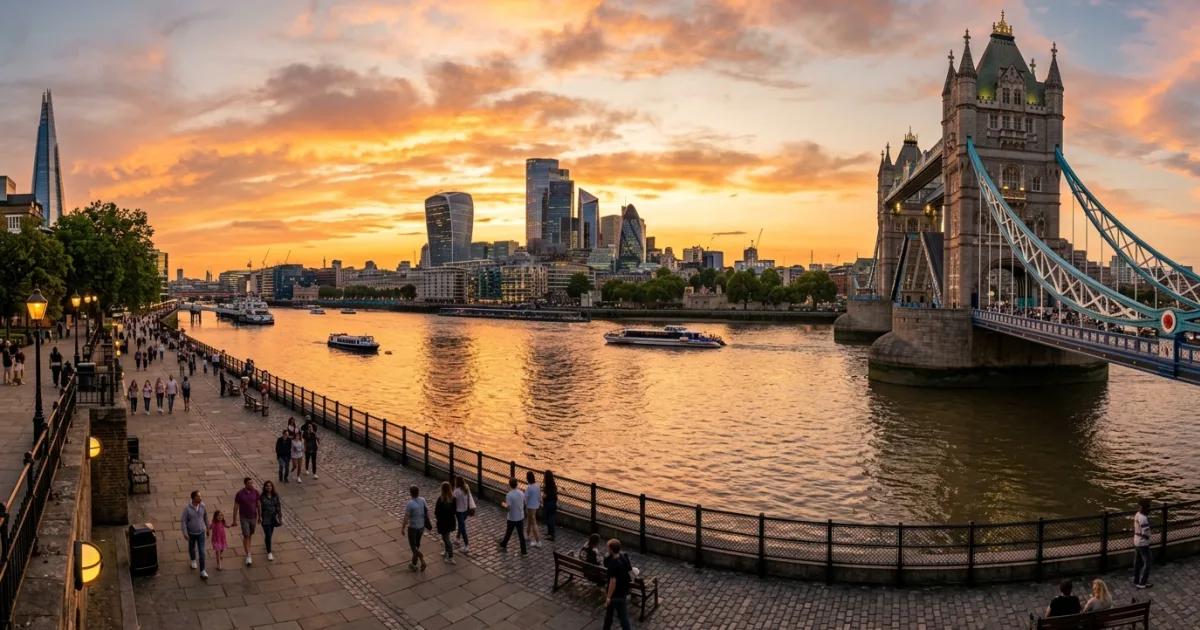
The River Thames serves as the historic lifeline of London, defining its urban layout since Roman Londinium was founded in 43 AD. Stretching across central London, it connects the major administrative, commercial, and artistic quarters of the capital. Iconic crossings such as Tower Bridge, London Bridge, and the Millennium Bridge unite North and South London, creating a vibrant network of promenades, floating restaurants, and public plazas that celebrate the city's relationship with water.
Reasons to Visit
- Unmatched views of premier London landmarks including the Houses of Parliament, St Paul's Cathedral, and the Tower of London from the water.
- The South Bank arts corridor, housing the National Theatre, Tate Modern, and Shakespeare's Globe.
- Historic riverside pubs with centuries of naval and literary lore, like The Mayflower and The Prospect of Whitby.
- Continuous traffic-free walking along the Thames Path with panoramic views of modern skyline architecture.
Things to Avoid
- Avoid booking overpriced tourist dining cruises when scheduled river buses offer equivalent skyline views for standard transit fares.
- Do not attempt to walk onto the tidal river mud without checking tide tables and holding an official permit.
- Avoid standing directly on congested bridge bicycle lanes, which are heavily used by fast-moving commuters.
Local Transportation Tips
The Thames is integrated into Transport for London's transit system. Uber Boat by Thames Clippers operates scheduled catamaran river buses stopping at 24 piers from Putney in the west to Woolwich in the east. Major London Underground stations including Westminster, London Bridge, Blackfriars, and Tower Hill provide immediate access to the river's main embankments.
Travel Etiquette
- Stand on the right side of escalators when exiting riverside Tube stations and piers.
- Yield pathway space to runners and cyclists along shared stretches of the Thames Path.
- Have your contactless card or mobile pass ready before reaching the boarding turnstiles on piers.
Recommended Age Group
The River Thames offers accessible waterfront promenades, river transit options, and diverse cultural stops suitable across generations.
- Babies (0-2 years): Recommended. Embankments and main piers feature step-free ramps, wide stroller paths, and easy access on catamaran river buses.
- Kids (3-12 years): Recommended. High engagement through riverboat rides, street performers along the South Bank, and proximity to attractions like the London Eye and HMS Belfast.
- Teens (13-19 years): Recommended. Vibrant urban settings, skateboard parks under Queen Elizabeth Hall, street food markets, and world-class modern art at Tate Modern.
- Adults (20-64 years): Recommended. Superb waterside dining, historic pubs, architectural walks, and scenic sunset cruises.
- Seniors (65+ years): Recommended. Gentle flat terrain along paved promenades, scenic seated transit on riverboats, and step-free access across key cultural venues.
Accessibility Level: Medium
- Most central London piers, including Westminster, Embankment, London Bridge City, and Tower Pier, feature step-free ramps for wheelchair boarding.
- Uber Boat catamarans are wheelchair accessible with dedicated boarding ramps and designated onboard seating bays.
- The South Bank promenade is fully paved with curb cuts and step-free alternative ramps around heritage stairways.
Did You Know?
The River Thames completely froze over at least 23 times between 1400 and 1814, leading to the famous 'Frost Fairs' where Londoners set up carnival markets, pubs, and ice rinks directly on the frozen river surface.
Cool Statistics
- Length of 215 miles (346 km), making it the longest river entirely in England.
- Over 200 bridges and 27 tunnels span or pass underneath the Thames.
- Tidal range reaches up to 7 meters (23 feet) in central London every 12 hours.






Buy a compatible power adapter for your trip