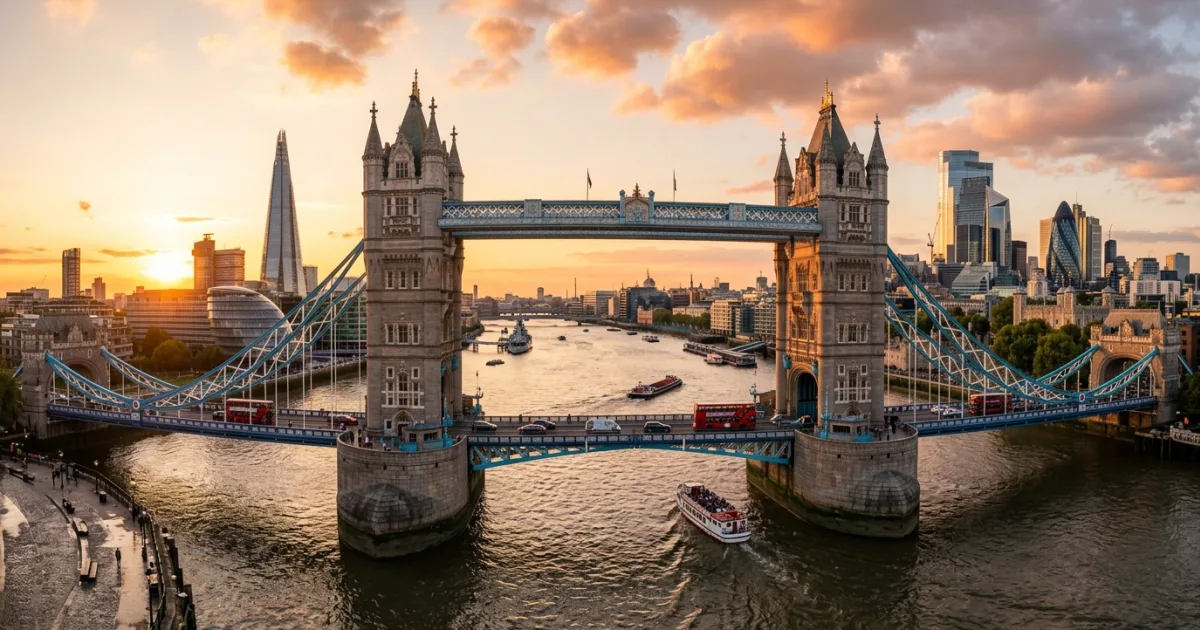
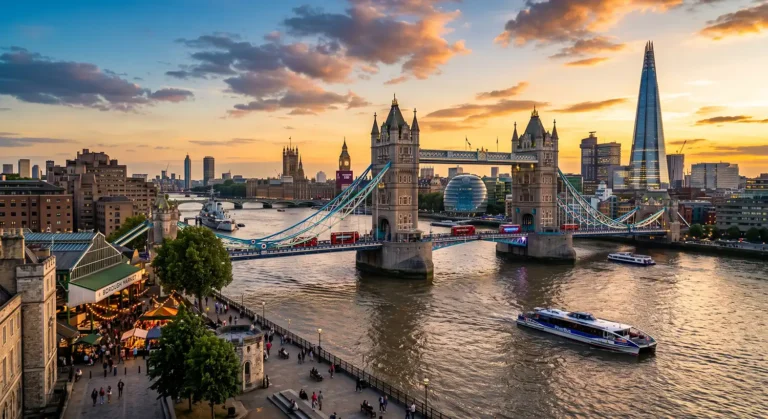
Tower Bridge stands as an enduring emblem of London's maritime supremacy and architectural daring. Completed in 1894 after eight years of rigorous construction by over 430 workforce members, it represented an ingenious answer to a complex Victorian dilemma: how to create a bridge downstream of London Bridge that allowed dense pedestrian and carriage movement without blocking tall-masted cargo ships bound for the bustling Pool of London docks. The solution was an ambitious combination of a suspension bridge for the outer spans and a double-leaf bascule system for the central 200-foot waterway, clad in striking Cornish granite and Portland stone to harmonize with the neighboring medieval Tower of London.
Today, visitors experiencing the Tower Bridge Exhibition can ascend the North Tower by elevator or staircase to access the pair of high-level walkways. These corridors feature reinforced glass floors installed 42 meters above the Thames, allowing brave sightseers to gaze straight down at passing red double-decker buses, cycling commuters, and river vessels. The tour continues down through the South Tower and into the historic Victorian Engine Rooms, where original coal-fed boilers, accumulators, and gleaming brass-finished steam engines are preserved in pristine working order, documenting the ingenuity that drove the bridge into modernity.
Reasons to Visit
- Walk across the high-level glass floor for a dizzying, bird's-eye view of London traffic and river barges directly below your feet.
- Inspect the immaculate, steam-powered Victorian Engine Rooms that originally raised the 1,000-ton bascules in just 60 seconds.
- Experience a living piece of London infrastructure that still operates daily under strict maritime navigation laws.
- Capture panoramic photographs of iconic landmarks including the Shard, St Paul's Cathedral, and the Tower of London from elevated viewpoints.
Things to Avoid
- Avoid confusing Tower Bridge with the plain, functional concrete span of London Bridge located half a mile westward.
- Avoid standing directly on the bridge road curb with selfie sticks during busy commuter rush hours when bicycle and bus traffic is intense.
- Avoid buying tickets from unofficial third-party street vendors; always use the official ticketing portal or on-site counter.
- Avoid planning your visit without checking the online bridge lift timetable, as witnessing a bascule raise is one of London's best spectacles.
Local Transportation Tips
Tower Bridge is exceptionally connected via London's public transit network. The nearest London Underground stations are Tower Hill (Circle and District lines) on the north bank, situated roughly a 7-minute walk away, and London Bridge (Jubilee and Northern lines) on the south bank, approximately a 10-minute scenic stroll along the Thames Path. Bermondsey station is also nearby. For river access, Uber Boat by Thames Clippers docks at Tower Pier and London Bridge City Pier. Multiple bus routes, including routes 42, 78, and 343, cross the bridge deck directly.
Travel Etiquette
- Keep to the left side of the pedestrian sidewalks on the bridge deck to allow faster local commuters to pass comfortably.
- Do not lean over safety barriers or attempt to climb the bridge ironwork under any circumstances.
- Remove dirty footwear or step carefully on the glass floor walkway inside the exhibition to prevent scratching the protective glass layer.
- Stand clear of the warning gates on the outdoor sidewalk whenever sirens sound for an impending bridge lift.
Recommended Age Group
Tower Bridge provides an educational and visually engaging experience suitable for all ages, with accessibility infrastructure accommodating strollers and mobility equipment.
- Babies (0-2 years): Recommended. Strollers and prams are fully accommodated via lifts in both towers, making navigation smooth for parents.
- Kids (3-12 years): Recommended. Interactive displays in the engine rooms and the thrill of lying or walking on the transparent glass floor provide memorable entertainment.
- Teens (13-19 years): Recommended. The architectural aesthetics, historical engineering feats, and dramatic social media photo angles make it highly appealing.
- Adults (20-64 years): Recommended. Offers rich historical context, architectural beauty, and panoramic city vistas that appeal to history lovers and urban explorers alike.
- Seniors (65+ years): Recommended. Step-free elevator access to the high walkways and flat resting benches throughout make it a low-strain, rewarding cultural landmark.
Accessibility Level: Wheelchair-Friendly
- Step-free access is available throughout the main exhibition, including dedicated lifts inside both North and South Towers.
- The Victorian Engine Rooms feature ramped entry and wide pathways suitable for manual and powered wheelchairs.
- Accessible restrooms equipped with emergency pull cords are located in both the South Tower and the Engine Rooms.
- Visual story guides, sensory maps, and audio description resources are available for visitors with neurodiverse or sensory requirements.
Did You Know?
In December 1952, a number 78 double-decker bus driven by Albert Gunter was crossing Tower Bridge when the bascules unexpectedly began to open. Realizing he could not brake in time, Gunter accelerated, leaped the widening gap, and successfully landed the bus on the opposite bascule, safely delivering all twenty passengers and earning a £10 bonus for bravery.
Cool Statistics
- Each bascule weighs over 1,000 tons and was counterbalanced so effectively that steam engines could raise them in just 60 seconds.
- The structural framework contains more than 11,000 tons of steel before being encased in ornate stone masonry.
- Over 40,000 pedestrians and motorists cross the bridge deck each day.
- The glass floor panels on the elevated walkways each weigh approximately 530 kilograms and can support the weight of four London taxis.







Buy a compatible power adapter for your trip