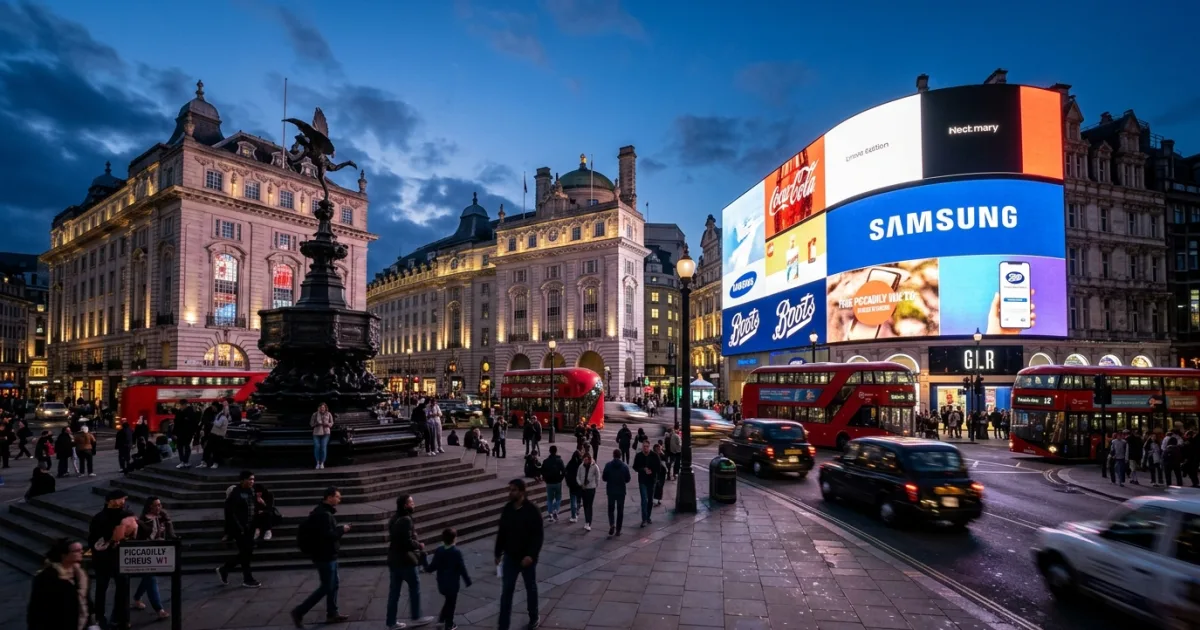
Originally created in 1819 to connect Regent Street with Piccadilly, Piccadilly Circus has evolved into one of the world's most famous intersections. The word 'circus' comes from the Latin word for circle, referring to the round open space at a street junction. Today, it is best known for its massive, curved electronic billboards that have illuminated the square since the early 1900s, initially using incandescent bulbs before transitioning to neon and now state-of-the-art 4K LED screens. At the southwestern side sits the Shaftesbury Memorial Fountain, erected in 1893 to commemorate the philanthropic works of Lord Shaftesbury. The fountain is crowned by the aluminum statue of Anteros, the Greek god of requited love, though it is popularly and mistakenly referred to as Eros. This statue is a popular meeting point for Londoners and tourists alike, offering a place to sit and take in the kinetic energy of the city. Surrounded by historic buildings like the London Pavilion and the Criterion Theatre, Piccadilly Circus is the ultimate crossroads, leading visitors directly into the shopping paradise of Regent Street, the entertainment hub of Leicester Square, and the vibrant nightlife of Soho.
Reasons to Visit
- Experience the iconic, Times Square-esque energy of London's most famous illuminated junction.
- Serve as the perfect starting point for exploring the West End theater district.
- Photograph the historic Shaftesbury Memorial Fountain and the statue of Anteros.
- Enjoy immediate access to world-class shopping on Regent Street and Oxford Street.
- Immerse yourself in the bustling street performances and vibrant nightlife of nearby Soho.
Things to Avoid
- Avoid buying food or souvenirs from the immediate, overpriced tourist traps surrounding the square.
- Do not stop abruptly in the middle of the pavement to take photos; step to the side to avoid blocking heavy pedestrian traffic.
- Avoid visiting during peak rush hours (8-9 AM and 5-6 PM) if you dislike severe crowding.
- Be cautious of unlicensed pedicabs (rickshaws) which often charge exorbitant, unregulated fares.
Local Transportation Tips
Piccadilly Circus is exceptionally well-connected. The Piccadilly Circus Underground station is located directly beneath the junction, serving the Piccadilly and Bakerloo lines. Numerous iconic red double-decker buses pass through the area, offering scenic routes across central London. The area is also highly walkable, with Leicester Square, Trafalgar Square, and Covent Garden all within a 10 to 15-minute stroll. Taxis and ride-shares are available, but traffic in the West End can be notoriously slow.
Travel Etiquette
- Stand on the right, walk on the left when using the escalators in the Underground station.
- Have your payment card or Oyster card ready before reaching the Tube barriers to avoid holding up the queue.
- Respect the space of street performers, but if you stop to watch a full act, it is customary to leave a small tip.
- Wait for the green pedestrian signal before crossing the busy roads, as traffic can be fast and unpredictable.
Recommended Age Group
Piccadilly Circus is a bustling, sensory-rich environment that appeals to a wide demographic, though its intense crowds require consideration for very young or elderly visitors.
- Babies (0-2 years): Neutral. The bright lights can be visually stimulating, but navigating strollers through the dense crowds and busy Underground station can be highly stressful.
- Kids (3-12 years): Recommended. Children are often mesmerized by the giant screens and street performers, and nearby attractions like the LEGO Store and M&M's World are major hits.
- Teens (13-19 years): Recommended. The vibrant energy, proximity to shopping, and highly Instagrammable neon backdrop make it a favorite for teenagers.
- Adults (20-64 years): Recommended. Adults will appreciate the central location, serving as a gateway to West End theaters, Soho nightlife, and world-class dining.
- Seniors (65+ years): Neutral. While historically significant and visually impressive, the lack of seating, fast-paced crowds, and heavy traffic can be exhausting for those with mobility issues.
Accessibility Level: Medium
- The Piccadilly Circus Underground station is unfortunately NOT step-free from street to train, which poses a challenge for wheelchair users.
- The pavement around the circus is flat and features dropped curbs at pedestrian crossings, making surface-level navigation manageable.
- Due to extreme crowding, especially in the evenings, navigating a wheelchair or mobility scooter requires extra caution and patience.
- Many nearby theaters and major stores offer accessible entrances and facilities, but it is highly recommended to check individual venues in advance.
Did You Know?
Did you know that during World War II, the famous illuminated signs at Piccadilly Circus were turned off to comply with the city's blackout regulations? They went dark in 1939 and were not turned back on until 1949. Since then, they have only been switched off for special occasions, such as the funerals of Winston Churchill and Princess Diana, and for Earth Hour.
Cool Statistics
- Over 100 million people walk through Piccadilly Circus every year.
- The first illuminated billboard was installed here in 1908, advertising Perrier.
- The current curved LED screen is the largest single digital display in Europe, measuring 780 square meters.
- The statue of Anteros was the first statue in the world to be cast in aluminum.







Buy a compatible power adapter for your trip