Petra served as the flourishing capital of the Nabataean kingdom from roughly the 4th century BCE to 106 CE, when it was annexed into the Roman Empire. Its inhabitants engineered advanced hydrologic systems, carving cisterns, terracotta pipelines, and diversion dams to channel rainwater through arid desert canyons. This ingenuity turned Petra into a strategic oasis along lucrative incense and spice trade routes linking Arabia, Egypt, and the Levant.
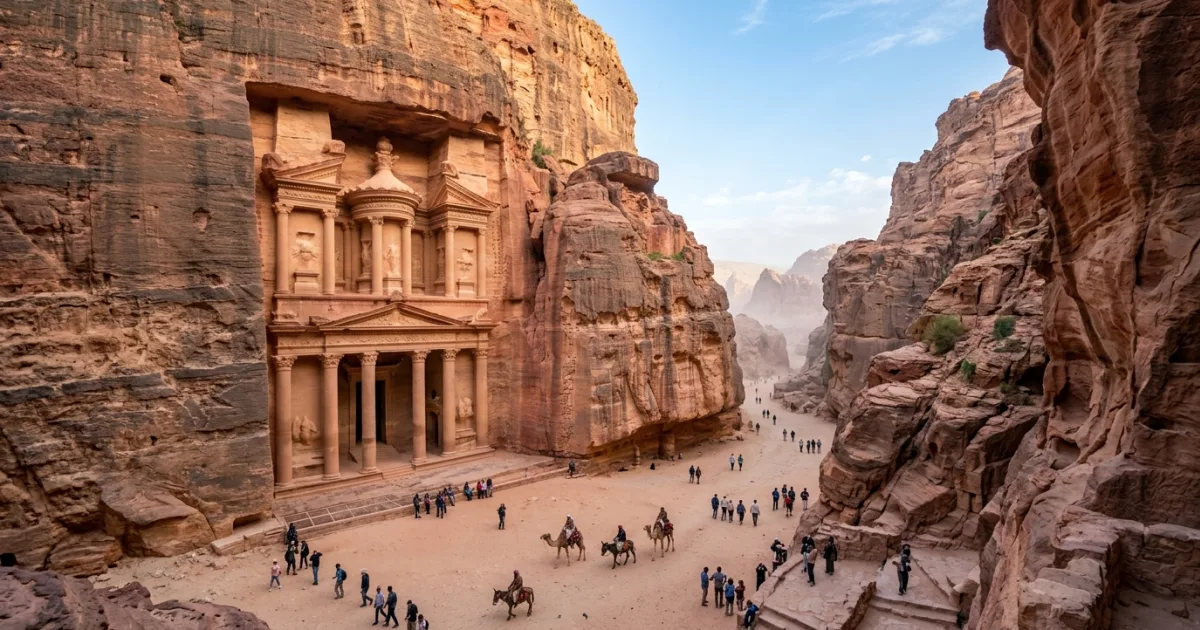
Today, visitors enter an expansive historical reserve characterized by monumental tombs chiseled directly into banded red, purple, and cream sandstone cliff faces. Beyond the iconic Treasury facade, highlights include the Royal Tombs, the Colonnaded Street, the Great Temple, and the challenging 850-step stairway up to Ad-Deir. The blend of Hellenistic architectural motifs with indigenous Nabataean rock-cut engineering makes Petra one of the world's most breathtaking open-air historical complexes.
Reasons to Visit
- Stand in awe before Al-Khazneh as it reveals itself through the narrow sandstone fissure of the Siq.
- Ascend the mountain steps to Ad-Deir (The Monastery) for colossal carved architecture and sweeping views toward the Wadi Araba desert.
- Discover sophisticated 2,000-year-old water conservation channels and rock-cut cistern networks engineered by Nabataean builders.
- Experience warm Bedouin culture with fresh sage tea, storytelling, and hospitality along mountain pathways.
- Photograph shifting pastel colors on ancient cliff facades as the desert sun moves from morning to dusk.
Things to Avoid
- Avoid starting your hike late in the morning during warm months; high midday heat in exposed canyons causes intense physical exhaustion.
- Avoid hiring donkeys on steep, slippery stone stairs to prevent animal distress and rider injury.
- Do not carve, scratch, or lean heavily against delicate sandstone walls, which erode easily.
- Avoid accepting unauthorized trails outside established routes without an official, licensed park guide.
Local Transportation Tips
Travelers explore the interior of Petra Archaeological Park entirely on foot. Licensed electric carts operate between the Visitor Center and the Treasury for mobility-impaired visitors. In the gateway town of Wadi Musa, local yellow taxis connect hotels to the park entrance, while rental cars and JETT buses link Wadi Musa to Amman, Aqaba, and Wadi Rum along the desert highway network.
Travel Etiquette
- Dress modestly by covering shoulders and knees when moving through public areas in Wadi Musa and around ancient ruins.
- Always ask permission before taking close-up portraits of local Bedouin residents or merchants.
- Accept offers of mint or sage tea when shopping or chatting, as declining abruptly can be viewed as impolite.
- Negotiate souvenir and camel ride prices with courtesy, patience, and good humor.
Recommended Age Group
Petra involves extensive walking across rocky slopes, dirt tracks, and stone stairs, making age-specific preparation essential.
- Babies (0-2 years): Not Recommended. Rugged sandstone terrain prevents stroller use, temperatures swing drastically, and carrying infants on long uphill trails poses physical strain.
- Kids (3-12 years): Neutral. Children with strong stamina will enjoy canyon walks and camel sights, though long distances and steep cliffs require continuous parent supervision.
- Teens (13-19 years): Recommended. Teenagers possess the endurance for adventurous mountain scrambles, scenic viewpoints, and historical exploration.
- Adults (20-64 years): Recommended. Exceptional trekking opportunities, cultural discovery, and world-class photography spots make this ideal for independent adult travelers.
- Seniors (65+ years): Neutral. Seniors in solid physical health will enjoy the main trail, but uneven surfaces, heat, and extensive walking require measured pacing and optional electric cart transport.
Accessibility Level: Medium
- Paved paths run from the Visitor Center through the Siq to the Treasury, with official electric golf carts available for visitors with mobility impairments.
- Trails past the Treasury turn into sand, gravel, and unpaved rock, making wheelchair access impossible beyond the lower basin without dedicated support.
- Accessible restrooms are located at the Petra Visitor Center and adjacent to the Basin Restaurant inside the park.
Did You Know?
Swiss explorer Johann Ludwig Burckhardt reintroduced Petra to the Western world in 1812 by disguising himself as an Arabic scholar named Sheikh Ibrahim Ibn Abdallah to convince a local guide to lead him into the sealed canyon.
Cool Statistics
- 80 meters: The towering height of the cliff walls enclosing the narrow Siq canyon.
- 850+: The approximate number of rock-cut stone steps required to hike to the Monastery (Ad-Deir).
- 1985: The year Petra was officially designated a UNESCO World Heritage Site.







Buy a compatible power adapter for your trip