St. Croix operates at an unhurried, independent pace compared to its sister islands of St. Thomas and St. John. Covering 84 square miles, it presents geographic contrasts ranging from the dense mahogany stands of the northwestern subtropical rainforest to the arid, cactus-strewn landscape of Point Udall—the easternmost point of the United States. Its twin towns, Christiansted on the northeast coast and Frederiksted on the west coast, preserve extensive Danish Neoclassical architecture finished in pastel yellows and pale reds, constructed by enslaved African laborers during the 18th and 19th centuries.
The island maintains deep agricultural and culinary traditions, celebrated annually at the St. Croix Food & Wine Experience and the Agriculture and Food Fair (Agrifest). Marine habitats are equally significant; protected reef systems, nesting sea turtles at Sandy Point National Wildlife Refuge, and mangrove lagoons at Salt River Bay National Historical Park provide expansive opportunities for eco-tourism and marine exploration.
Reasons to Visit
- Snorkel the underwater interpretive trail at Buck Island Reef National Monument, home to protected elkhorn coral arrays.
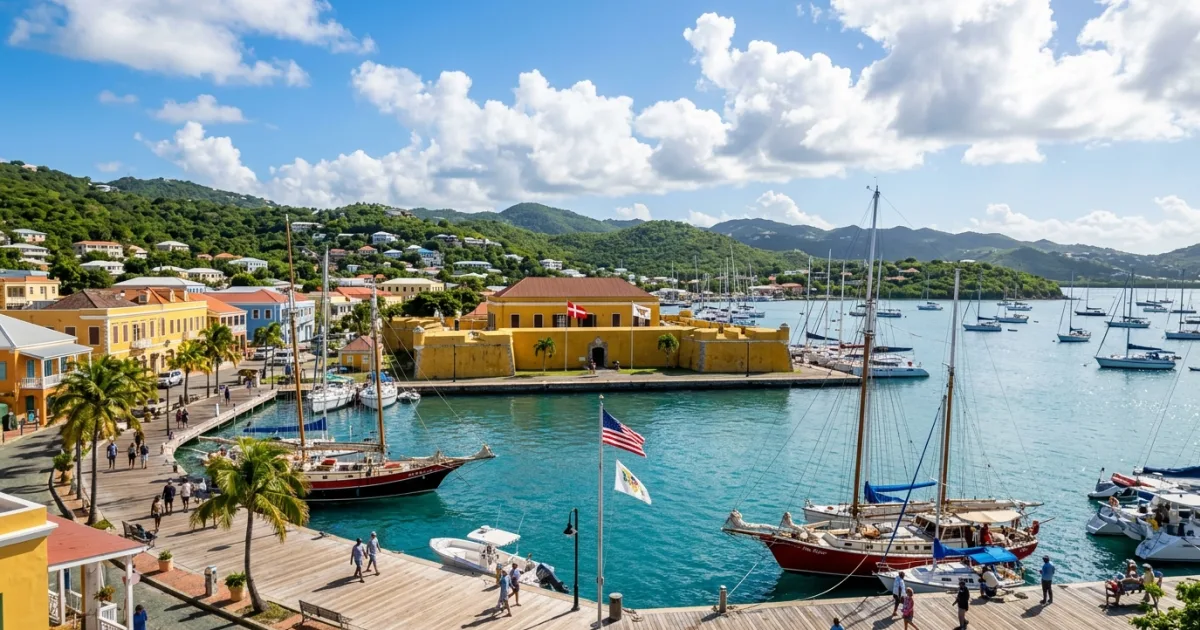
- Walk the historic waterfront streets of Christiansted and tour the well-preserved 18th-century yellow ramparts of Fort Christiansvaern.
- Stand at Point Udall to view the earliest sunrise in any United States territory.
- Sample single-estate and aged rums at the historic Cruzan Rum Distillery.
- Kayak bioluminescent waters at Salt River Bay, where Christopher Columbus anchored in 1493.
Things to Avoid
- Do not forget to keep left when driving; turning corners onto the incorrect side is the leading cause of tourist traffic accidents.
- Avoid touching or standing on coral reefs during boat tours and beach entries, which damages living marine systems and violates local environmental laws.
- Avoid wearing beachwear or swimsuits in downtown shopping districts or municipal buildings; Crucian culture maintains modest public dress standards.
- Do not rely entirely on ride-share services such as Uber or Lyft, as they do not operate reliably on the island.
Local Transportation Tips
Renting an automobile is the most practical way to explore St. Croix thoroughly due to the island's dispersed attractions and hilly geography. Public bus service (VITRAN) operates along major corridors connecting Christiansted and Frederiksted, but routes run on limited schedules. Shared-ride safari buses (unregulated open-air trucks) run fixed main roads during daylight hours for small cash fares, while standard licensed taxis charge regulated rates established per zone rather than via taximeters.
Travel Etiquette
- Always greet residents with 'Good morning', 'Good afternoon', or 'Good night' before asking a question or initiating a commercial transaction.
- Dress respectfully when leaving the beach; cover-ups and shirts are expected in town shops and dining establishments.
- Ask permission prior to taking close-up photographs of local artisans, vendors, or residential properties.
Recommended Age Group
St. Croix accommodates travelers across generations due to its blend of gentle coastal excursions, historical walking districts, and outdoor sports.
- Babies (0-2 years): Neutral. Tropical humidity, sun exposure, and uneven colonial cobblestones require careful planning and shaded recreation.
- Kids (3-12 years): Recommended. Calm swimming bays, accessible snorkeling tours at Buck Island, and historical fort explorations engage school-age children effectively.
- Teens (13-19 years): Recommended. Scuba diving certification opportunities, bioluminescent night kayaking, and surf breaks at Cane Bay appeal to active teenagers.
- Adults (20-64 years): Recommended. Farm-to-table dining, rum tastings, hiking trails, and historical sightseeing cater thoroughly to adult travelers.
- Seniors (65+ years): Recommended. Accessible oceanfront resorts, scenic driving circuits, and flat harbor boardwalks in Christiansted provide comfortable leisure.
Accessibility Level: Medium
- Historic Christiansted and Frederiksted feature brick sidewalks with high step-ups and uneven flagstones that can challenge wheelchair users.
- Christiansted National Historic Site and Fort Christiansvaern offer partial ground-level wheelchair accessibility, though ramp steepness varies.
- Modern dive operators and selected Buck Island charter boats provide specialized boarding ladders and accessibility accommodations upon advance request.
Did You Know?
Seven different sovereign flags have flown over St. Croix throughout its documented history: Spain, the Netherlands, England, France, the Knights of Malta, Denmark, and the United States, earning it the historical moniker 'The Garden of the Antilles'.
Cool Statistics
- 84 square miles: St. Croix is the largest landmass in the U.S. Virgin Islands archipelago.
- 176 feet: The depth of the famous underwater coral drop-off wall located at Cane Bay.
- 1917: The year the United States purchased St. Croix and the Danish West Indies from Denmark for $25 million in gold.







Buy a compatible power adapter for your trip