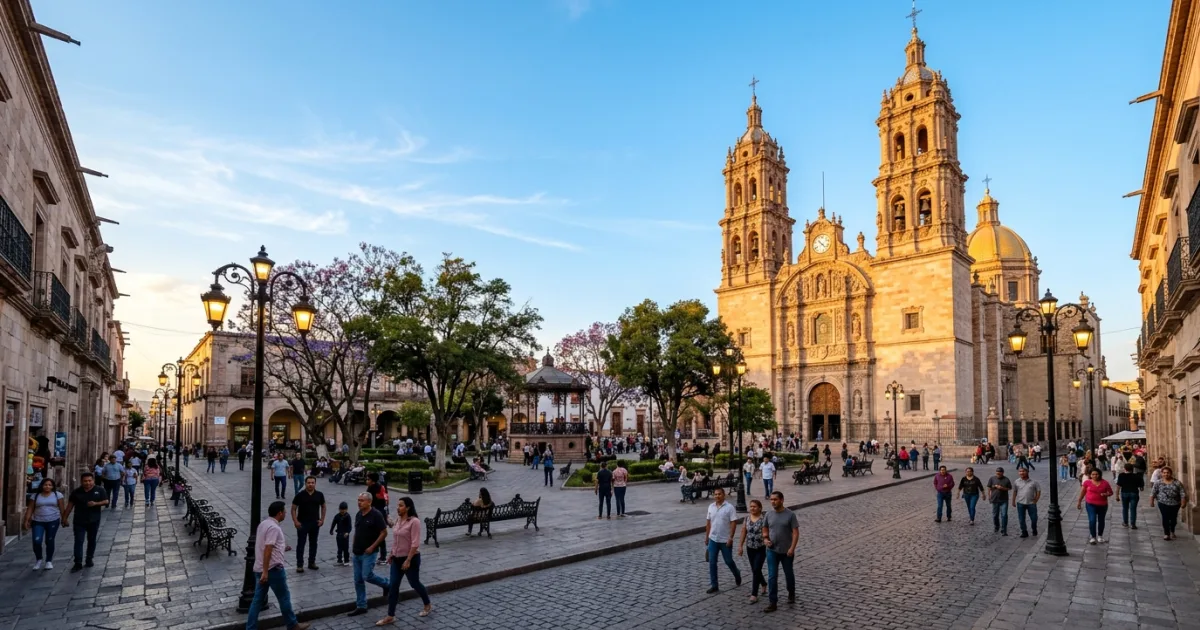
Centro Historico Durango holds an extraordinary place in Mexican heritage, representing one of the northernmost jewels along the historic Camino Real de Tierra Adentro. Originally settled in 1563, the district evolved into an affluent administrative and trading center driven by rich silver deposits in the surrounding Sierra Madre Occidental. This wealth funded magnificent colonial mansions, sprawling plazas, and baroque cathedrals constructed with local cantera stone, retaining their architectural integrity across centuries.
Today, visitors wander down pedestrian-friendly avenues like Paseo Constitución, lined with vibrant outdoor dining tables, artisan galleries, and cultural centers. The area hosts premier institutions including the Francisco Villa Museum, the Museum of Sacred Art, and the City Museum at the iconic Palacio de las Lágrimas. Whether admiring ironwork balconies or taking in the evening illumination of the cathedral towers, Centro Historico delivers an authentic, unhurried immersion into Mexico's storied past.
Reasons to Visit
- Home to one of northern Mexico's largest and most pristine historic centers with nearly a thousand preserved monuments.
- Designated part of the Camino Real de Tierra Adentro UNESCO World Heritage site.
- Vibrant pedestrian corridor Paseo Constitución offering relaxed outdoor dining, cafes, and street art.
- Rich cultural institutions including the Pancho Villa Museum and the subterranean Túnel de Minería.
- Spectacular aerial perspectives of the entire valley aboard the historic Teleférico to Cerro de los Remedios.
Things to Avoid
- Avoid wearing slick-soled footwear; historic stone walkways and cobblestone transitions can be slippery when damp.
- Do not exchange currency at airport desks if avoidable; commercial bank ATMs around Plaza de Armas provide far better rates.
- Avoid planning museum visits on Mondays when most state and municipal cultural venues are closed.
- Do not rely entirely on credit cards when browsing Mercado Gómez Palacio or taking local transit.
Local Transportation Tips
Exploring Centro Historico is best done entirely on foot, as primary attractions, dining options, and plazas are located within comfortable walking distances along pedestrianized corridors. For journeys outside the central zone, such as to the airport, bus terminal, or film sets like Villas del Oeste, licensed radio taxis and app-based ride services (such as Uber and Didi) are readily available, reliable, and inexpensive.
Travel Etiquette
- Greet shopkeepers and restaurant staff politely with 'Buenos días' or 'Buenas tardes' upon entering.
- Dress modestly and remove hats when entering Cathedral Basilica or other working churches in the district.
- Tipping 10% to 15% is standard practice in sit-down restaurants and cafes for good service.
- Always ask permission before taking close-up portraits of street artisans, market vendors, or indigenous Tepehuán and Huichol community members selling crafts.
Recommended Age Group
Centro Historico Durango offers educational, visually engaging, and accessible experiences that cater across multiple age brackets.
- Babies (0-2 years): Neutral. Most pedestrian streets are flat, but historical cobblestones and museum steps can make handling bulky strollers challenging.
- Kids (3-12 years): Recommended. Children will love exploring the subterranean Túnel de Minería, riding the aerial cable car, and discovering film heritage.
- Teens (13-19 years): Recommended. Vibrant cafes, camera-ready colonial backdrops, cinema history, and pedestrian plazas provide engaging exploration.
- Adults (20-64 years): Recommended. Outstanding access to historical architecture, mezcal tastings, traditional cuisine, and fascinating regional museums.
- Seniors (65+ years): Recommended. A flat, walkable historic core with ample shaded benches around Plaza de Armas makes for relaxed, low-strain sightseeing.
Accessibility Level: Medium
- Paseo Constitución features flat, level stone pavers that offer smooth passage for wheelchairs and mobility aids.
- The Teleférico Durango cable car stations provide ramp access and assistance for travelers with reduced mobility.
- Certain colonial-era buildings and smaller museums contain stepped thresholds and lack elevators to upper galleries; ground floors remain mostly accessible.
- Curb cuts are present along major avenues like Avenida 20 de Noviembre, though side streets may feature narrower or uneven sidewalks.
Did You Know?
Durango is home to an underground mining tunnel turned museum running directly beneath the historic center streets, where tourists walk through 280 meters of subterranean tunnels while traffic drives overhead.
Cool Statistics
- Designated with over 900 protected historical monuments across the metropolitan core.
- Durango has served as the filming location for more than 150 international and domestic feature films.
- Perched at an elevation of 1,890 meters (6,200 feet) above sea level in the Guadiana Valley.
- The Cathedral of Durango took more than a century to build, beginning in 1695 and concluding in the mid-19th century.






Buy a compatible power adapter for your trip