Spanning an arid stretch of Peru's southwestern shoreline, the Ica Region showcases some of South America's most arresting natural contrasts. Moving inland from the rocky Pacific headlands where cold Humboldt Current waters sustain millions of seabirds, fur seals, and dolphins, the terrain rapidly shifts into a sun-baked sea of colossal golden sand dunes. At the center of this desert landscape sits the provincial capital of Ica, flanked by emerald green agricultural valleys irrigated by subterranean runoff from the western slopes of the Andes Mountains.
Historically, the area served as the cradle for complex pre-Inca cultures including the Paracas civilization—celebrated for their intricate textiles and surgical cranial trepanation—and the Nazca culture, who carved colossal geometric lines and zoomorphic figures into the desert floor between 500 BCE and 500 CE. Following Spanish colonization, Ica's sun-drenched valleys became South America's prime grape-growing territory, giving birth to the continent's earliest viticultural industries and its definitive grape spirit: Pisco. Today, the Ica Region serves as a dynamic corridor where marine conservation, archaeology, and world-renowned desert exploration coexist seamlessly.
Reasons to Visit
- Wildlife Safaris in Paracas: Board speedboats to the Ballestas Islands, known as Peru's 'Mini Galápagos', to observe colonies of Humboldt penguins, sea lions, blue-footed boobies, and pelicans.
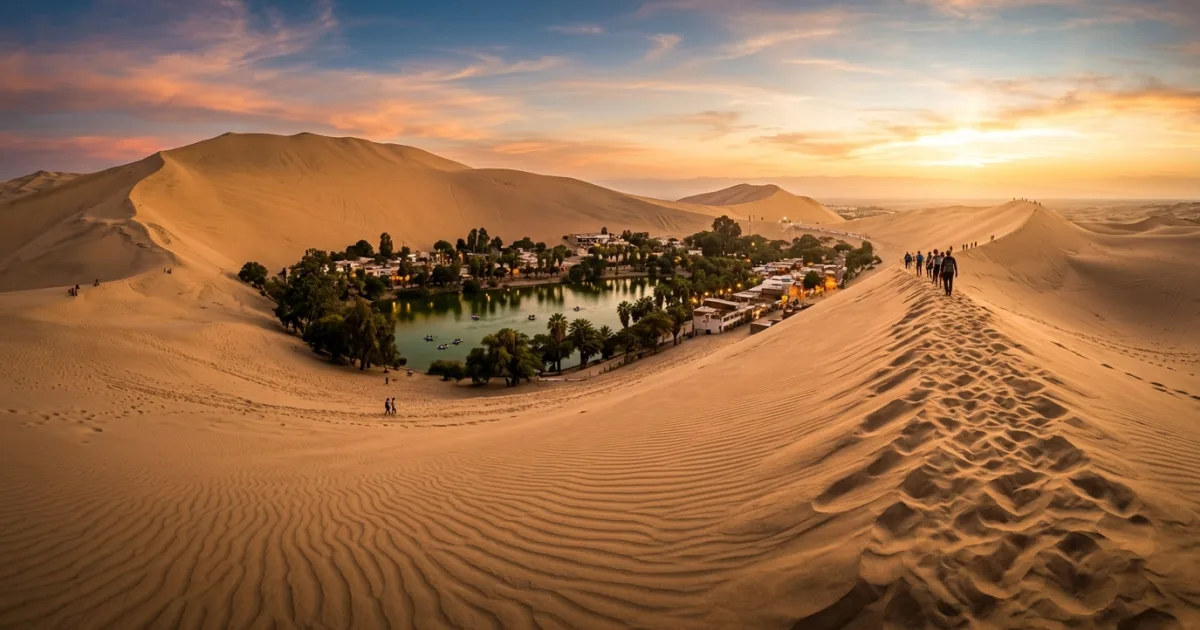
- Huacachina Desert Adventures: Experience thrilling 4x4 dune buggy rides and sandboarding down massive 100-meter dunes surrounding South America's only natural desert oasis lagoon.
- The Enigmatic Nazca Lines: Fly above the ancient desert plateau to witness prehistoric geoglyphs depicting hummingbirds, monkeys, and trapezoidal patterns preserved for millennia by the rainless climate.
- Historic Pisco & Wine Estates: Tour Tacama—the oldest vineyard in South America—alongside artisanal bodegas like El Catador to witness traditional copper-still distillation and sample award-winning Piscos.
- Raw Desert Coastlines: Explore the dramatic red sand beaches (Playa Roja) and cathedral cliffs inside the Paracas National Reserve where the desert drops steeply into the Pacific Ocean.
Things to Avoid
- Avoid booking unregulated, unofficial dune buggy drivers outside certified agency stalls in Huacachina, as reckless driving on open dunes presents safety hazards.
- Avoid eating heavy meals immediately prior to flying over the Nazca Lines, as the required sharp banking maneuvers by small aircraft frequently induce motion sickness.
- Avoid stepping off designated boardwalks or trails inside Paracas National Reserve and around the Nazca geoglyphs, as delicate desert crusts and nesting grounds take decades to recover from footprint damage.
- Avoid purchasing unlabeled, unsealed 'homemade' Pisco from unauthorized street stalls; rely on bottled spirits with official denomination of origin seals.
Local Transportation Tips
Intercity transit across the Ica Region operates efficiently along the paved Pan-American Highway (Ruta Nacional 1S). First-class coach lines connect Lima to Paracas, Ica city, and Nazca with departures every hour. For local commutes between Ica and the Huacachina oasis (a 10-minute journey), standard licensed yellow taxis charge fixed fares of 10 to 12 PEN ($3 USD). Within Paracas village (El Chaco), the compact town is easily traversed on foot, while bicycle rentals, scooter rentals, or guided tour mini-vans serve travelers venturing into the Paracas National Reserve.
Travel Etiquette
- Tipping Practices: Leaving a 10% gratuity is standard practice in sit-down restaurants in Paracas and Ica. Tipping dune buggy drivers and boat captains 10 to 20 PEN per party is customary for attentive service.
- Respecting Archaeological Monuments: The Nazca Lines and Palpa geoglyphs are protected UNESCO World Heritage sites; never attempt to walk or drive vehicles over unpaved desert plains.
- Water Conservation: The Ica Valley faces significant aquifer depletion due to intensive agriculture and desert climate conditions; keep showers brief and reuse hotel towels.
Recommended Age Group
The Ica Region offers a broad variety of maritime encounters, vineyard retreats, and desert adventures tailored to varying fitness levels.
- Babies (0-2 years): Neutral. Strong desert sun, blowing sand in dune corridors, and bumpy maritime speedboat rides require diligent protection and preparation for infant travelers.
- Kids (3-12 years): Recommended. Children love observing sea lion colonies and penguins up close at the Ballestas Islands and sledding down smaller sand dunes on belly-boards.
- Teens (13-19 years): Recommended. High-energy teenagers thrive on sandboarding, adrenaline-pumping dune buggy runs in Huacachina, and coastal cycling trails.
- Adults (20-64 years): Recommended. An outstanding destination pairing adventurous terrain, scenic flights over ancient mysteries, world-class coastal photography, and private Pisco and culinary tours.
- Seniors (65+ years): Recommended. Mature travelers can comfortably enjoy tranquil stays at Paracas bayfront resorts, scenic vineyard visits, and leisurely chartered flights over the Nazca desert without demanding physical exertion.
Accessibility Level: Medium
- Paracas Marina: The main El Chaco passenger pier offers flat, paved ramps for boarding boats, though sea swell conditions may require physical stepping onto vessels.
- Vineyard Grounds: Historic bodegas like Tacama feature paved courtyard walkways, ground-level tasting rooms, and accessible restrooms.
- Desert Dunes: The deep, shifting sand dunes of Huacachina and remote Nazca lookout points present significant barriers for manual wheelchairs and travelers with limited mobility.
Did You Know?
The Ica desert is one of the driest places on Earth, receiving less than 2 millimeters of rainfall per year. This exceptional dryness and stable barometric pressure are the primary reasons why the Nazca Lines have remained visible and un-eroded on the desert floor for over 1,500 years.
Cool Statistics
- Home to South America's oldest operating winery, Tacama, established in the Ica Valley in 1540.
- The Ballestas Islands and Paracas National Reserve harbor over 215 species of migratory and resident birds.
- The Nazca desert contains more than 800 individual geometric lines, 300 figures, and 70 distinct animal drawings.






Buy a compatible power adapter for your trip