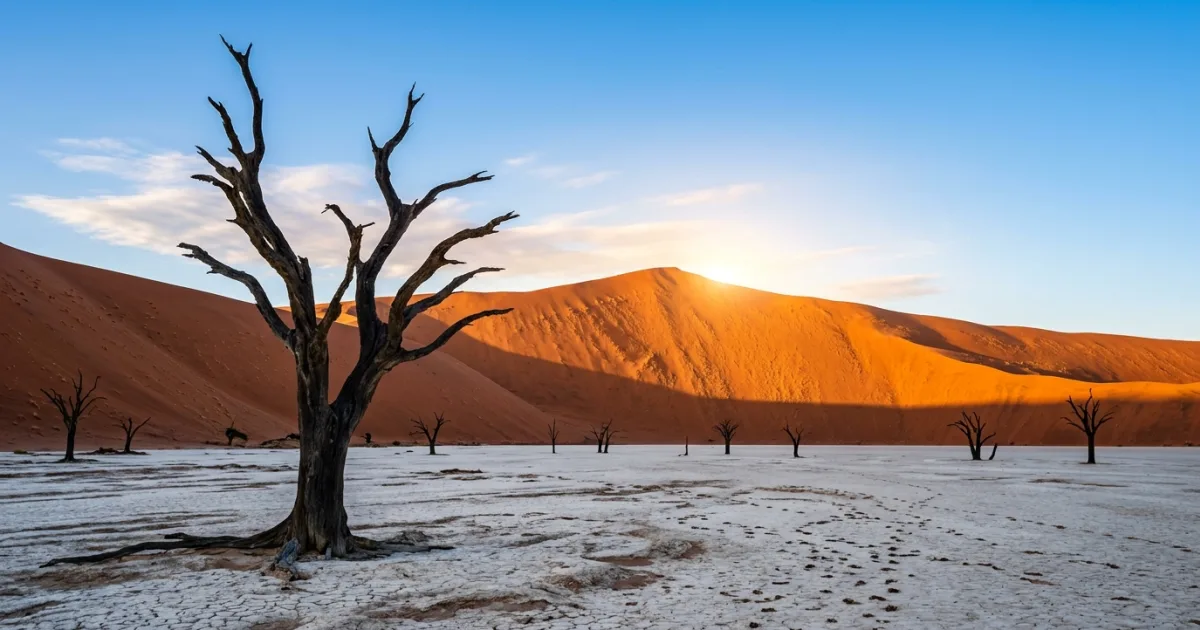
The Namib Desert is a vast and ancient landscape, characterized by its towering red sand dunes, rugged mountains, and gravel plains. Spanning the coast of Namibia, it is a place of extremes where temperatures fluctuate wildly between day and night. The most famous section is the Sossusvlei area within the Namib-Naukluft National Park, home to iconic dunes like Dune 45 and Big Daddy. The surreal Deadvlei, a white clay pan punctuated by 900-year-old dead camel thorn trees against a backdrop of vibrant orange sand, is a photographer's dream.
Beyond the dunes, the desert supports a surprising array of life. Desert-adapted elephants, lions, and rhinos roam the northern reaches, while the southern and central areas are populated by oryx, springbok, and ostriches. The coastal town of Swakopmund offers a stark contrast, where the desert meets the Atlantic Ocean, providing opportunities for adventure sports like sandboarding and quad biking. Whether you are seeking solitude, adventure, or unparalleled natural beauty, the Namib Desert delivers an unforgettable experience.
Reasons to Visit
- Witness the sunrise over the towering red dunes of Sossusvlei.
- Photograph the stark, contrasting colors of Deadvlei.
- Experience world-class stargazing in a designated Dark Sky Reserve.
- Spot unique desert-adapted wildlife like the majestic oryx.
- Enjoy off-grid glamping and exclusive luxury lodges in complete isolation.
Things to Avoid
- Avoid hiking the dunes during the midday heat to prevent heatstroke.
- Do not drive off designated tracks, as this damages the fragile desert ecosystem.
- Avoid driving at night due to roaming wildlife.
- Do not underestimate the amount of water you need; always carry extra.
Local Transportation Tips
Public transport is virtually non-existent in the Namib Desert. The most practical way to explore the region is by renting a vehicle, preferably a 4x4, which allows you to navigate gravel roads and sandy tracks safely. Guided tours and fly-in safaris are also popular options for those who prefer not to drive. Small charter flights offer spectacular aerial views of the dunes meeting the ocean.
Travel Etiquette
- Respect the fragile environment by leaving no trace and taking all rubbish with you.
- Stick to marked paths and roads to protect the delicate desert flora and fauna.
- Always ask for permission before photographing local people, such as the Himba or San communities.
- Conserve water at all times, as it is a precious and scarce resource in the desert.
Recommended Age Group
The Namib Desert offers incredible experiences, but its harsh climate and remote nature require careful consideration for different age groups.
- Babies (0-2 years): Not Recommended. The extreme heat, long driving distances on bumpy roads, and lack of immediate medical facilities make it unsuitable for infants.
- Kids (3-12 years): Neutral. Older children may enjoy the sand dunes and wildlife, but the long drives and intense sun can be exhausting. Careful planning and lodge selection are essential.
- Teens (13-19 years): Recommended. Teenagers will appreciate the adventure activities, such as sandboarding, quad biking, and climbing the massive dunes.
- Adults (20-64 years): Recommended. Ideal for adults seeking adventure, photography, self-drive safaris, and luxury desert retreats.
- Seniors (65+ years): Recommended. Seniors can enjoy the stunning scenery and wildlife through guided tours and comfortable lodges, though climbing the highest dunes may be physically demanding.
Accessibility Level: Low
- Accessibility in the Namib Desert is generally limited due to the sandy and rugged terrain.
- Some luxury lodges offer accessible rooms and facilities, but it is crucial to confirm in advance.
- Viewing the dunes from a vehicle is possible, but accessing Deadvlei requires traversing deep sand, which is not wheelchair friendly.
- Scenic flights provide an excellent, barrier-free way to experience the vastness of the desert.
Did You Know?
The Namib Desert is considered the oldest desert in the world, having endured arid or semi-arid conditions for at least 55 to 80 million years. It is also home to the Welwitschia mirabilis, a bizarre plant that can live for over 1,000 years, producing only two leaves throughout its entire lifespan.
Cool Statistics
- Age: Estimated to be 55-80 million years old.
- Size: Covers an area of over 81,000 square kilometers.
- Highest Dune: Dune 7 reaches an impressive height of 383 meters (1,256 feet).
- Rainfall: Receives less than 10 mm (0.39 inches) of rain annually in some areas.






Buy a compatible power adapter for your trip