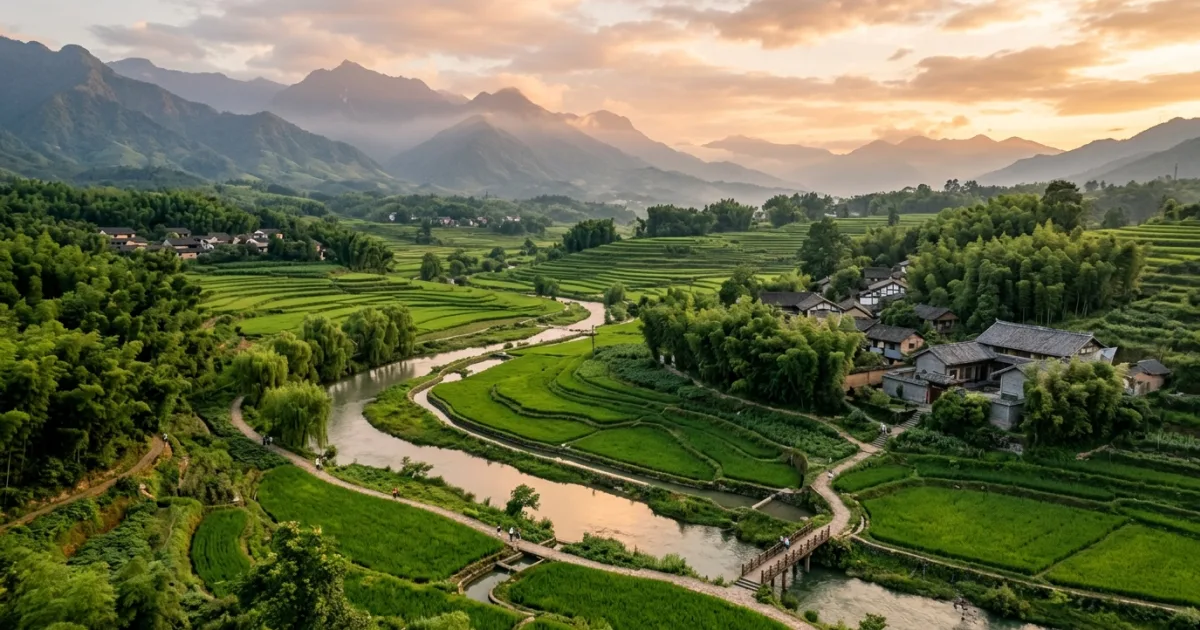
The Chengdu Plain is a sprawling, saucer-shaped alluvial depression covering roughly 23,000 square kilometers within western Sichuan. Ringed by the Longmen Mountains to the northwest and the Longquan Hills to the east, the basin owes its perpetual agricultural bounty to the Min River and Tuo River systems. For millennia, this protective geographic bowl nurtured sovereign civilisations independent of the Yellow River heartland, most notably the enigmatic bronze-casting culture of Sanxingdui dating back to the 12th century BC.
Today, the region combines deep agrarian heritage with modern infrastructure. Ancient tree canopies shade river embankments where open-air teahouses line stone bridges, while high-speed trains glide across manicured paddy fields and rapeseed plains. Travelers experience an authentic pace of life where historical monuments like the Dujiangyan waterworks still function as intended, cooling mist bathes sacred Taoist temples, and open markets serve farm-fresh produce celebrated worldwide under UNESCO's City of Gastronomy designation.
Reasons to Visit
- Marvel at the Dujiangyan Irrigation System, a UNESCO World Heritage marvel engineered in 256 BC that still controls floodwaters naturally.
- Encounter giant pandas in semi-wild bamboo reserves dedicated to ethical scientific breeding and conservation.
- Explore the groundbreaking Sanxingdui Museum, housing mesmerizing bronze masks and gold artifacts from the ancient Shu civilization.
- Ascend Mount Qingcheng, one of the foundational birthplaces of Taoism, surrounded by perpetual mountain mist and ancient cedar forests.
- Immerse yourself in authentic Sichuan teahouse culture, characterized by Gaiwan tea service, bamboo chairs, and relaxed social banter.
Things to Avoid
- Avoid planning outdoor activities during midday in peak summer (July and August) due to intense heat and thick humidity.
- Do not rely entirely on foreign credit cards; ensure digital wallets (Alipay or WeChat Pay) are configured before arrival.
- Avoid booking unregulated private cabs outside train stations; use verified taxi stands or ride-hailing apps instead.
- Do not disturb or attempt to feed captive wildlife at panda sanctuaries or nature reserves.
Local Transportation Tips
Transit across the Chengdu Plain is extraordinarily straightforward thanks to China's dense rail infrastructure. Intercity high-speed trains (C and D trains) connect central Chengdu to Dujiangyan, Mount Qingcheng, Pengzhou, and Guanghan in 20 to 45 minutes, with ticketing managed smoothly through Trip.com or the official 12306 rail app. Municipal metro lines extend far into the outer suburbs, complemented by clean public bus lines and metered taxis. Within historic towns, shared bicycles and pedestrian boardwalks provide the easiest way to explore.
Travel Etiquette
- When receiving a Gaiwan tea bowl, keep the saucer, cup, and lid together; tilt the lid gently to sweep tea leaves aside before sipping.
- Placing the teacup lid upside down or slanted on the saucer signals to teahouse staff that your hot water needs a refill.
- Always ask before photographing locals playing Mahjong in parks or teahouses, though most will warmly welcome you.
- Tipping is not customary in Chinese restaurants, taxis, or hotels; excellent service is rewarded with polite verbal thanks.
Recommended Age Group
The Chengdu Plain is exceptionally versatile, offering gentle geography, family-centric amenities, and deep cultural appeal across all generations.
- Babies (0-2 years): Recommended. Flat urban paths, abundant green parks, and welcoming hospitality make stroller navigation straightforward across the plain.
- Kids (3-12 years): Recommended. The presence of giant panda conservation centers, interactive science displays, and spacious botanical gardens captivates young travelers.
- Teens (13-19 years): Recommended. High-speed rail travel, spicy culinary challenges, vibrant night markets, and mysterious archaeological relics at Sanxingdui offer high engagement.
- Adults (20-64 years): Recommended. Perfect balance of rich culinary scenes, hiking Taoist trails, craft beer scenes, teahouses, and world-class historical exploration.
- Seniors (65+ years): Recommended. Gentle flat terrain across cities and ancient towns, seamless barrier-free transit, and relaxing teahouse culture cater effortlessly to mature travelers.
Accessibility Level: Medium
- High-speed rail stations throughout the plain feature step-free platform access, spacious elevators, and tactile guidance paving.
- Major attractions including Sanxingdui Museum and Chengdu Panda Base provide smooth wheelchair-accessible ramps, paved walkways, and motorized shuttle options.
- Historic stone towns like Jiezi or Huanglongxi feature occasional raised thresholds and cobblestones that require assistance for manual wheelchair users.
- Accessible public restrooms with grab rails are standard across major railway hubs, modern museums, and class-5A scenic attractions.
Did You Know?
The Dujiangyan Irrigation System on the Min River has operated continuously for more than 2,200 years without building a single solid dam wall. By using the natural topography, water velocity, and seasonal sediment flow, ancient engineer Li Bing tamed chronic regional flooding and turned the Chengdu Plain into China's most drought-resistant grain basket.
Cool Statistics
- Over 2,280 continuous years of functioning irrigation at Dujiangyan without an artificial dam wall
- Home to over 80% of the world's captive and wild giant panda population habitats along its perimeter
- More than 10,000 traditional teahouses operating across the plains and its municipal boundaries
- Historical site of the world's earliest recorded paper currency, the Jiaozi, issued in the 11th century




Buy a compatible power adapter for your trip