Disclosure: This site contains affiliate links. We may earn a commission if you make a purchase, at no extra cost to you.

>
>
>
>
>
Yuanyang
Panoramic sunrise over the flooded Yuanyang rice terraces with golden light reflecting in water tiers

Yuanyang Overview & Key Highlights

Yuanyang County sits precariously along the southern slopes of the Ailao Mountains in Yunnan, China, recognized globally for the monumental Honghe Hani Rice Terraces carved over 1,300 years by the Hani people. This sprawling UNESCO World Heritage landscape spans thousands of cascading tiers that plunge steeply from high mountain ridgelines down to the banks of the Red River. The terraced engineering balances an intricate ecosystem of forests, villages, paddies, and water systems that function without modern reservoirs, offering an extraordinary synthesis of human agriculture and wild topography. Travelers visit primarily to witness the flooded terraces between late autumn and early spring, when the paddies transform into giant mirrors reflecting vibrant sunrises, shifting cloud seas, and dramatic sunsets. Beyond the iconic viewpoints of Duoyishu, Bada, and Laohuzui, Yuanyang introduces visitors to authentic Hani and Yi indigenous cultures through distinctive mushroom-shaped thatched houses, weekly hill-tribe barter markets, and distinct culinary traditions rooted in mountain herbs and terrace-grown red rice.

Yuanyang Travel Guide: Logistics & In-Depth Tips

Carved over thirteen centuries into the rugged slopes of the Ailao Mountains, the Yuanyang Rice Terraces represent one of humanity's most breathtaking feats of agricultural landscape design. Established by the ancestors of the Hani people who migrated to the heights of southern Yunnan, this complex multi-tiered ecosystem spans over 16,000 hectares. Rain and mountain mists collect in high-altitude virgin forests that cap the peaks, naturally filtering water down through terraced gravity-fed bamboo canals that irrigate thousands of descending paddies before emptying into the Red River valley far below.

Today, Yuanyang is a dream destination for landscape photographers, cultural travelers, and slow-travel enthusiasts. Visiting during the winter flooding season allows travelers to witness sunlight blazing across hundreds of cascading tiers, silhouetting solitary water buffalo and local farmers in traditional headdresses. The villages themselves, with characteristic mushroom-shaped architecture, remain living communities where ancient agricultural festivals, communal farming methods, and ethnic customs thrive largely unaltered by mass commercialism.

Reasons to Visit

  • Witness the legendary sunrise over Duoyishu, where morning light reflects through hundreds of flooded, mist-veiled tiers.
  • Immerse yourself in authentic Hani and Yi tribal culture at bustling weekly open-air trade markets in Shengcun and Xinjiezhen.
  • Hike off-the-beaten-path trails winding between ancient stone-and-thatch mushroom houses in traditional villages like Azheke.
  • Marvel at the engineering marvel of a gravity-fed UNESCO World Heritage ecosystem preserved across more than a millennium.
  • Savor rare culinary treasures, including indigenous mountain red rice, terrace-raised fish, and foraged wild botanical greens.

Things to Avoid

  • Avoid basing yourself in Nansha (the low-altitude new town), which sits far from the viewpoints and requires grueling daily mountain climbs.
  • Do not walk along narrow mud terrace ridges without checking for stability, as damp clay gives way easily and ruins footwear.
  • Avoid booking your trip during the summer monsoon (July-August) if your goal is landscape photography, due to heavy persistent cloud cover.
  • Do not photograph local ethnic elders up close without politely asking permission first or offering a small purchase from their stalls.
  • Never leave for early morning shoots without a warm jacket and flashlight; mountain conditions before dawn are pitch black and near freezing.

Local Transportation Tips

Public transit directly within the terrace clusters is informal. The primary way to get between viewpoints and villages is by hailing shared seven-seater minivans (known locally as mianbaoche) that run regularly along the main paved road connecting Xinjiezhen, Shengcun, and Duoyishu. Fares typically cost between 5 and 20 RMB per ride. For comprehensive exploration or specific sunrise and sunset timings, it is best to charter a private minivan and driver through your guesthouse for approximately 300 to 400 RMB per day.

Travel Etiquette

  • Always show profound respect toward the agricultural landscape; never trample across active paddies, step on rice seedlings, or pollute irrigation water.
  • Dress modestly and remove hats when invited into private traditional Hani wooden homes or communal village pavilions.
  • Ask for permission with a nod or a warm smile before photographing tribal elders in traditional indigo garments at the markets.
  • Practice sustainable tourism by packing out all your plastic waste, as remote villages lack advanced municipal recycling systems.

Recommended Age Group

Yuanyang offers an unforgettable, wild mountain experience, though terrain and logistical challenges dictate who will enjoy it most.

  • Babies (0-2 years): Not Recommended. Mountain roads are long and winding, uneven terrace trails make strollers impossible, and pediatric healthcare is distant.
  • Kids (3-12 years): Neutral. Older children with outdoor curiosity will enjoy seeing water buffalo and village life, but walking requires intense supervision near steep drops.
  • Teens (13-19 years): Recommended. Perfect for active adolescents interested in hiking, drone photography, and discovering living cultural history.
  • Adults (20-64 years): Recommended. Ideal for independent hikers, cultural explorers, and landscape photographers capable of navigating variable weather and rural trails.
  • Seniors (65+ years): Neutral. Main viewing decks (like Duoyishu and Bada) are well-paved, but high stairs and thin mountain air can challenge travelers with limited mobility.

Accessibility Level: Medium

  • Major designated scenic viewpoints such as Duoyishu and Bada feature paved wooden viewing decks accessible via ramps from main parking lots, though some stair climbing is required for lower platforms.
  • Inter-village trails, active rice terrace bunds, and traditional village stone alleys are entirely non-wheelchair-accessible due to steep steps, slick mud, and loose rocks.
  • Local public transportation vehicles (shared vans) lack wheelchair ramps or lifts; travelers with limited mobility will require private door-to-door vehicle charters.
  • Most traditional guesthouses and mushroom-house homestays lack elevators and roll-in showers, making advance verification of ground-floor rooms imperative.

Did You Know?

The Hani agricultural system has no man-made reservoirs. Instead, the entire hydrological system functions on a continuous, natural four-tier ecological layout: mountaintop rain catchment forests, mid-mountain residential villages, lower-mountain terraced paddies, and base-level river drainage systems, all managed through communal water-allocation wood gates that divide stream currents with exact mathematical precision.

Cool Statistics

  • The terraces climb from an elevation of roughly 140 meters above sea level to over 2,000 meters, often packing up to 3,000 individual steps onto a single mountain slope.
  • The entire Honghe Hani Rice Terraces complex covers an astounding 16,603 hectares of cultivated mountainside.
  • The Hani people have continuously farmed these slopes using organic gravity-flow water management for more than 1,300 years.


Address:

Yuanyang County, Honghe Hani and Yi Autonomous Prefecture, Yunnan, China

Find Nearby Accommodations

Basic Info

address icon

COUNTRY & Region

China,
Asia

ACCESSIBILITY LEVEL​

Medium
Currency icon

LOCAL CURRENCY​

Chinese Yuan (CNY)
Price level icon
Low
Safety Level icon

SAFETY LEVEL

Duration icon

Recommended Duration

• 1-7 days

Electricity

electricity icon

Electricity

220-240V, 
50Hz
Plug Socket icon

Plug Type

• Type A (Flat blade)
• Type C (Round pin)
• Type I (Two flat pins in V-shape, grounding pin)
Plug types
Click To View Plug Types
Yuanyang is part of our
Slow Travel & Nature collection

Activities To Do In Yuanyang

Best Time To Visit Yuanyang

The optimal travel window for Yuanyang spans from late November through March, when the paddies are fully flooded with water and reflect the sky.

  • November to March (Flooding Season): Prime season for photographers. The weather is cool, morning sea-of-clouds phenomena are frequent, and the terraces form shimmering mirrors under golden light.
  • April to September (Green & Growing Season): Warmer temperatures with lush, emerald-green hillsides during late spring, transitioning to vibrant yellow fields by late August before the autumn harvest.
  • July to August (Rainy Season): Heavy monsoon rains can trigger mountain landslides, disrupting winding roads and obscuring viewpoints with dense, persistent fog.

Average Temperatures Per Month

Remember to check the weather forecast a few days before the trip and before heading to the airport.

Safety Level icon

Safety Level

Yuanyang is exceptionally safe regarding violent crime and theft, but natural mountain terrain requires caution. Roads feature steep drop-offs and hairpin turns that become treacherous during heavy rainfall or dense fog; hire experienced local drivers rather than renting a scooter. Exercise care when walking across narrow, mud-slicked terrace bunds to avoid twisting ankles or falling into deep, water-filled paddies. Pack basic gastrointestinal remedies, as remote culinary standards may test sensitive stomachs.

The rating is based on multi-year peace, crime, and security indices. Before you go, always verify current conditions through official government travel advisories.

Emergency Numbers

Police: 110
Ambulance: 120

No internet needed • Includes local translations • Free for TravelingWiz readers

Spoken Languages

Southwestern Mandarin, Hani, Yi

Learn The Language

  • Nǐ hǎo – Hello
  • Xièxie – Thank you
  • Duōshao qián? – How much does this cost?
  • Tài guì le – Too expensive
  • Cèsuǒ zài nǎlǐ? – Where is the restroom?
  • Jiùmìng! – Help!
  • Tíng yīxià – Stop here (useful for shared vans)
  • Wǒ yào qù… – I want to go to…
Travel Booking Partner - TravelingWiz

Trip Cost & Budgeting for Yuanyang, 2026

Everything you need to know about money while traveling
Is Yuanyang expensive for tourists in 2026? No, Yuanyang remains an affordable destination for travelers exploring Yunnan's terraced fields. You can expect to pay around 25 CNY for a coffee, 10 CNY for a local domestic beer, and 60 CNY for a hearty mid-range restaurant meal. Based on Human Verified prices, accommodation and food offer exceptional value here. Use the data table below to calculate your specific daily budget based on your travel style.
Currency icon

LOCAL CURRENCY​:

Chinese Yuan (CNY)
Price level icon
Low
Mobile payments via WeChat Pay and Alipay dominate, while foreign credit cards are rarely accepted, so keep cash handy.

Per person, per day – pocket cash for small purchases.

Local: 45
Chinese Yuan (CNY)
≈ 7 USD

Full daily spend estimation (accommodation, food, transportation, attractions).

Travel Style
Chinese Yuan (CNY)
≈ USD ($)
Budget
240
36
Mid-range
430
64
Comfort
950
142

The Prices, Daily costs, and calculator results are estimates for planning purposes only. Actual costs may vary based on season, booking timing, personal spending habits, and currency fluctuations. TravelingWiz cannot be held responsible for discrepancies between these estimates and your final trip expenses.

  • • Link international cards to Alipay or WeChat Pay before arriving to pay seamlessly at most local eateries.
  • • Travel between terrace view platforms using shared local minivans rather than hiring expensive private drivers.
  • • Book guesthouses in Duoyishu or Xinjie village that include breakfast and panoramic rice terrace views in the room rate.
  • • Eat at local Hani family-run eateries ordering local red rice and seasonal terrace dishes instead of tourist-targeted menus.

Pre-Order Tickets

Avoid disappointment when tickets sell out — and skip the long lines by booking online in advance. You’ll often save up to 20% too.
Save up to 20%

Travel Discounts & Coupons

Save on hotels, attractions, transport, and gear — find verified discounts for smarter travel spending.
Verified Coupons

What To Pack

  • Sturdy waterproof hiking boots with deep tread for slick, clay-heavy terrace paths
  • Layered clothing including a windproof fleece and thermal underwear for freezing dawn photo shoots
  • High-grade polarizing filter, wide-angle lens, telephoto zoom, and a sturdy travel tripod
  • Compact LED headlamp for early morning treks to unlit photography platforms
  • Universal plug adapter and a high-capacity power bank, as cold mountain air drains phone batteries quickly
  • Cash (RMB) in small denominations, as remote village merchants and van drivers rarely take foreign cards or digital wallets linked to foreign accounts
We couldn't find tips for Yuanyang.
If you got any, please share

Recommended Itineraries for Traveling to Yuanyang

We couldn't find itineraries for Yuanyang.
you can contact us for custom trip plan

Food & Drink Highlights

Local Food Overview

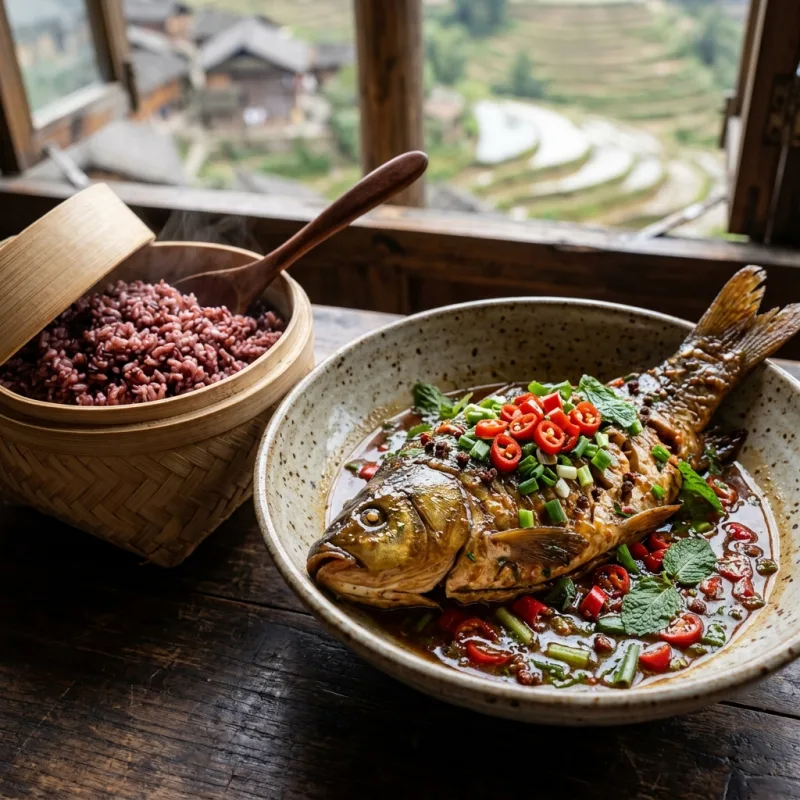
Hani cuisine in Yuanyang revolves entirely around what is farmed directly in the aquatic terrace biosphere and gathered from mountain forests. Staples include aromatic, nutty red rice, freshly harvested terrace carp (raised directly in the flooded paddies alongside the grain), and free-range mountain poultry. Dishes rely on fresh herbs, wild fern shoots, pickled bamboo, and pungent dipping sauces loaded with fresh chilies, mountain garlic, and mint, creating clean, rustic, and deeply comforting flavors.
Yuanyang braised terrace carp served with local steamed red rice in a rustic ceramic dish

Must Try Dish

Yuanyang Terrace Carp with Red Rice - Fresh carp harvested straight from the flooded rice paddies, braised with mountain chilies, ginger, and wild herbs, served alongside indigenous Hani steamed red rice.
Food Experiences Title Icon

Food
Experiences

Discover cooking classes, tastings and local food tours

No food experience found
Maya, the human travel expert at TravelingWiz, offering curated, non-AI expertise

Maya’s Final Checklist for Yuanyang

Logistics shouldn’t be the focus of your trip—the experience should. I’ve hand-vetted these essential partners to ensure your arrival, stay, and exploration are as smooth as an Athenian breeze.

Where to Stay

From boutique hotels to local apartments—compare thousands of options and find the perfect stay in the best neighborhood.

Air Travel

Getting there should be seamless. Compare the best routes and prices across top airlines to start your journey on the right note.

Local Guides

Connect with experts who know the destination best. Get personalized advice and insider tips to help you plan your perfect trip.

Travel Protection

The “Engineer’s” rule: always have a backup. Secure your trip with a plan that covers every “what if” and unexpected change.

Car Rentals

Explore at your own pace with total freedom. Compare reliable rental options and find the right vehicle for your adventure.

Visa Services

Don’t let paperwork slow you down. Get expert assistance with your application to ensure all your entry documents are in order.

FAQs

December to February is the prime window. During these months, the terraces are fully flooded with clear water, rice shoots have not yet sprouted, and the sun rises and sets against mirror-like water surfaces amidst atmospheric valley fog.
Take a high-speed train from Kunming to Mengzi, Jianshui, or Lin’an, followed by a local bus or private hire car up the mountain to Xinjiezhen (Old Yuanyang), a journey that takes approximately 4 to 5 hours in total.
Stay in Xinjiezhen or directly inside traditional villages near the scenic areas, like Pugao Laozhai or Duoyishu. Nansha is the new administrative center located in the hot valley floor, requiring an hour-long winding drive up the mountain every day to reach the terraces.
Major platforms like Duoyishu and Bada have paved boardwalks. However, paths winding between villages and directly through the paddies are narrow, dirt paths without English signage; hiring a local Hani guide or using offline GPS maps is highly recommended.

Your Insights Matter

TravelingWiz grows through the stories of our community. If you’ve recently explored ,Yuanyang share your tips and stories to help us perfect our guides for the next traveler.

Related Articles

Check out our related articles and blog posts to learn even more about the destination.

No related articles found

Don’t Travel Alone

Share with your friends and family

Where should we send your offline card?

We hate spam just as much as you do

newsletter_consent *