Chittorgarh sits majestically in the southern quadrant of Rajasthan, serving as the historical capital of the Mewar Kingdom from the 8th to the 16th centuries. Dominated by its hill fortress—a designated UNESCO World Heritage Site—the city is immortalized in Indian history for the legendary courage, chivalry, and tragic sacrifices of its rulers and residents during sieges led by Alauddin Khalji, Bahadur Shah, and Emperor Akbar.
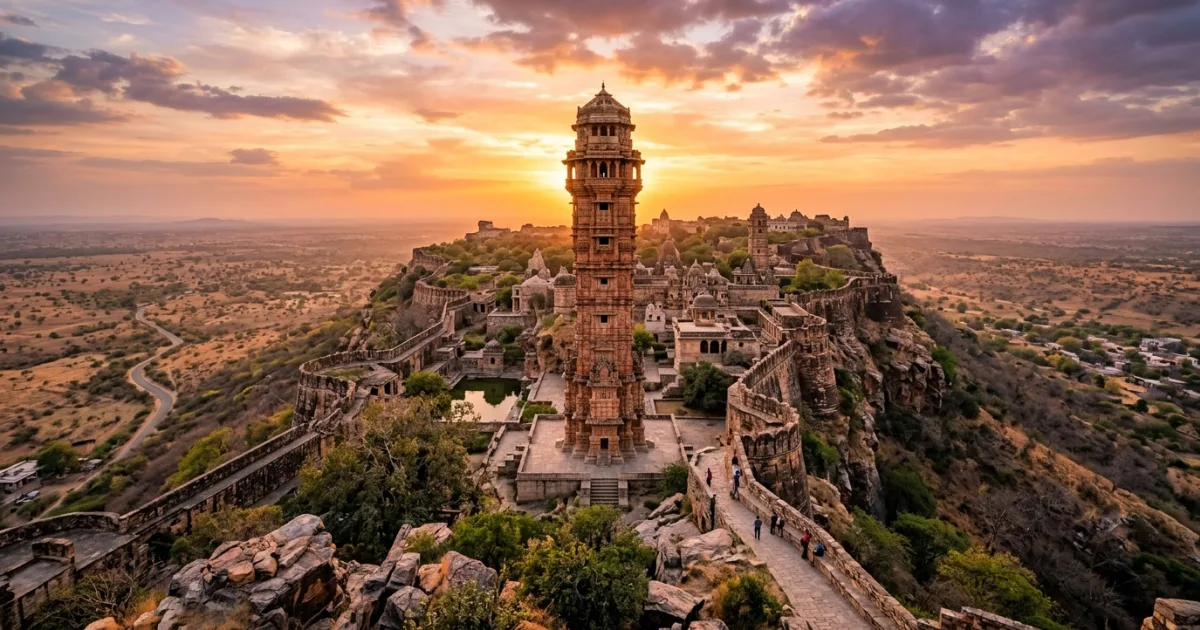
Beyond the epic stories of historical sieges and Jauhar, Chittorgarh presents extraordinary examples of Rajput and Solanki architecture. The soaring Vijay Stambha, constructed by Maharana Kumbha in 1448, features nine distinct levels adorned with intricate carvings of Hindu deities. Surrounding it are sacred pools like Gaumukh Reservoir, where mountain springs trickle directly from stone cow muzzles, and ornate sanctuaries dedicated to Mirabai, cementing the city's place as an enduring symbol of spiritual and architectural devotion.
Reasons to Visit
- Explore India's largest fort complex, spanning over 700 acres of monumental stone architecture.
- Climb the legendary 9-story Vijay Stambha for panoramic views across the Mewar countryside.
- Immerse yourself in vibrant spiritual history at the Meera Temple and historic Jain shrines.
- Experience an authentic, unhurried Rajasthani town free from intense commercial tourist crowds.
- Marvel at ancient hydraulic engineering at the cliffside Gaumukh Reservoir.
Things to Avoid
- Avoid attempting to walk between fort monuments on foot under direct midday sun; the distances are vast and tiring.
- Avoid teasing or holding open food around the local langur monkeys inhabiting the fort ruins.
- Avoid hiring unauthorized guides outside ticket areas; always request to see official tourism board credentials.
- Avoid visiting during midday in peak summer months (April to June) when surface temperatures on stone become dangerously hot.
Local Transportation Tips
Navigating Chittorgarh Fort is easiest by negotiating a half-day or full-day rate with an auto-rickshaw from the lower city or railway station. Typical round-trip hires covering all major sights inside the fort range between 500 and 800 INR. Taxis can also be booked through local hotels. Within the flat lower town, cycle rickshaws and short auto rides connect markets, bus terminals, and the Chittorgarh Junction railway station.
Travel Etiquette
- Remove footwear and hats before stepping inside any functioning temple or sanctum.
- Always seek permission before photographing local residents, particularly women and sadhus.
- Dress modestly with covered shoulders, chest, and legs to respect conservative local customs.
- Accept food or hand money using your right hand rather than your left hand.
Recommended Age Group
Chittorgarh Fort offers an unforgettable educational journey through medieval military architecture, though its sprawling physical layout and stone steps demand stamina.
- Babies (0-2 years): Not Recommended. Cobblestone paths, massive staircases, and lack of smooth stroller tracks make infant navigation physically demanding.
- Kids (3-12 years): Neutral. Children enjoy the expansive ramparts and tower stories, but the extensive walking under direct sun can cause rapid fatigue.
- Teens (13-19 years): Recommended. Highly engaging for photography, history exploration, and climbing the historic towers and rampart lookouts.
- Adults (20-64 years): Recommended. Ideal for cultural travelers, photographers, and history enthusiasts capable of self-paced walking across broad historical grounds.
- Seniors (65+ years): Neutral. Enjoyable if vehicle transport is utilized between monuments, but high stone plinths and tower stairs pose mobility challenges.
Accessibility Level: Medium
- Chittorgarh Fort features rough stone pathways, ancient thresholds, and steep stairs that present substantial obstacles for wheelchair users.
- Lower portions of palace complexes can be viewed from paved vehicle drop-off zones, but interior courtyards and upper chambers require climbing steps.
- Accessible toilet facilities are scarce within the historic fort grounds; standard facilities are located primarily near the main ticketing entrance.
- Hiring a private vehicle or autorickshaw allows travelers with limited mobility to drive directly to exterior view terraces across the fort.
Did You Know?
Chittorgarh Fort originally accommodated 84 historic water bodies, including stepwells, reservoirs, and ponds, which could store roughly 4 billion liters of water—sufficient to keep a standing army of 50,000 soldiers supplied for four consecutive years during a siege.
Cool Statistics
- Chittorgarh Fort spans approximately 691.9 acres (2.8 sq km) with a perimeter wall of 13 kilometers.
- The Vijay Stambha towers 37.2 meters (122 feet) high and contains 157 narrow steps to the summit.
- The fortress rises roughly 180 meters above the surrounding Berach River plain.
- Over 22 historic water reservoirs remain fully intact and filled within the citadel today.






Buy a compatible power adapter for your trip