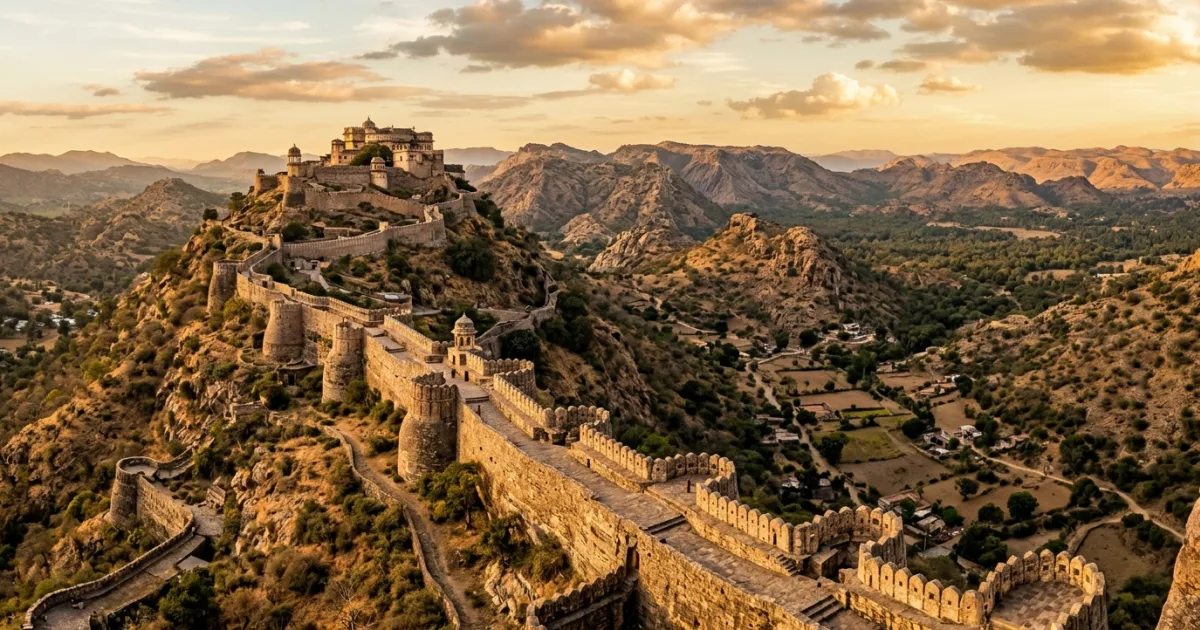
Kumbhalgarh represents one of the crowning defensive accomplishments of the Sisodia Rajput dynasty. Built during the 15th century by Rana Kumbha, it served as an impenetrable refuge for Mewar rulers during times of conflict, notably shielding infant Maharana Pratap from hostile forces. Its formidable ramparts snake across thirteen mountain peaks, giving the bastion both tactical dominance and dramatic architectural presence. Today, the monument is protected as an Archaeological Survey of India site and forms part of the Hill Forts of Rajasthan UNESCO World Heritage group.
Surrounding the fortress is the Kumbhalgarh Wildlife Sanctuary, an expansive tract of dry deciduous forest that shelters wolves, leopards, and over 200 bird species. The interplay between massive stone monuments and untamed scrub forest gives Kumbhalgarh an atmospheric, timeless character distinct from urban palace complexes like Jaipur or Udaipur.
Reasons to Visit
- Witness the second-longest continuous defensive wall on Earth, curling dramatically over rugged Aravalli ridges.
- Explore Badal Mahal (Palace of Clouds) at the highest summit, offering sweeping panoramic views across Mewar and Marwar plains.
- Tour over 300 ornate Jain and Hindu temples constructed within the fortress perimeter between the 10th and 15th centuries.
- Embark on nature treks and jeep safaris into the contiguous Kumbhalgarh Wildlife Sanctuary.
Things to Avoid
- Avoid attempting the wall climb in flimsy flip-flops or smooth-soled dress shoes; the historic flagstones are steep and slick.
- Do not rely entirely on ride-hailing mobile apps like Uber or Ola, as they do not operate reliably in Kumbhalgarh; arrange private cabs in advance.
- Avoid approaching or feeding the troop of wild langurs lounging near the entrance gates.
- Do not forget to carry warm outer layers if traveling between December and February, as evening temperatures drop sharply.
Local Transportation Tips
Public transportation within Kumbhalgarh is minimal. Most travelers arrive via pre-booked private taxicab or self-drive rental from Udaipur or Jodhpur. Inside the fortress grounds, exploration is conducted entirely on foot across stone inclines, ramps, and staircases. Local open-top safari jeeps are readily hireable through hotels for game drives into the adjacent Kumbhalgarh Wildlife Sanctuary.
Travel Etiquette
- Remove your shoes and leave leather goods outside before stepping into active Jain and Hindu temple sanctums.
- Dress respectfully with covered knees and shoulders when touring inner temple courtyards.
- Ask permission before photographing local villagers, pastoral Rabari herdsmen, or priests.
- Carry away all personal trash, especially plastic water bottles, to preserve the natural hilltop ecology.
Recommended Age Group
Kumbhalgarh suits travelers able to manage sustained walking on steep, uneven surfaces.
- Babies (0-2 years): Not Recommended. Paved stroller paths do not exist; steep stone ramps and steps make baby-wearing physically taxing and hazardous.
- Kids (3-12 years): Recommended. School-age children are captivated by the towering battlements, expansive views, and castle legends.
- Teens (13-19 years): Recommended. An excellent destination for teenagers interested in photography, hiking, and military history.
- Adults (20-64 years): Recommended. Perfectly suited for adults who appreciate heritage architecture, nature walks, and historical exploration.
- Seniors (65+ years): Neutral. Seniors with good mobility will enjoy the scenic lower courtyards, but the steep climb to Badal Mahal can prove difficult for those with joint or cardiovascular concerns.
Accessibility Level: Medium
- The lower gateway (Ram Pol) offers relatively flat viewing areas, but upper palaces require navigating steep, unpaved ramps and high steps.
- Wheelchair accessibility is virtually absent across the main monument due to historic defense architecture designed to prevent wheeled ascents.
- Visitors with limited mobility can access designated scenic viewpoints near the base and hotel terraces overlooking the illuminated ramparts.
Did You Know?
Legend holds that the massive stone wall of Kumbhalgarh was engineered so wide—measuring between 15 to 20 feet across in key sectors—that eight horses could gallop abreast along its top parapets during defensive maneuvers.
Cool Statistics
- 36 kilometers: Total length of the fortress perimeter wall.
- 1,100 meters: Elevation above sea level at the fortress summit.
- 360+: Number of ancient temples documented inside the enclosure.
- 1458 CE: Year construction of the primary fort structure was completed under Rana Kumbha.







Buy a compatible power adapter for your trip