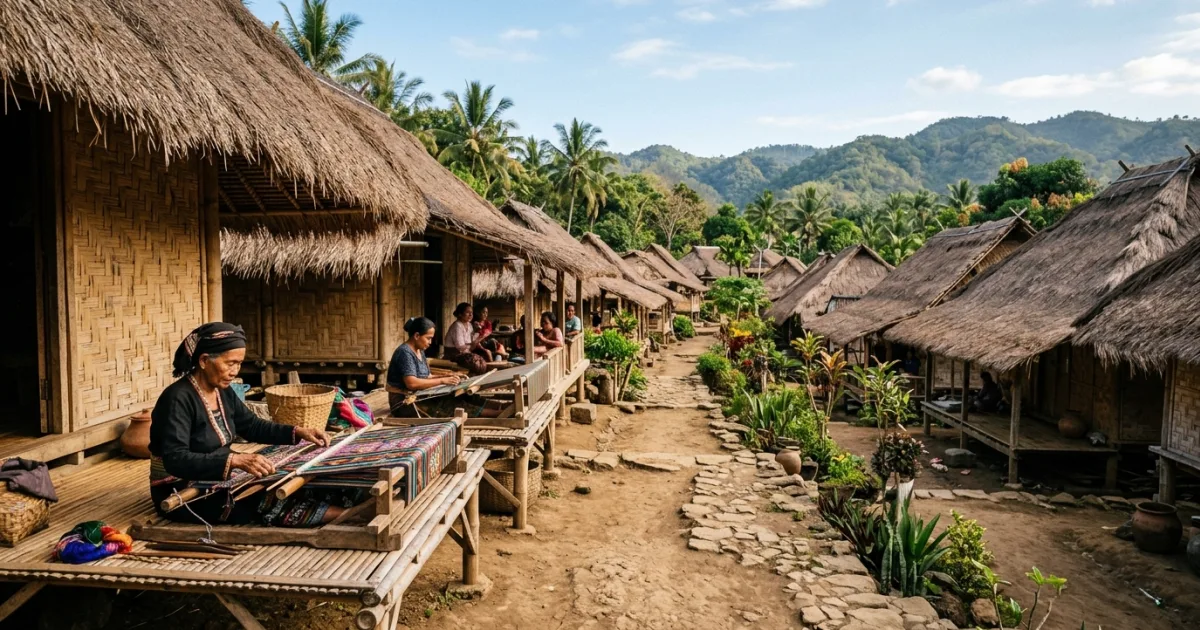
Ende Village (Dusun Ende) stands as an enduring testament to the cultural tenacity of the Sasak, the indigenous Austronesian ethnic group native to Lombok. Tucked quietly off the primary arterial highway linking Lombok International Airport with the southern resort hub of Kuta, this rural hamlet of roughly thirty families preserves social structures and building techniques that have disappeared from most modern Indonesian communities. The village layout adheres strictly to customary spatial arrangements, featuring residential homes (Bale Tani), raised granaries (Alang/Lumbung), and community gathering pavilions positioned according to directional beliefs that balance ancestral veneration with everyday subsistence farming.
A walk through Ende Village provides an intimate masterclass in sustainable indigenous vernacular architecture. The dwellings are assembled entirely without nails, utilizing lashed bamboo trusses, wooden framing, compacted earthen foundations, and dense thatch fashioned from dried alang-alang wild cogon grass. Perhaps the most famous hallmark of Sasak domestic architecture observed here is the ceremonial treatment of clay floors with a mixture of water buffalo or cow dung and ash, which polishes the surface to a marble-like sheen while acting as a natural pest deterrent. Ende continues to run community-managed cultural tourism, ensuring that revenues from visits assist in maintaining structural thatched roofs and subsidizing school costs for local children.
Reasons to Visit
- Authentic and unhurried cultural immersion with local Sasak families without high-pressure souvenir sales
- Firsthand observation of ancient Sasak building arts, including hand-laid grass thatch and buffalo-dung polished floors
- Interactive demonstrations of heritage songket backstrap weaving, with opportunities to try operating the traditional wooden loom
- Community-led guiding model where resident storytellers share folklore, courtship customs, and marital kidnap rituals (Merariq)
- Convenient geographic location, ideal as an educational stopover between Lombok Airport and southern coastline beaches
Things to Avoid
- Avoid wearing swimwear, short shorts, or sleeveless tank tops inside the village perimeter without wrapping a provided sarong
- Do not step over the threshold of a family's Bale Tani residence without waiting for an explicit verbal invitation and removing your shoes
- Avoid touching the heads of children or elders, as the head is revered as the spiritual center of the body in Indonesian customary traditions
- Do not point your feet directly at elders or sacred home shrines when seated on bamboo platforms
- Avoid visiting during heavy midday heat without sun protection, as the unpaved courtyards offer little tree shade
Local Transportation Tips
Ende Village is situated in Sengkol within the Pujut district of Central Lombok, roughly a 15-minute drive south of Lombok International Airport (LOP) and 20 minutes north of Kuta Beach Lombok along Jalan Raya Sengkol. The most flexible way to visit is by renting an automatic scooter (70,000–90,000 IDR per day) or chartering a private air-conditioned vehicle with a local driver (500,000–650,000 IDR per full day). Ride-hailing services like Grab and Gojek can drop passengers off from the airport, but finding return rides directly from the village gate can be inconsistent, making a round-trip driver or rental vehicle the most reliable choice.
Travel Etiquette
- Always smile and offer a gentle nod when passing village elders resting on communal verandahs
- Accept offered welcome tea or village-grown black coffee as a courteous gesture of mutual respect
- Ask permission prior to filming weavers or children, and show them the photograph on your display afterward
- Keep conversations moderate in volume, especially around ancestral tombs and clan gathering pavilions
Recommended Age Group
Ende Village offers an educational, low-impact cultural excursion suitable for travelers across multiple generations.
- Babies (0-2 years): Neutral. Dirt pathways make push strollers unusable, requiring parents to use baby carriers or wraps in warm tropical weather.
- Kids (3-12 years): Recommended. Children are fascinated by the buffalo dung building method, open-air farm animals, and interactive weaving displays.
- Teens (13-19 years): Recommended. High educational value regarding indigenous sociology, traditional architecture, and authentic photographic settings.
- Adults (20-64 years): Recommended. Ideal demographic for unhurried cultural immersion, textile purchasing, and learning about Sasak philosophy.
- Seniors (65+ years): Recommended. The flat terrain requires minimal strenuous walking, though visitors should take care on slightly uneven earthen ground.
Accessibility Level: Medium
- Ground surfaces consist entirely of compacted dirt, dry soil, and gravel, which can hinder standard manual wheelchairs.
- Entryways into traditional Bale Tani homes feature raised wooden thresholds requiring high steps to enter.
- Restroom facilities on-site are basic rural squat and seated toilets that lack reinforced grab bars.
- Visitors with mild mobility limitations can complete the compact perimeter walk with the assistance of a cane or trekking pole.
Did You Know?
Historically, a young Sasak woman in villages like Ende could not marry until she mastered the intricate art of weaving songket fabric on a traditional backstrap loom. Creating a single bridal sarong often demands three to six weeks of meticulous manual labor, embedding sacred tribal geometry and clan symbols into hand-spun cotton threads dyed with turmeric, indigo, and mahogany bark.
Cool Statistics
- 30: Approximate number of indigenous Sasak family households living within Ende Village
- 100%: Percentage of residential homes built using organic bamboo, clay, and alang-alang thatch
- 15: Minutes required to drive from Lombok International Airport to the village entrance
- 3–6: Weeks required by a resident weaver to complete a master-grade songket cloth






Buy a compatible power adapter for your trip