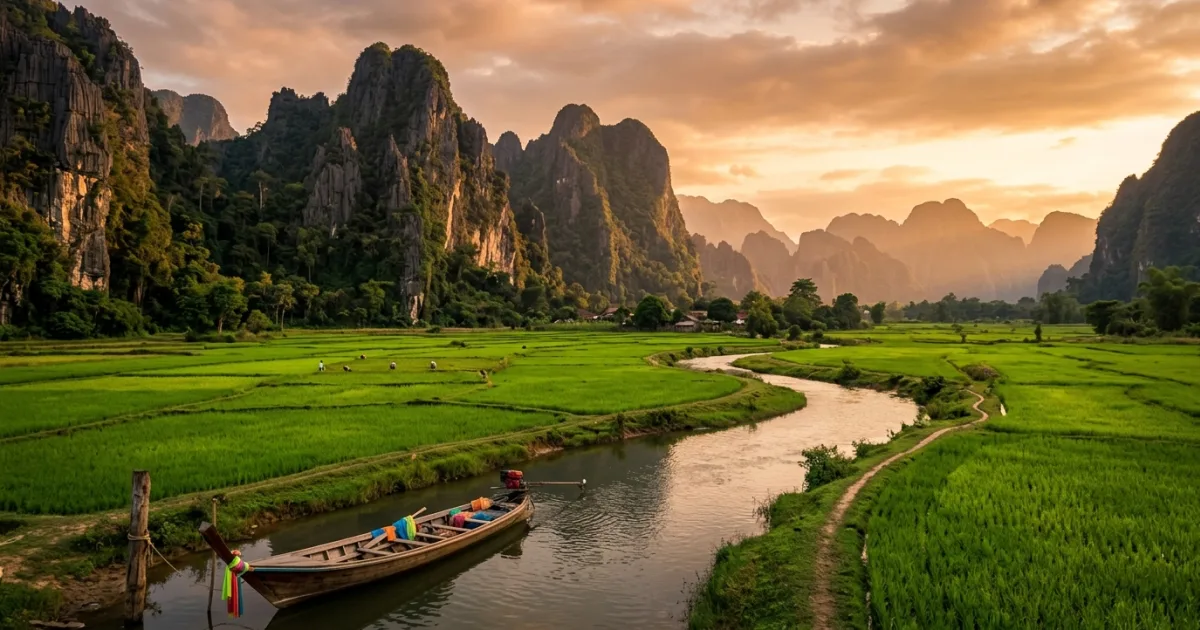
Central Laos spans a breathtaking geological corridor where millions of years of water erosion have sculpted jagged limestone massifs, hidden subterranean drainage networks, and vibrant emerald lagoons. The region primarily encompasses Khammouane and Bolikhamsai provinces, bordered by the Mekong River to the west and the forested Annamite Range to the east. Historically a quiet transit corridor along the Ho Chi Minh Trail network, it has emerged as Southeast Asia's premier destination for genuine, unpolished rural adventure travel.
Travelers base themselves in Thakhek, a sleepy colonial-era trading outpost on the Mekong opposite Nakhon Phanom, Thailand. From here, expeditions branch outward into the Phou Hin Poun National Protected Area and the Nam Theun reservoir basin. Along the routes, quiet communities of farmers cultivate rice paddies framed by steep rock walls, and world-class sport climbing thrives alongside sleepy village homestays. The slower pace of life, coupled with dramatic natural architecture, delivers an unforgettable immersion into authentic Indochina.
Reasons to Visit
- Navigate the 7.5-kilometer subterranean river of Kong Lor Cave aboard an unlit wooden longtail boat.
- Ride the Thakhek Loop, universally considered one of Southeast Asia's finest scenic motorcycling routes.
- Tackle limestone sport climbing routes on pristine overhangs at Green Climbers Home.
- Cool off in the crystal-clear turquoise waters of the natural spring at Tha Falang.
- Witness the stark beauty of the sunken ghost forest on the flooded Nam Theun reservoir near Thalang.
Things to Avoid
- Do not operate a motorcycle without full protective gear, sturdy closed-toe shoes, and comprehensive medical evacuation insurance.
- Avoid trekking off established trails in untamed backcountry areas due to remnant Unexploded Ordnance (UXO).
- Do not point the soles of your feet toward people or sacred Buddha statues inside revered cave sanctuaries.
- Avoid driving rural highways after dark, as road lighting is non-existent and unlit agricultural tractors are common.
Local Transportation Tips
Long-distance travel into Central Laos relies on air-conditioned VIP sleeper buses connecting Vientiane, Pakse, or Savannakhet with Thakhek. Within the region, semi-automatic 110cc-125cc motorcycles are the undisputed vehicle of choice for independent travelers tackling the loop, rented locally in Thakhek for roughly 150,000 to 200,000 LAK per day. For non-riders, private songthaews (modified pickup trucks with bench seating) or organized minivan tours can be chartered to specific attractions such as Kong Lor and Tham Nang Aen.
Travel Etiquette
- Dress conservatively when entering villages and sacred cave shrines by covering your shoulders and knees.
- Always remove your footwear before entering a Lao home, temple pavilion, or traditional guesthouse living area.
- Greet locals with a slight bow and hands pressed together at chest level in the traditional 'Nop' gesture.
- Never touch anyone on the top of the head, as it is considered the most sacred part of the physical body.
Recommended Age Group
Central Laos is tailored primarily toward energetic explorers with reasonable physical stamina and road confidence.
- Babies (0-2 years): Not Recommended. Infrastructure is basic, medical clinics are distant, and long distances on bumpy roads present significant discomfort for infants.
- Kids (3-12 years): Neutral. Children with adventure travel experience may enjoy boat rides and shallow swim holes, though long scooter rides and rugged trails prove challenging.
- Teens (13-19 years): Recommended. Older teenagers thrive on active outdoor pursuits like cavern exploring, swimming, rock climbing, and boat expeditions.
- Adults (20-64 years): Recommended. Perfect demographic for self-guided motorbike tours, world-class climbing, cave trekking, and budget-friendly exploration.
- Seniors (65+ years): Neutral. Independent motorcycling is not recommended, though active mature travelers booking private air-conditioned vehicles can enjoy the karst scenery and comfortable riverside stays.
Accessibility Level: Medium
- Uneven dirt pathways, loose gravel trails, and wooden gangplanks make limestone caves inaccessible to manual or motorized wheelchairs.
- Entering and exiting longtail boats at Kong Lor requires balance across slippery mud embankments and wet river rocks without handrails.
- Public songthaews and budget minivans lack hydraulic lifts, ramps, or dedicated secure wheelchair anchorage points.
- Travelers with restricted physical mobility should arrange private van transfers and base themselves in modern Thakhek riverside hotels with ground-floor accommodations.
Did You Know?
Kong Lor Cave acts as an essential navigable highway for local villagers. Before modern roads reached the remote valley of Hinboun, farmers loaded entire crops of tobacco, rice, and livestock into wooden dugout canoes and floated through the pitch-black 7.5-kilometer cave mountain tunnel to reach commercial markets on the opposite side.
Cool Statistics
- 7.5 km: The total continuous navigable length of the subterranean river inside Kong Lor Cave.
- 450 km: The approximate length of the classic Thakhek Loop motorcycle circuit.
- 100+ m: The vertical height of the cavern ceiling in the colossal chambers of Tham Pha Inh and Kong Lor.







Buy a compatible power adapter for your trip