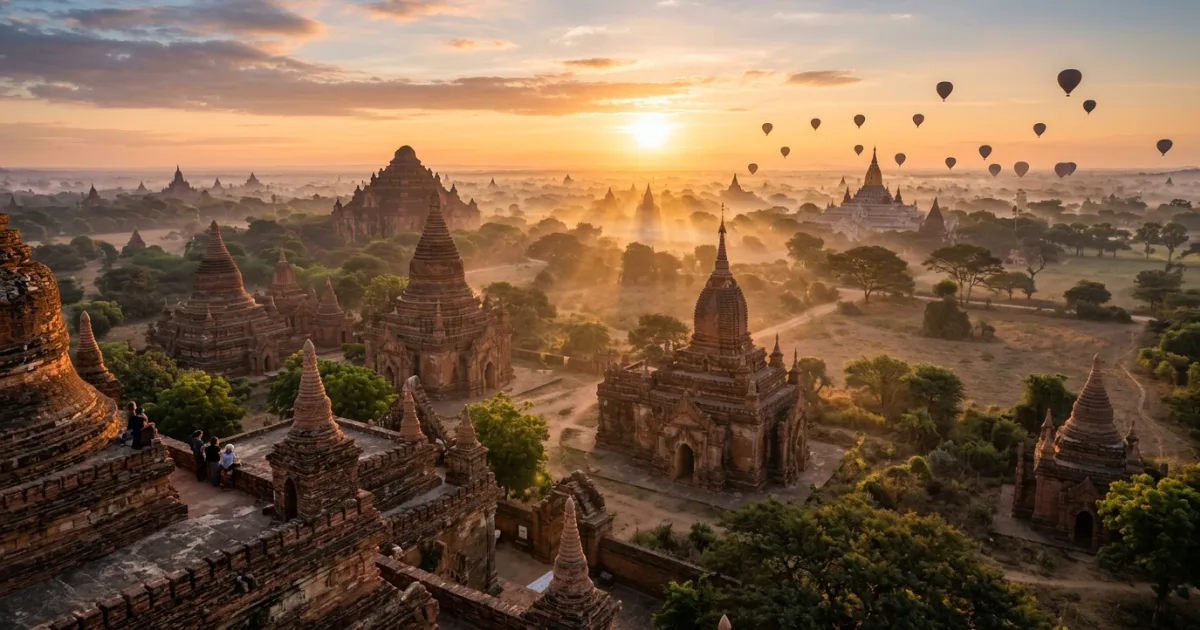
Bagan is one of the world's greatest archaeological wonders, rivaling Angkor in Cambodia and Borobudur in Indonesia. Between the 11th and 13th centuries, monarchs of the Pagan Empire constructed more than 10,000 religious monuments across this 104-square-kilometer river valley, creating a dense architectural testament to Theravada Buddhist devotion. Today, over 2,200 structures survive, ranging from massive gilded landmarks like the Shwezigon and Ananda Pagodas to secluded brick shrines half-hidden among acacia trees.
The region is geographically divided into three primary settlements: Nyaung-U to the north, which hosts the river jetty, highway bus terminal, and affordable hostels; Old Bagan to the southwest, situated within the ancient city walls alongside upscale riverfront resorts; and New Bagan further south, established in 1990, featuring boutique hotels, lacquerware workshops, and welcoming family restaurants. This layout allows travelers to balance historical exploration with tranquil village life.
Reasons to Visit
- Witness thousands of ancient Buddhist stupas rising through morning mist across the semi-arid plains.
- Experience silent, emission-free e-bike travel down unpaved tracks between remote 12th-century shrines.
- Observe master artisans crafting authentic bamboo and horsehair lacquerware using centuries-old natural pigment techniques.
- Sail along the Ayeyarwady River during golden hour on traditional wooden longtail boats.
- Marvel at remarkable fresco paintings and Mon-style architecture inside preserved interior temple sanctuaries.
Things to Avoid
- Do not wear shoes, sandals, or socks inside any temple compound; bare feet are strictly mandatory starting at the exterior threshold.
- Avoid climbing any stupas or brick walls, which incurs steep fines and degrades fragile historical architecture.
- Do not point your feet toward Buddha images or monks when sitting; tuck your legs beneath you respectfully.
- Avoid riding e-bikes without a helmet or after dark without functioning front lights on unpaved sandy trails.
- Do not buy genuine antique artifacts, as the removal of historical cultural property from Myanmar is illegal.
Local Transportation Tips
Independent travel in Bagan is dominated by silent electric scooters (e-bikes), which can be rented from almost every guesthouse and street corner in Nyaung-U and New Bagan. These bikes require no local license and have sufficient battery range for a full day of riding. For groups or travelers seeking shelter from daytime heat, hiring a private car with an experienced local driver is easily arranged. Traditional horse carts remain an atmospheric, slow-paced option, while passenger ferries connect Bagan to Mandalay along the Ayeyarwady River.
Travel Etiquette
- Dress conservatively at all times: shoulders and knees must be completely covered when entering religious sites.
- Always walk clockwise around Buddhist pagodas and stupas (pradaksina).
- Never touch anyone on the head, which is considered the highest and most sacred part of the body.
- Use your right hand (or support your right elbow with your left hand) when giving or receiving money and gifts.
- Ask permission before photographing local monks, nuns, or village residents.
Recommended Age Group
Bagan is a profound destination best suited for travelers who can comfortably handle hot weather, dusty outdoor trails, and active daily exploration.
- Babies (0-2 years): Not Recommended. Extreme daytime heat, unpaved sandy terrain unsuitable for strollers, and limited pediatric medical care make traveling with infants challenging.
- Kids (3-12 years): Neutral. Children interested in exploration will enjoy horse cart rides and river cruises, but long temple walks in bare feet across hot stones can cause fatigue quickly.
- Teens (13-19 years): Recommended. Independent e-bike riding, rich archaeological photography, and outdoor adventure make Bagan highly engaging for older youth.
- Adults (20-64 years): Recommended. The flexibility of independent scooter travel, world-class photography, and profound cultural immersion offer an unmatched travel experience.
- Seniors (65+ years): Neutral. While stair climbing is minimal at modern viewing mounds, dusty tracks, extreme heat, and bare-foot walking over uneven stone require steady mobility and heat tolerance; private car charters are recommended.
Accessibility Level: Medium
- Ancient temple compounds feature uneven stone floors, raised brick thresholds, and sandy approach paths that present significant challenges for standard wheelchairs.
- Modern viewing mounds have graded ramps in selected areas, but most remote monuments lack ramp infrastructure.
- Visitors with reduced mobility can arrange private air-conditioned vans to access ground-level viewpoints and well-paved sites like Shwezigon Pagoda.
- Upscale resorts in Old Bagan and New Bagan feature step-free ground-floor rooms and accessible dining pavilions.
Did You Know?
During its peak under King Anawrahta and his successors, Bagan was a cosmopolitan center for religious and secular studies, attracting scholars, monks, and architects from Ceylon, the Khmer Empire, and Northern India to study grammar, philosophy, astrology, and medicine.
Cool Statistics
- Over 2,200 standing religious monuments survive today from an estimated original total of more than 10,000 structures.
- The Bagan Archaeological Zone spans approximately 104 square kilometers (40 square miles).
- Bagan was officially inscribed as a UNESCO World Heritage site in July 2019 after decades of conservation efforts.






Buy a compatible power adapter for your trip