Mandalay represents the spiritual heart of Myanmar, where monastic life and artisanal heritage flourish alongside commercial enterprise. The city was founded in 1857 under the reign of King Mindon, serving as the final royal capital of the Burmese monarchy before British annexation. Centered around the grand walled fortress of Mandalay Palace, the city grid extends outward toward the Ayeyarwady (Irrawaddy) River, acting as an indispensable trading hub for Upper Myanmar.
Today, Mandalay is globally celebrated for its vast concentration of monasteries and pagodas, including the venerated Mahamuni Buddha Temple, clad in thick sheets of beaten gold. Encircling the city are the ancient capitals of Sagaing, Inwa, and Amarapura, making the region an unparalleled repository of classical Burmese architecture, traditional woodcarving, and monastic scholarship.
Reasons to Visit
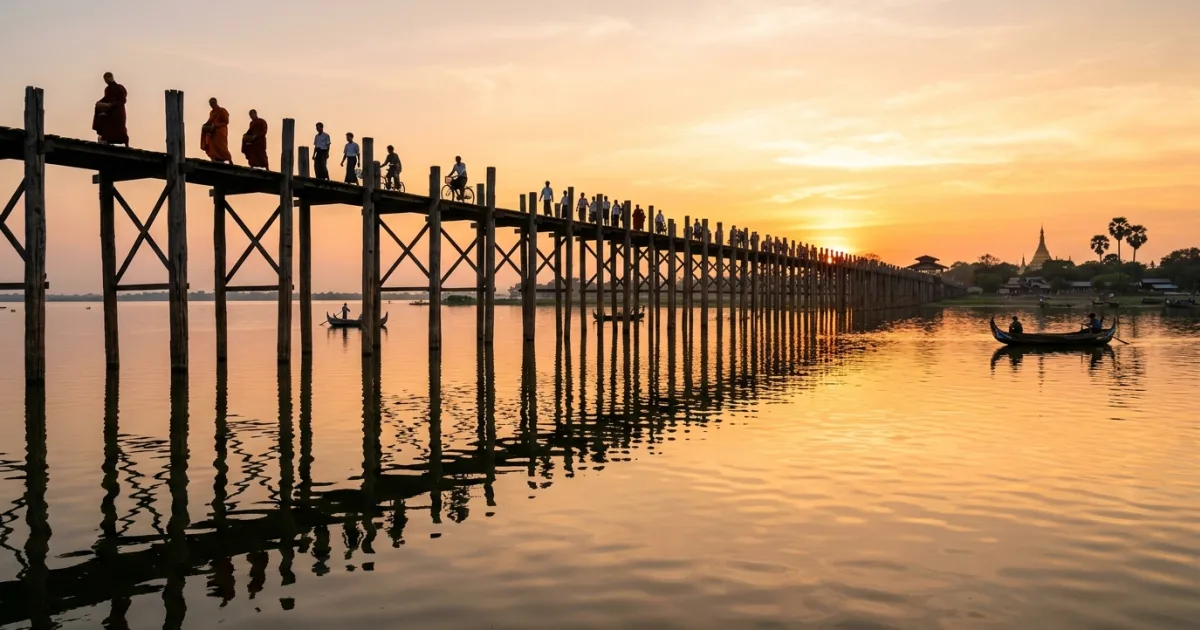
- U Bein Bridge: Walk across the world's longest and oldest teakwood footbridge during dramatic sunrise or sunset hours.
- Mahamuni Buddha Temple: Witness one of Myanmar's most revered Buddha images, encrusted in decades of applied gold leaf.
- Mandalay Hill: Climb the sheltered staircases past ancient shrines to experience 360-degree views over the royal city and river plains.
- Traditional Craft Quarters: Observe master craftspeople hand-beating gold leaf, carving pure white marble, and weaving silk longyis.
- Ancient Capitals: Take easy day trips to explore the serene monastic hills of Sagaing and the atmospheric ruins of Inwa.
Things to Avoid
- Avoid wearing footwear or socks into pagoda grounds, as this is strictly prohibited and offensive to local religious customs.
- Do not point your feet toward Buddha images, monks, or elders when seated on the floor.
- Avoid touching anyone on the top of the head, as the head is considered the spiritually highest part of the body.
- Do not travel outside standard urban borders or onto rural highways after dusk without verifying local security parameters.
Local Transportation Tips
Taxis, motorized three-wheelers (tuk-tuks), and motorcycle taxis serve as the primary means of navigating Mandalay. Ride-hailing apps operate in central districts, offering transparent pricing without the need for haggling. For full-day itineraries covering outer ancient towns like Sagaing and Amarapura, booking a private driver or car for the day offers the most reliable comfort.
Travel Etiquette
- Dress respectfully in all religious compounds by keeping shoulders and knees completely covered.
- Offer and accept items, money, or food with your right hand, resting your left hand lightly under your right forearm as a sign of respect.
- Treat Buddhist monks and nuns with high deference; do not sit higher than a monk, and women must never touch a monk or hand items directly to him.
- Ask permission politely before taking close-up portraits of local artisans, vendors, or monks.
Recommended Age Group
Mandalay provides meaningful historical and spiritual depth, though infrastructure and physical walking demands determine traveler comfort.
- Babies (0-2 years): Not Recommended. Uneven pavements, persistent tropical heat, and bare-foot temple walking create significant logistical hurdles with strollers.
- Kids (3-12 years): Neutral. Children with strong heat tolerance may enjoy boat rides and bridge walks, but extended pagoda visits can cause fatigue.
- Teens (13-19 years): Recommended. Older youth appreciate the dramatic photography spots, distinct culinary experiences, and rich royal history.
- Adults (20-64 years): Recommended. Excellent destination for culture seekers, history buffs, and travelers interested in traditional arts and Buddhism.
- Seniors (65+ years): Neutral. Rich in cultural rewards, but stairways at Mandalay Hill and bare-foot temple terrain can be challenging for those with limited mobility.
Accessibility Level: Medium
- Pagoda compounds feature wide marble courtyards, but bare-foot requirements and raised stone thresholds present obstacles for wheelchair users.
- Mandalay Hill features an elevator and escalator near the top terrace, though lower ascents rely on steep covered stairs.
- Urban footpaths are often uneven or blocked by parked motorbikes; private vehicle charters with door-to-door transit are strongly advised for mobility-impaired visitors.
Did You Know?
The Mahamuni Buddha image in Mandalay is covered in a layer of gold leaf estimated to be over 15 centimeters (6 inches) thick, applied day after day by devout male pilgrims over centuries, noticeably altering the original contours of the statue.
Cool Statistics
- 1,200 meters: The length of U Bein Bridge, supported by over 1,000 teakwood posts across Taungthaman Lake.
- 240 meters: The elevation of Mandalay Hill above the surrounding river plains.
- 1857: The year King Mindon founded the royal city of Mandalay to fulfill a Buddhist prophecy.
- 729: The number of marble slabs at Kuthodaw Pagoda, collectively recognized as the 'World's Largest Book'.






Buy a compatible power adapter for your trip