Disclosure: This site contains affiliate links. We may earn a commission if you make a purchase, at no extra cost to you.

Golden Shwemawdaw Pagoda towering over the temple courtyards in Bago Myanmar at sunrise

Bago Overview & Key Highlights

Bago, historically known as Hanthawaddy, serves as a monumental repository of Mon and Burmese imperial history situated roughly 80 kilometers northeast of Yangon. Founded in the sixth century, the city flourished as the grand maritime capital of the Hanthawaddy Kingdom and King Bayinnaung's Second Burmese Empire. Travelers arrive primarily to encounter colossal Buddhist monuments, including the towering Shwemawdaw Pagoda, which rises higher than Yangon's Shwedagon, and the monumental reclining Buddha figures of Shwethalyaung and Mya Tha Lyaung. Beyond its gilded spires, Bago provides a direct look into ancient Mon architectural innovation and royal court legacy at the reconstructed Kanbawzathadi Golden Palace. While modern Bago functions as an energetic commercial thoroughfare along the Yangon-Mandalay highway, its religious enclaves remain quiet centers of active monastic study, notably at the sprawling Kya Kha Wain Monastery. The city is ideal as an intensive cultural day trip from Yangon or a relaxed base for deeper historical exploration into Lower Myanmar.

Bago Travel Guide: Logistics & In-Depth Tips

Bago stands as one of the most culturally significant historic centers in Lower Myanmar. Formerly celebrated under the Mon name Hanthawaddy (Pegu), the city served as an empire capital across several distinct golden eras, notably dominating sixteenth-century trade across Southeast Asia. Its wide landscape is punctuated by architectural marvels that reflect centuries of religious devotion and imperial supremacy, from the sky-piercing Shwemawdaw Pagoda to quiet brick monasteries nestled along shady rural laneways.

Today, visitors navigate a destination caught gracefully between functioning agricultural market town and outdoor open-air museum. Exploring Bago involves moving between towering open-air Buddha images, reconstructed royal halls made of teak, and peaceful monastic dining quarters where hundreds of monks walk in silent morning procession. With its proximity to Yangon, Bago delivers an immediate transition from metropolitan bustle to the deep historical and spiritual traditions of Myanmar's heartland.

Reasons to Visit

  • Witness Shwemawdaw Pagoda, whose spire stands at 114 meters—taller than Yangon's Shwedagon Pagoda.
  • Marvel at the massive 55-meter-long Shwethalyaung reclining Buddha, renowned as one of Southeast Asia's most lifelike depictions.
  • Explore the reconstructed royal grandeur of Kanbawzathadi Palace, original seat of King Bayinnaung's sixteenth-century empire.
  • Experience Kyaik Pun Pagoda, featuring four back-to-back colossal seated Buddhas facing the cardinal points.
  • Observe the disciplined morning alms procession at Kya Kha Wain Monastery, one of the country's premier teaching centers.

Things to Avoid

  • Avoid wearing shorts, sleeveless shirts, or revealing tops at any temple or monastic compound.
  • Do not point the soles of your feet toward Buddha images or revered monks when seated.
  • Avoid touching anyone on the head, which is regarded culturally as the most sacred part of the body.
  • Do not drink municipal or unfiltered tap water; stick exclusively to certified bottled water brands.
  • Avoid scheduling visits during the peak heat hours of 12:00 PM to 3:00 PM when pagoda tiles become painfully hot for barefoot walking.

Local Transportation Tips

Navigating Bago requires mechanized transport due to the significant geographical spread between major archaeological attractions. The most convenient method is hiring a local three-wheeled motorized rickshaw (tuk-tuk) or a private motorbike taxi for a half-day or full-day arrangement. Standard full-day driver hires cost between 30,000 and 45,000 MMK. Shared pickup trucks (songthaews) run linear routes along the main Yangon-Mandalay arterial road for negligible sums, though routes rarely divert to specific monument gates.

Travel Etiquette

  • Always remove shoes, sandals, and socks at the outer entrance archways of all religious complexes.
  • Use your right hand (supported under the elbow by your left) when handing money, gifts, or documents to locals.
  • Speak in quiet, respectful tones within pagoda meditation halls and monastery grounds.
  • Always walk clockwise around Buddhist stupas, shrines, and relics.
  • Ask for permission prior to taking close-up portraits of monks, nuns, or community elders.

Recommended Age Group

Bago is best suited for independent adult travelers, history enthusiasts, and culturally focused explorers who can manage outdoor heat and irregular walking surfaces.

  • Babies (0-2 years): Not Recommended. Intense humidity, hot barefoot walking grounds, and uneven terrain make managing strollers and infants impractical.
  • Kids (3-12 years): Neutral. Children may appreciate the scale of giant Buddha statues, but long days of quiet temple visiting can prove tiring without play facilities.
  • Teens (13-19 years): Recommended. Teenagers with an appreciation for photography, ancient history, and distinctive cultural customs will find Bago educational and intriguing.
  • Adults (20-64 years): Recommended. Highly rewarding for culture seekers, history buffs, and solo backpackers interested in Southeast Asian heritage.
  • Seniors (65+ years): Neutral. Demands considerable stamina due to hot weather, lack of handrails, and mandatory barefoot walking across large stone courtyards.

Accessibility Level: Medium

  • Most historic pagodas require visitors to navigate flights of stone or concrete stairs without ramps.
  • Barefoot mandates at all sacred monuments mean visitors cannot use standard footwear or supportive orthotics inside precincts.
  • Pedestrian pavements throughout central Bago are uneven, narrow, or obstructed by street stalls.
  • Hiring a private car with driver provides the most comfortable transit option for travelers with mild mobility challenges.

Did You Know?

The Shwemawdaw Pagoda has been toppled and reconstructed several times due to catastrophic earthquakes throughout history. During the massive 1930 temblor, the spire broke off completely; a massive brick fragment of that fallen crown was deliberately preserved and cemented directly into the current stupa wall as a monument to resilience.

Cool Statistics

  • 114 meters: The towering height of Shwemawdaw Pagoda, making it the tallest stupa in Myanmar.
  • 55 meters: The total length of the historic Shwethalyaung Reclining Buddha image.
  • 1556: The year King Bayinnaung established his legendary Kanbawzathadi Palace complex in Bago.
  • 80 kilometers: The transit distance between central Yangon and the historic gates of Bago.

Address:

Bago, Myanmar

Find Nearby Accommodations

Basic Info

address icon

COUNTRY & Region

Myanmar,
Asia

ACCESSIBILITY LEVEL​

Medium
Currency icon

LOCAL CURRENCY​

Myanmar Kyat (MMK)
Price level icon
Low
Safety Level icon

SAFETY LEVEL

Duration icon

Recommended Duration

• Full day
• 1-7 days

Electricity

electricity icon

Electricity

220-240V, 
50Hz
Plug Socket icon

Plug Type

• Type C (Round pin)
• Type D (Three round pins in a triangular pattern)
• Type F (Two round pins with earth clips)
• Type G (Three rectangular pins in a triangular pattern)
Plug types
Click To View Plug Types

Activities To Do In Bago

Best Time To Visit Bago

Bago experiences a tropical monsoon climate characterized by three distinct seasons: cool/dry, hot, and wet.

  • November to February (Cool & Dry Season): The best time to visit, featuring lower humidity, minimal rainfall, and daytime temperatures around 28°C to 31°C.
  • March to May (Hot Season): Temperatures consistently exceed 37°C to 40°C, making midday temple touring demanding and barefoot pagoda visits scalding.
  • June to October (Monsoon Season): Heavy rainfall and elevated humidity levels prevail; outdoor photography can be disrupted, though regional landscapes turn lush green.

Average Temperatures Per Month

Remember to check the weather forecast a few days before the trip and before heading to the airport.

Safety Level icon

Safety Level

Bago experiences relatively low rates of violent street crime against visitors, but travelers must remain alert to regional political instability and security regulations across Myanmar. Stay informed on regional travel advisories and curfews issued by local authorities. Drink only sealed bottled water and avoid tap water or unpeeled raw produce. Watch out for uneven brick pathways and broken concrete pavements around older ruin complexes.

The rating is based on multi-year peace, crime, and security indices. Before you go, always verify current conditions through official government travel advisories.

Emergency Numbers

Police: 199
Ambulance: 192

No internet needed • Includes local translations • Free for TravelingWiz readers

Spoken Languages

Burmese, Mon, basic tourist English

Learn The Language

  • Mingalaba – Hello (formal greeting)
  • Kyei-zu tin-ba-de – Thank you
  • Ho de – Yes
  • Ma-ho bu – No
  • Di-ha bale-lout le? – How much is this?
  • Kyei-zu-pyu-ywe – Please
  • Bago boke ka be-hma le? – Where is the station?
  • Htauk-hpa-hpa lote-ba – Help!
Travel Booking Partner - TravelingWiz

Trip Cost & Budgeting for Bago, 2026

Everything you need to know about money while traveling
Is Bago expensive for tourists in 2026? No, Bago remains an exceptionally affordable destination for international travelers. Expect to pay around 4,500 MMK for a cappuccino, 3,500 MMK for a domestic beer, and 12,000 MMK for a standard restaurant meal. With our Human Verified prices, visiting ancient pagodas and dining locally requires very little spending. Use the data table below to calculate your specific daily budget based on your travel style.
Currency icon

LOCAL CURRENCY​:

Myanmar Kyat (MMK)
Price level icon
Low
Credit cards are rarely accepted in Bago, making cash in local Kyat and pristine US dollars essential.

Per person, per day – pocket cash for small purchases.

Local: 9500
Myanmar Kyat (MMK)
≈ 15 USD

Full daily spend estimation (accommodation, food, transportation, attractions).

Travel Style
Myanmar Kyat (MMK)
≈ USD ($)
Budget
52250
15
Mid-range
95000
32
Comfort
209000
70

The Prices, Daily costs, and calculator results are estimates for planning purposes only. Actual costs may vary based on season, booking timing, personal spending habits, and currency fluctuations. TravelingWiz cannot be held responsible for discrepancies between these estimates and your final trip expenses.

  • • Dine at traditional tea shops and local beer stations for authentic meals at a fraction of hotel restaurant prices.
  • • Hire a local tuk-tuk or motorbike taxi for whole-day sightseeing tours around key pagodas instead of private cars.
  • • Bring clean, unblemished US dollar bills in cash to exchange locally as ATMs can be unreliable.
  • • Plan your visits to major temples together to maximize value on regional entry zone permits.

Pre-Order Tickets

Avoid disappointment when tickets sell out — and skip the long lines by booking online in advance. You’ll often save up to 20% too.
Save up to 20%

Travel Discounts & Coupons

Save on hotels, attractions, transport, and gear — find verified discounts for smarter travel spending.
Verified Coupons

What To Pack

  • Modest clothing covering shoulders and knees for temple entry (longyis or lightweight linen trousers)
  • Slip-on shoes or flip-flops for frequent barefoot entry at religious sites
  • Wet wipes and travel towels to clean feet after walking on outdoor pagoda marble
  • High-protection sunscreen, wide-brimmed hat, and polarized sunglasses for sun glare
  • Personal hand sanitizer and mosquito repellent containing DEET
  • Compact umbrella for unexpected rain or shade against intense midday heat
  • Lightweight cotton scarf for covering shoulders or temple dust protection
  • Sufficient cash in clean, uncreased US dollars or crisp Myanmar Kyat
We couldn't find tips for Bago.
If you got any, please share

Recommended Itineraries for Traveling to Bago

We couldn't find itineraries for Bago.
you can contact us for custom trip plan

Food & Drink Highlights

Local Food Overview

Dining in Bago reflects classical Mon culinary heritage alongside Burmese staples. Meals typically center on rice surrounded by an assortment of oil-based curries containing freshwater fish, prawns, chicken, or mutton. These are invariably complemented by 'ngapi yay' (a fermented fish sauce dip) accompanied by an abundant platter of fresh, boiled, and bitter vegetables known as 'to-zaya'. Mon cuisine is distinct for its balanced inclusion of sour notes derived from tamarind leaves and subtle lemongrass seasoning. Roadside stalls and morning teahouses offer quick staples such as steaming bowls of Mohinga, coconut milk noodles (Ohn No Khao Swe), and freshly fried lentil fritters paired with strong sweet milk tea.
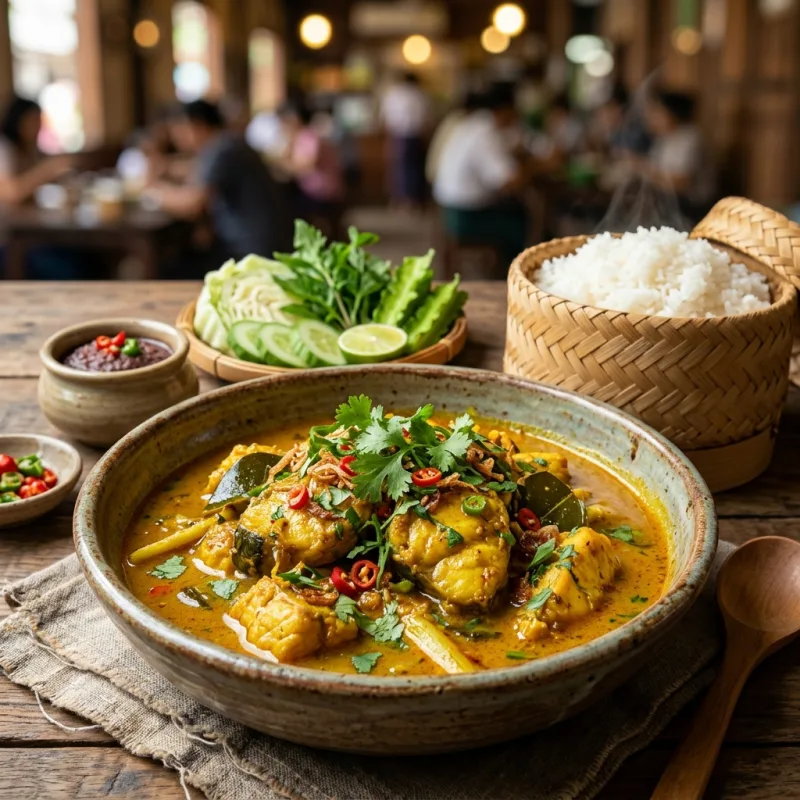
Authentic Mon-style fish curry served with white rice and fresh herbs in Bago

Must Try Dish

Mon-style Fish Curry - Tender freshwater river fish simmered slowly in an aromatic paste of shallots, garlic, turmeric, and sour tamarind sauce. This fragrant dish balances gentle sourness with savory umami and is traditionally accompanied by bowls of steamed jasmine rice and fresh herbs.
Food Experiences Title Icon

Food
Experiences

Discover cooking classes, tastings and local food tours

No food experience found
Maya, the human travel expert at TravelingWiz, offering curated, non-AI expertise

Maya’s Final Checklist for Bago

Logistics shouldn’t be the focus of your trip—the experience should. I’ve hand-vetted these essential partners to ensure your arrival, stay, and exploration are as smooth as an Athenian breeze.

Where to Stay

From boutique hotels to local apartments—compare thousands of options and find the perfect stay in the best neighborhood.

Air Travel

Getting there should be seamless. Compare the best routes and prices across top airlines to start your journey on the right note.

Local Guides

Connect with experts who know the destination best. Get personalized advice and insider tips to help you plan your perfect trip.

Travel Protection

The “Engineer’s” rule: always have a backup. Secure your trip with a plan that covers every “what if” and unexpected change.

Car Rentals

Explore at your own pace with total freedom. Compare reliable rental options and find the right vehicle for your adventure.

Visa Services

Don’t let paperwork slow you down. Get expert assistance with your application to ensure all your entry documents are in order.

FAQs

Yes, Bago is situated approximately 80 kilometers northeast of Yangon, making it an easy day trip taking 2 to 2.5 hours each way by private taxi or morning express bus.
You must dress respectfully by keeping shoulders and knees completely covered. All footwear, including socks, must be removed before entering temple compounds.
The zone ticket covers major historical monuments such as the Shwethalyaung Buddha and Kanbawzathadi Palace, though some active pagodas may request separate minor maintenance donations.
The most practical method is to hire an auto-rickshaw or motorbike taxi for the day, as attractions are spread across a wide perimeter outside walkable distance.
While banks and ATMs exist along the main road, service interruptions and card rejections can occur. It is highly advisable to withdraw sufficient Myanmar Kyat in Yangon prior to visiting.

Your Insights Matter

TravelingWiz grows through the stories of our community. If you’ve recently explored ,Bago share your tips and stories to help us perfect our guides for the next traveler.

Related Articles

Check out our related articles and blog posts to learn even more about the destination.

No related articles found

Don’t Travel Alone

Share with your friends and family

Where should we send your offline card?

We hate spam just as much as you do

newsletter_consent *