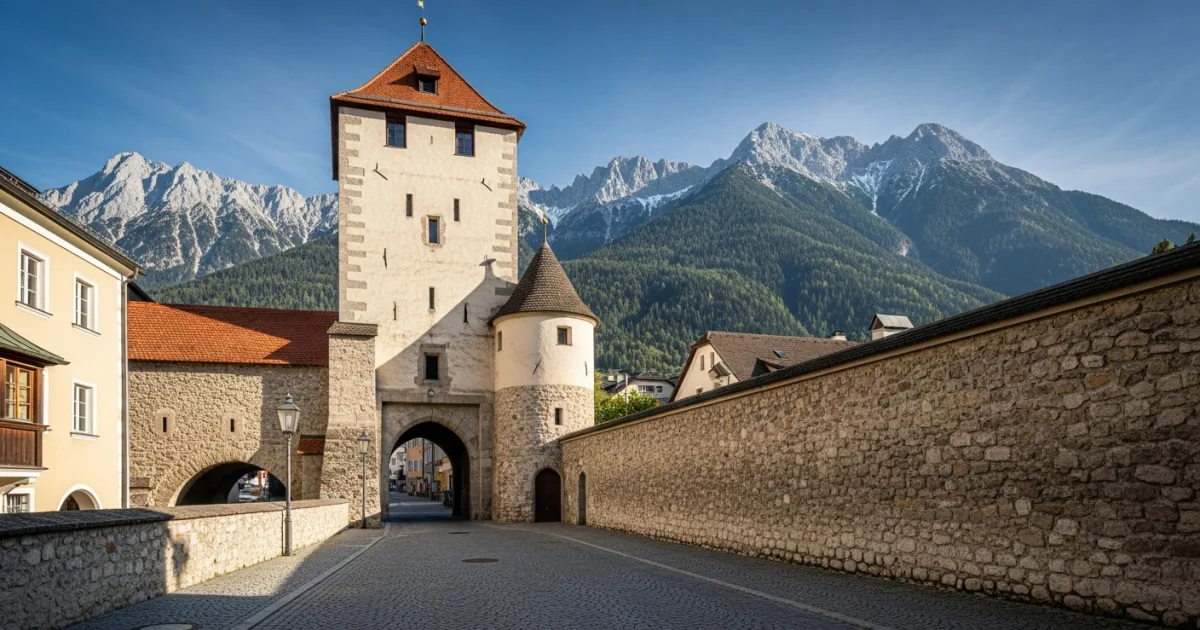
The Münzertor is more than just a beautiful piece of medieval architecture; it is a symbol of the immense wealth and power that Hall in Tirol wielded during the Middle Ages. Built to protect the town's most valuable asset—the silver mint—the gate was heavily fortified. The mint itself was relocated to Burg Hasegg in the 15th century by Archduke Sigismund the Rich in Coin, transforming the immediate area around the gate into a high-security zone of the era.
Today, walking through the Münzertor transports visitors back to a time when the rhythmic striking of coins echoed through the streets. The gate seamlessly connects the modern world to the meticulously preserved Altstadt, where narrow alleys, frescoed facades, and historic squares await. It stands as a proud testament to the town's legacy as the birthplace of the Thaler, the silver coin that set the standard for European currency and eventually lent its name to the US Dollar.
Reasons to Visit
- Architectural Beauty: Admire the robust medieval stonework and the iconic tower that forms a classic Tyrolean postcard view.
- Historical Significance: Stand at the entrance of the complex where the first high-quality silver Thalers were minted.
- Gateway to the Altstadt: Use it as the perfect starting point to explore one of Austria's largest and most intact medieval old towns.
- Photography: Capture stunning images of the gate framed by the majestic Karwendel mountain range.
Things to Avoid
- Rushing the Visit: Don't just snap a photo and leave; take the time to explore the adjacent Burg Hasegg and the Mint Museum.
- Inappropriate Footwear: Avoid high heels or thin-soled shoes, as the cobblestones in and around the gate can be unforgiving.
- Driving into the Altstadt: Avoid trying to drive through the old town; park in the designated lots outside the historic center and walk to the gate.
Local Transportation Tips
Hall in Tirol is highly walkable, and the best way to experience the Münzertor and the surrounding Altstadt is on foot. If you are arriving from outside the town, the local train station (Bahnhof Hall in Tirol) is just a 10-minute walk away. Regional buses also stop near the historic center. For those driving, there are several paid parking garages located just outside the pedestrian zones of the old town.
Travel Etiquette
- Respect the Residents: While it is a historic site, the Altstadt is a living neighborhood. Keep noise levels reasonable, especially in the early morning or late evening.
- Photography Rules: You are free to photograph the exterior of the gate, but be mindful not to block the pathway for locals and other tourists.
- Greeting: It is polite to greet shopkeepers and locals with a friendly 'Grüß Gott' or 'Guten Tag' when entering nearby establishments.
Recommended Age Group
The Münzertor and its surrounding historical complex offer an engaging experience for a wide range of visitors.
- Babies (0-2 years): Neutral. The gate is easy to pass through, but the surrounding cobblestones can make stroller navigation slightly bumpy.
- Kids (3-12 years): Recommended. Children are often fascinated by the castle-like appearance of the gate and the interactive exhibits in the nearby Mint Museum.
- Teens (13-19 years): Recommended. The connection to the origin of the US Dollar provides a cool historical hook, and the architecture is highly photogenic for social media.
- Adults (20-64 years): Recommended. Adults will appreciate the deep historical context, the preservation of the architecture, and the charming cafes nearby.
- Seniors (65+ years): Recommended. The area is relatively flat, making it accessible for walking, and the rich history is highly engaging for mature travelers.
Accessibility Level: Medium
- Mobility Access: The archway of the Münzertor is wide and flat, allowing easy passage for wheelchairs and mobility scooters.
- Surface Texture: Be aware that the ground is paved with historic cobblestones, which may cause vibrations for wheelchair users.
- Nearby Facilities: The adjacent Münze Hall museum has been updated to include elevators and accessible restrooms for visitors.
Did You Know?
Did you know that the word 'Dollar' originates right here? The silver coins minted at the complex attached to the Münzertor were called 'Thalers' (short for Joachimsthaler). The widespread use and reliability of the Thaler led to the name being adapted into various languages, eventually becoming 'Dollar' in English.
Cool Statistics
- Construction Era: The current structure of the gate and adjacent fortifications dates back primarily to the 15th century.
- Coin Production: At its peak, the Hall mint produced up to 30,000 silver coins per day using innovative roller coining machines.
- Town Size: Hall in Tirol's Altstadt, accessed via this gate, is actually larger than the old town of the neighboring capital, Innsbruck.






Buy a compatible power adapter for your trip