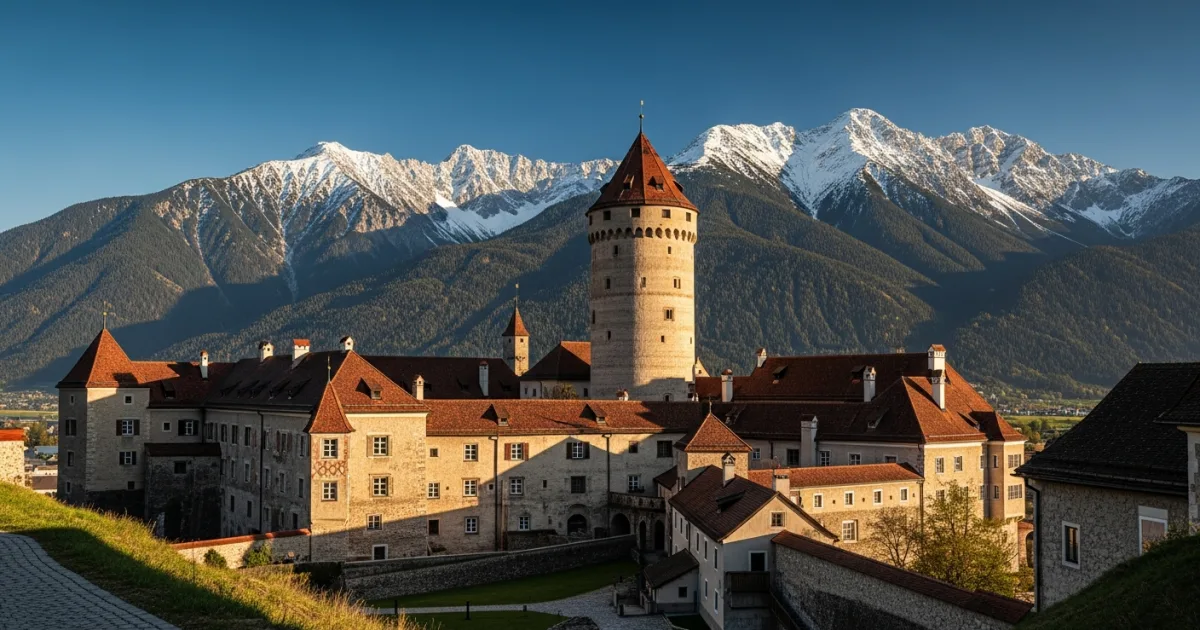
Hasegg Castle (Burg Hasegg) was originally built to protect the salt mines, the river traffic on the Inn, and the old bridge. Its transformation into a minting powerhouse began in the 15th century. Archduke Sigismund 'the Coin-Rich' moved the mint from Meran to Hall, capitalizing on the nearby silver mines in Schwaz. This move revolutionized European currency, leading to the creation of the first high-value silver coin, the Guldiner, which eventually evolved into the Thaler—the linguistic ancestor of the Dollar.
Today, the castle complex is a beautifully preserved piece of Tyrolean history. The Mint Museum utilizes modern audio guides and interactive displays to bring the history of coin making to life. The highlight for many is the Münzerturm (Mint Tower), a 15th-century cylindrical tower that dominates the town's skyline. Climbing its stairs rewards visitors with sweeping views of the Karwendel mountain range and the intricate rooftops of Hall's medieval Old Town.
Reasons to Visit
- Experience the birthplace of the Thaler, the coin that gave the US Dollar its name.
- Climb the iconic Mint Tower for unparalleled 360-degree views of the Tyrolean Alps.
- Engage with interactive exhibits, including the chance to strike your own souvenir coin.
- Explore one of Austria's best-preserved medieval towns, Hall in Tirol, right outside the castle gates.
- View the world's largest silver coin, the Europe Taler, weighing over 20 kilograms.
Things to Avoid
- Avoid visiting on Mondays during the off-season, as the museum and tower may be closed.
- Do not attempt the tower climb if you have severe mobility issues or claustrophobia, as the stairs are narrow.
- Avoid driving directly into the narrow streets of the Old Town; use the designated parking garages nearby.
Local Transportation Tips
Hall in Tirol is highly accessible via public transportation. Regular ÖBB trains run from Innsbruck Hauptbahnhof to Hall in Tirol station, taking about 10 minutes. From the station, Hasegg Castle is a short, scenic 10-minute walk. Alternatively, regional buses (like line 504) connect Innsbruck directly to the center of Hall. If driving, the 'Münzerpark' underground parking garage is conveniently located just steps from the castle entrance.
Travel Etiquette
- Respect the historic artifacts; do not touch museum displays unless they are explicitly marked as interactive.
- Keep noise levels down inside the museum to allow others to hear their audio guides.
- When climbing the tower, yield to visitors descending the narrow staircases.
- Greet shopkeepers and museum staff with a polite 'Grüß Gott' or 'Hallo' upon entering.
Recommended Age Group
Hasegg Castle offers a fascinating historical experience that appeals to a wide range of ages, though the physical layout presents some limitations.
- Babies (0-2 years): Neutral. The ground floor museum is accessible, but strollers cannot be taken up the Mint Tower. A baby carrier is required for the stairs.
- Kids (3-12 years): Recommended. Children love the interactive elements, especially the opportunity to mint their own coin and explore a real medieval castle.
- Teens (13-19 years): Recommended. The connection between the local Thaler and the modern Dollar provides engaging historical context, and the tower offers great photo opportunities.
- Adults (20-64 years): Recommended. Adults will appreciate the deep dive into European economic history, the architectural preservation, and the stunning alpine views.
- Seniors (65+ years): Recommended. The museum exhibits are highly informative and accessible. However, seniors with mobility issues should skip the tower climb and enjoy the ground-level attractions.
Accessibility Level: Medium
- The Hall Mint Museum on the ground floor is fully accessible for wheelchair users.
- Accessible restrooms are available within the museum complex.
- The Mint Tower is not accessible for wheelchairs or those with severe mobility impairments due to the historic, narrow, and steep staircases.
- Audio guides are provided, which are helpful for visitors with visual impairments, though tactile exhibits are limited.
Did You Know?
The word 'Dollar' originates from the coins minted right here in the region. The large silver coins were called 'Joachimsthalers' (from a nearby valley), which was later shortened to 'Thaler', eventually morphing into 'Dollar' in English.
Cool Statistics
- Year the mint was relocated to Hasegg Castle: 1477.
- Number of steps to the top of the Mint Tower: 186.
- Weight of the world's largest silver coin on display: 20.14 kg.
- Diameter of the Europe Taler: 36 cm.






Buy a compatible power adapter for your trip