Haute-Corse forms the northern administrative department of the island of Corsica, distinguished by sheer vertical topography that tumbles directly into the deep blue Mediterranean. Unlike the rolling granite hills of the south, the northern landscape features the dramatic schist backbone of Cap Corse, the vast limestone enclave around Saint-Florent, and the highest peak on the island, Monte Cinto, standing at 2,706 meters. Bastia, the economic pulse of the north, greets arrivals with Italianate facades, baroque oratories, and a bustling Vieux Port.
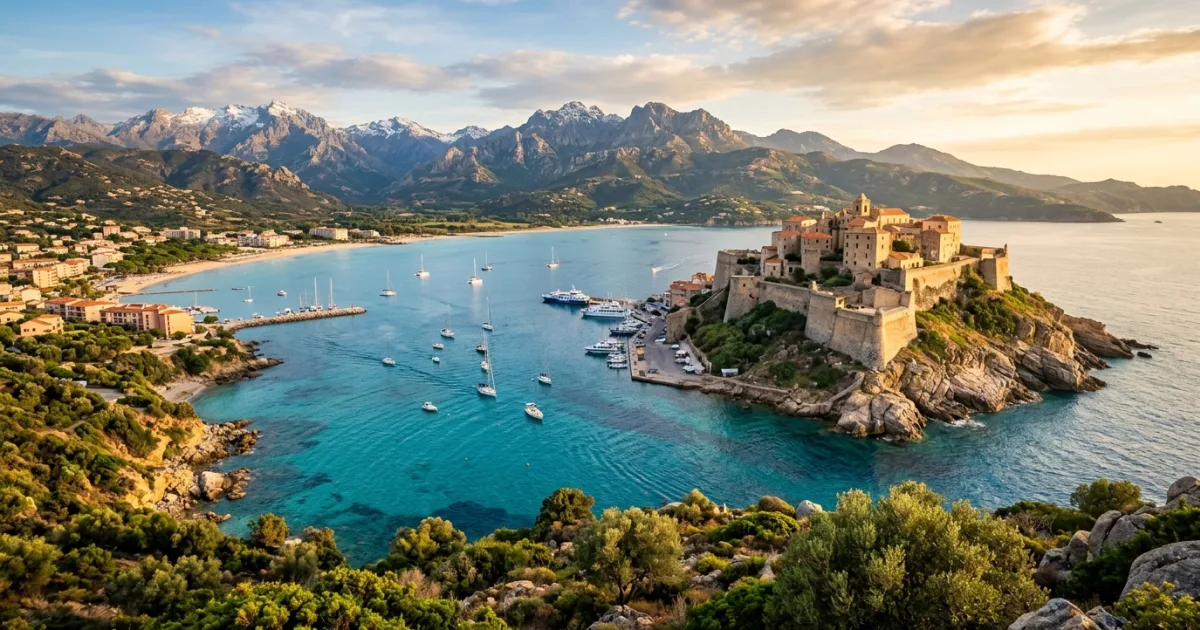
Venture inland to find Corte, the historic heart of Corsican independence led by Pasquale Paoli in the 18th century, set against the towering background of the Restonica and Tavignano valleys. To the west, the Balagne region—often called the garden of Corsica—showcases hilltop villages like Sant'Antonino and Pigna looking down over olive groves toward the dramatic bay and citadel of Calvi. Haute-Corse balances intense natural wilderness with distinct cultural pride, reflected in polyphonic choral music, deep-seated culinary traditions, and rugged outdoor recreation.
Reasons to Visit
- The Cap Corse Peninsula: A dramatic 110-kilometer coastal loop featuring precipitous cliffs, Genoese defense towers, and historic fishing hamlets like Erbalunga and Centuri.
- Citadel of Calvi: A 13th-century fortified stronghold towering above crescent sandy beaches and turquoise waters, steeped in naval history.
- Corte and Mountain Valleys: The historic inland university town providing immediate trail access to the emerald swimming basins of the Gorges de la Restonica.
- Patrimonio Wine Route: The island's oldest AOC wine region, renowned for full-bodied red Nielluccio and refreshing white Vermentino grown in limestone-rich soils.
- Désert des Agriates: An uninhabited protected wilderness of scrubland framing world-class white sand beaches including Plage de Saleccia and Plage du Lotu.
Things to Avoid
- Avoid planning tight travel itineraries based solely on distance; mountain roads with switchbacks make 50 kilometers take up to two hours.
- Avoid parking beneath dried pine trees or discarding cigarettes anywhere outdoors, as forest fire risks are severe during hot, dry summer months.
- Do not attempt to hike the alpine sections of the GR20 without appropriate gear, topographical maps, and reliable weather monitoring.
- Avoid leaving belongings visible in parked cars at isolated trailheads or remote beach parking areas.
- Do not honk aggressively at livestock on rural roads; wait patiently or maneuver past slowly with caution.
Local Transportation Tips
Public transportation in Haute-Corse is limited but offers unforgettable scenery. The regional train service, affectionately called 'U Trinicellu' (The Little Train), operates on narrow-gauge tracks running from Bastia through the mountains to Corte, with a connecting branch leading to L'Île-Rousse and Calvi along coastal tracks. Regional buses run periodically between major cities like Bastia, Calvi, and Saint-Florent, but schedules are infrequent, especially on weekends and outside peak summer. For full autonomy to access remote mountain passes, hidden auberges, and Cap Corse coves, hiring a compact car at Bastia Poretta Airport or Calvi Sainte-Catherine Airport is highly recommended.
Travel Etiquette
- Always greet shopkeepers, cafe owners, and bus drivers with a polite 'Bonjour' or 'Bonsoir' upon entering and 'Merci, au revoir' upon leaving.
- Show respect for regional culture and identity; Corsicans value their distinct heritage, so avoid comparing local customs negatively to mainland France.
- Adhere strictly to Leave No Trace principles when exploring nature reserves; wild camping outside designated camping grounds is strictly forbidden by law.
- When encountering free-roaming cows or wild pigs along the roadway, maintain distance and avoid feeding them to prevent dangerous interactions.
Recommended Age Group
Haute-Corse accommodates adventurous travelers of diverse generations, though its steep terrain and winding road network cater best to active adults and teenagers.
- Babies (0-2 years): Neutral. Narrow cobblestone streets and mountain switchbacks can make stroller travel difficult, though seaside resorts near Calvi offer gentle beach access.
- Kids (3-12 years): Neutral. Children enjoy the sandy beaches of Balagne and rides on the scenic narrow-gauge train, but long driving times between remote valleys can be challenging.
- Teens (13-19 years): Recommended. Ideal for active teens who enjoy sea kayaking, canyoning, rock climbing, and exploring fortified coastal citadels.
- Adults (20-64 years): Recommended. Perfect for scenic road trips, strenuous high-altitude hiking, coastal trails, wine tasting, and authentic culinary immersion.
- Seniors (65+ years): Neutral. Older travelers who enjoy relaxed coastal drives, historic towns, and vineyard tours will love the region, provided they are comfortable navigating stairs and uneven stone surfaces.
Accessibility Level: Medium
- Historic citadels in Calvi and Corte feature steep grades, rough cobblestones, and extensive stone stairs, presenting substantial barriers for manual wheelchair users.
- Harbor promenades and port zones in Bastia and Saint-Florent feature paved, level surfaces suitable for visitors with reduced mobility.
- Specially adapted beach access ramps and amphibious beach chairs (Tiralo) are available during peak summer months at select municipal beaches in Calvi and L'Île-Rousse.
- Regional trains operated by CFC offer limited accessibility features; travelers requiring ramp assistance should coordinate with stations in advance.
Did You Know?
The village of Nonza on the western shore of Cap Corse is famous for its striking black pebble beach, created not by volcanic activity, but from the inert stone tailings of an abandoned asbestos quarry that operated nearby until 1965.
Cool Statistics
- Haute-Corse encompasses Monte Cinto, the island's tallest mountain, reaching an elevation of 2,706 meters (8,878 feet).
- The Agriates Desert spans roughly 15,000 hectares of completely uninhabited Mediterranean coastal maquis.
- Over 60 historic Genoese watchtowers still stand along the rugged coastline of Corsica, built between the 16th and 18th centuries to guard against pirate raids.






Buy a compatible power adapter for your trip