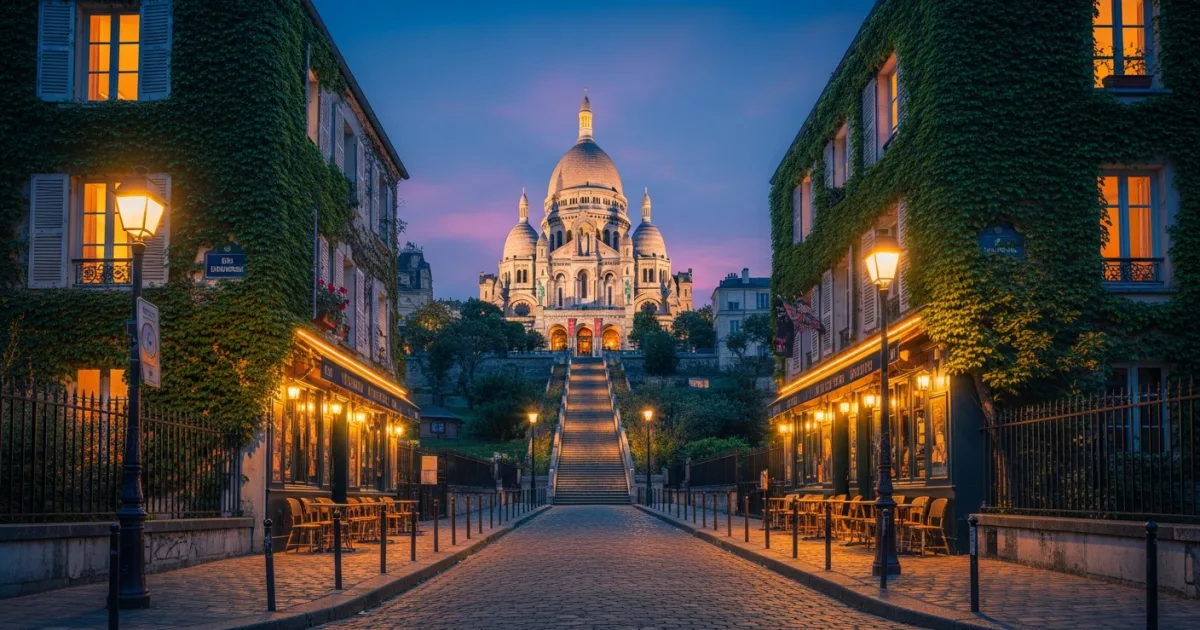
Montmartre is more than just a neighborhood; it is a symbol of Paris's artistic soul. Situated on a prominent hill (the 'butte') in the northern part of the city, it offers a distinct contrast to the grand boulevards of central Paris. The area is characterized by its steep staircases, hidden gardens, and historic windmills, such as the Moulin de la Galette. Walking through Montmartre feels like stepping into a 19th-century painting, where every corner reveals a new piece of history or a stunning vista.
Beyond the famous landmarks, Montmartre is a living, breathing community. Visitors can explore the Musée de Montmartre to delve into the area's rich past, visit the Espace Dalí, or simply enjoy a café crème at the iconic Café des Deux Moulins, made famous by the film 'Amélie'. The neighborhood's unique blend of tourist highlights and quiet, residential charm makes it a must-visit destination for anyone traveling to Paris.
Reasons to Visit
- Unmatched panoramic views of Paris from the steps of the Sacré-Cœur Basilica.
- A rich artistic history with former residences and hangouts of legendary painters.
- Charming, village-like atmosphere with picturesque cobblestone streets.
- Vibrant café culture and authentic French bistros.
- Unique attractions like the Montmartre Vineyard (Vignes du Clos Montmartre).
Things to Avoid
- Avoid engaging with individuals trying to tie string bracelets around your wrist near the Sacré-Cœur stairs; it is a common scam.
- Try not to eat directly on Place du Tertre if you are on a budget, as prices are heavily inflated for tourists.
- Avoid wearing high heels; the steep, uneven cobblestone streets require comfortable walking shoes.
- Don't leave your belongings unattended or carry valuables in easily accessible pockets due to pickpockets.
Local Transportation Tips
Montmartre is best explored on foot, though its steep inclines can be challenging. To reach the top of the hill without the strenuous climb, you can use the Montmartre Funicular, which costs the price of a standard Metro ticket. The Montmartrobus (Line 40) is also a convenient option, specifically designed to navigate the narrow, winding streets of the neighborhood. The closest Metro stations are Anvers (Line 2), Abbesses (Line 12), and Blanche (Line 2).
Travel Etiquette
- Always greet shopkeepers and waiters with a polite 'Bonjour' before asking a question or ordering.
- Keep your voice down in residential areas and inside the Sacré-Cœur Basilica, which is an active place of worship.
- Ask for permission before taking close-up photos of the artists working in Place du Tertre.
- When dining, remember that the tip (service compris) is usually included in the bill, but leaving a small extra coin is appreciated for good service.
Recommended Age Group
Montmartre offers a magical experience, but its unique geography means it caters differently to various age groups.
- Babies (0-2 years): Neutral. The steep hills, numerous stairs, and cobblestone streets make navigating with a stroller very difficult. A baby carrier is highly recommended.
- Kids (3-12 years): Recommended. Children will enjoy the lively atmosphere, street performers, the funicular ride, and the vintage carousels at the base of the hill.
- Teens (13-19 years): Recommended. The area is highly photogenic and Instagrammable, with plenty of trendy cafés, street art, and pop-culture landmarks like the 'Amélie' café.
- Adults (20-64 years): Recommended. Perfect for romantic walks, exploring art history, enjoying fine dining, and taking in the stunning architecture and views.
- Seniors (65+ years): Neutral. While the history and views are spectacular, the steep inclines and uneven surfaces can be physically demanding. Utilizing the funicular and local bus is advised.
Accessibility Level: Medium
- The Montmartre Funicular is wheelchair accessible and provides an easy way to reach the Sacré-Cœur without climbing the stairs.
- Many of the historic cobblestone streets are uneven and lack dropped curbs, which can pose challenges for wheelchair users or those with limited mobility.
- The Sacré-Cœur Basilica has a ramp for wheelchair access at the rear entrance, but the dome is only accessible via a narrow, winding staircase.
- Accessible restrooms can be difficult to find; it is best to use facilities in larger museums or modern cafés.
Did You Know?
Did you know that Montmartre has its own working vineyard? The Vignes du Clos Montmartre produces a small batch of wine each year, and the harvest is celebrated every October with a lively festival known as the Fête des Vendanges.
Cool Statistics
- The Sacré-Cœur Basilica is located at the highest point in the city, 130 meters above sea level.
- Montmartre was an independent village until it was annexed by the city of Paris in 1860.
- The Montmartre Funicular carries over 2 million passengers every year.
- Place du Tertre hosts around 300 artists who share 140 tiny workspaces, taking turns to paint and sell their art.






Buy a compatible power adapter for your trip