The Louvre is not just a museum; it is a monumental piece of Parisian history. Originally built as a fortress in the late 12th century under Philip II, remnants of the original structure can still be seen in the basement. It was later converted into a royal palace, serving as the primary residence of French kings until Louis XIV chose the Palace of Versailles in 1682. During the French Revolution, the National Assembly decreed that the Louvre should be used as a museum to display the nation's masterpieces, officially opening its doors in 1793.
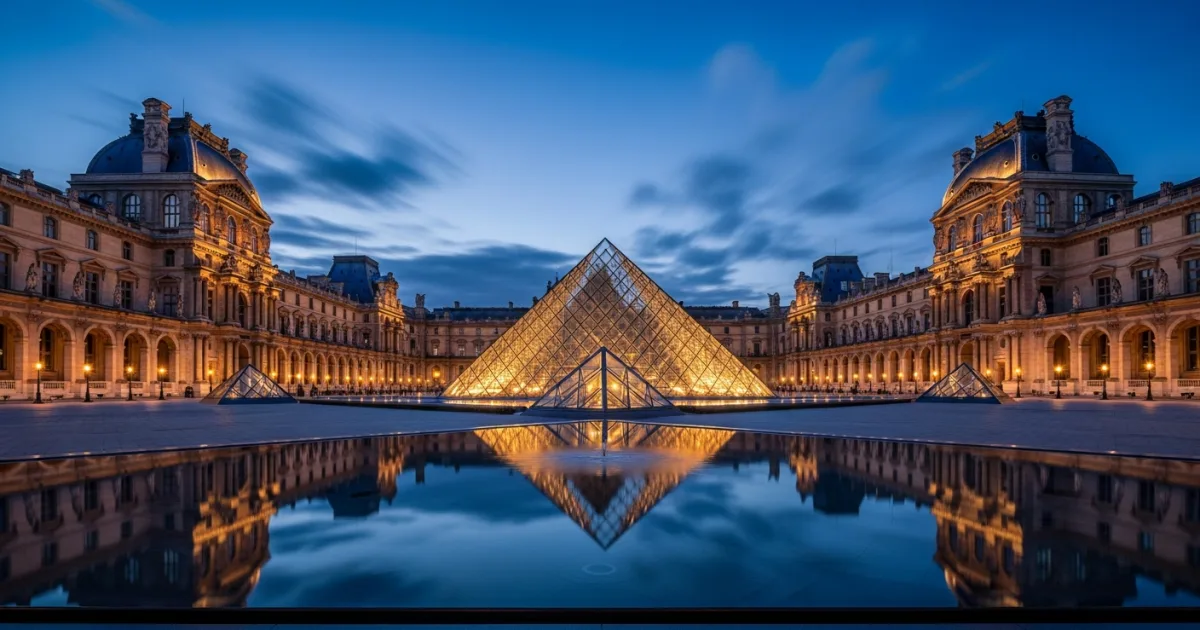
Today, the museum is divided into eight curatorial departments: Egyptian Antiquities; Near Eastern Antiquities; Greek, Etruscan, and Roman Antiquities; Islamic Art; Sculpture; Decorative Arts; Paintings; and Prints and Drawings. The iconic glass pyramid, designed by architect I.M. Pei and inaugurated in 1989, serves as the main entrance and beautifully contrasts the classical architecture of the palace. With over 35,000 works of art on display across 60,600 square meters, a visit to the Louvre is a profound dive into the artistic achievements of humanity.
Reasons to Visit
- To see the Mona Lisa, arguably the most famous painting in the world.
- To admire the stunning architecture of the former royal palace and the modern glass pyramid.
- To explore one of the most comprehensive collections of Egyptian antiquities outside of Cairo.
- To witness the grandeur of the Apollo Gallery, which houses the French Crown Jewels.
- To experience the sheer scale of human history and artistic endeavor in a single location.
Things to Avoid
- Avoid arriving without a pre-booked ticket, as you may be turned away or face hours of waiting.
- Do not attempt to see the entire museum in one day; it is impossible and will lead to museum fatigue.
- Avoid the main Pyramid entrance during peak hours; use the Carrousel du Louvre entrance instead.
- Do not carry large backpacks or suitcases, as items exceeding 55 x 35 x 20 cm are not allowed inside.
- Avoid buying tickets from unofficial vendors outside the museum to prevent scams.
Local Transportation Tips
The Louvre is highly accessible via public transportation. The most convenient way to arrive is by the Paris Métro. Take Line 1 or Line 7 and disembark at the Palais-Royal Musée du Louvre station, which offers direct underground access to the museum via the Carrousel du Louvre. Several bus lines, including 21, 24, 27, 39, 48, 68, 69, 72, 81, and 95, also stop right in front of the Pyramid. If you prefer cycling, there are multiple Vélib' bike-sharing stations nearby.
Travel Etiquette
- Maintain a quiet and respectful demeanor, as it is a place of cultural appreciation.
- Do not touch the artworks, sculptures, or display cases.
- Be mindful of others when viewing popular pieces like the Mona Lisa; take your photo and move along to let others see.
- Follow the instructions of museum guards and staff at all times.
- Consume food and drinks only in designated cafe areas, not in the galleries.
Recommended Age Group
The Louvre Museum offers a vast and diverse collection that appeals to a wide range of ages, though its sheer size requires some planning.
- Babies (0-2 years): Neutral. While strollers are permitted and elevators are available, navigating the dense crowds and vast distances can be exhausting for both parents and infants.
- Kids (3-12 years): Recommended. Children are often captivated by the Egyptian mummies, large sculptures, and the sheer scale of the palace, especially if visits are kept short and focused.
- Teens (13-19 years): Recommended. The museum provides an excellent educational experience, allowing teens to see world-famous masterpieces they have studied in school up close.
- Adults (20-64 years): Recommended. Adults will fully appreciate the depth, history, and architectural beauty of the museum, making it a must-visit cultural landmark.
- Seniors (65+ years): Recommended. The museum is highly accessible with elevators, ramps, and free wheelchair rentals, though the extensive walking requires pacing and frequent breaks.
Accessibility Level: Medium
- The museum is fully accessible to visitors with reduced mobility.
- Wheelchairs, folding stools, and walking sticks can be borrowed free of charge at the visitor assistance desk (subject to availability).
- Priority access is granted to visitors with disabilities and their accompanying person at the Pyramid entrance.
- Tactile tours and audio descriptive guides are available for visually impaired visitors.
- Accessible restrooms are located throughout the museum.
Did You Know?
Did you know that if you spent just 30 seconds looking at every single piece of art displayed in the Louvre, it would take you approximately 100 days to see everything, assuming you were there 24 hours a day?
Cool Statistics
- The Louvre welcomes approximately 8 to 9 million visitors annually.
- The museum's collection includes over 380,000 objects, with about 35,000 on display at any given time.
- The galleries span a total walking distance of roughly 8 miles (13 kilometers).
- The iconic glass pyramid consists of exactly 673 glass panes (603 rhombi and 70 triangles).
- During World War II, the museum's director secretly evacuated thousands of artworks, including the Mona Lisa, to protect them from looting.







Buy a compatible power adapter for your trip