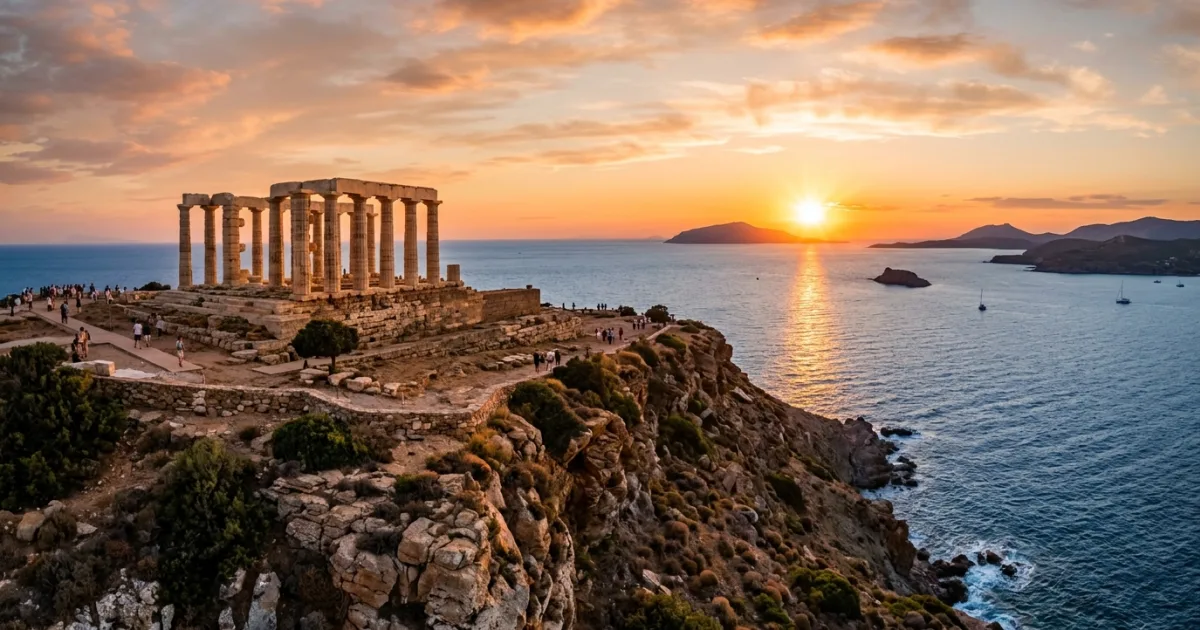
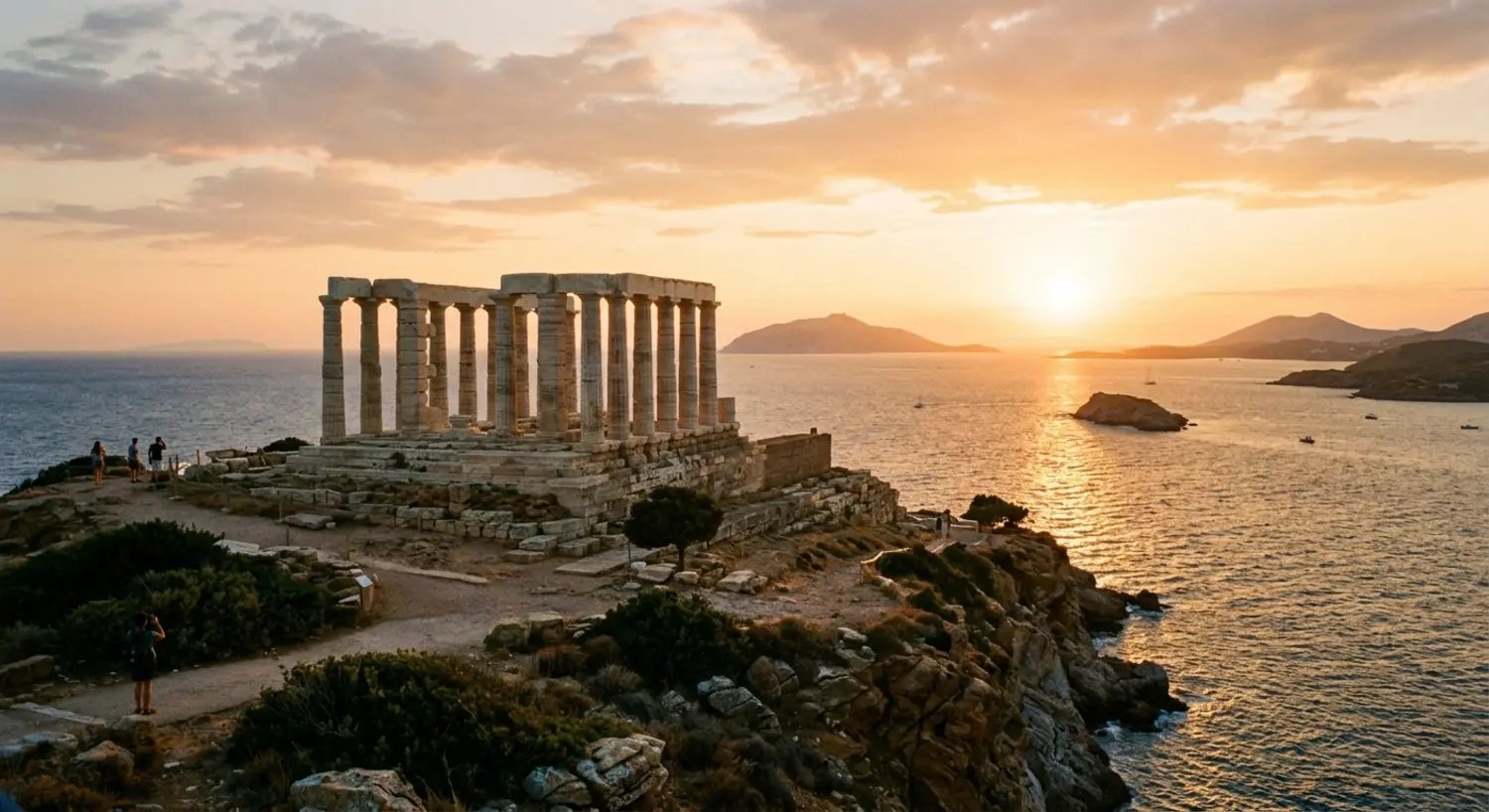
The Temple of Poseidon at Cape Sounion is one of the pinnacle achievements of Golden Age Athenian architecture. Constructed under the supervision of the statesman Pericles during the 5th century BC, the current temple replaced an older limestone sanctuary destroyed by the Persians in 480 BC during the Greco-Persian Wars. The architect is believed to be the same unknown master who designed the Temple of Hephaestus in the Ancient Agora of Athens and the Temple of Nemesis at Rhamnous. Sixteen elegant Doric columns remain standing out of the original thirty-four, featuring sixteen flutes rather than the standard twenty, a structural choice made to prevent wind and salt erosion from wearing away the stone edges.
Beyond its monumental religious value, Cape Sounion served a vital strategic purpose. Perched at the southernmost tip of the Attic peninsula, it functioned as an armed naval watchtower commanding the maritime sea-lanes into Piraeus and the silver-rich mining region of Lavrion. During the Peloponnesian War, the Athenians fortified the entire promontory with a 400-meter-long perimeter defensive wall and excavated dry-dock ship sheds into the rocky cove below to shelter triremes. Walking the grounds today reveals these layered defensive structures alongside the sacred temple enclosure.
Reasons to Visit
- Witness one of the Mediterranean's most spectacular sunset panoramas as the sun sinks beneath the Aegean horizon.
- Examine the remarkable 5th-century BC Doric architecture built from distinctive local Agrileza marble.
- Walk the mythic grounds where King Aegeus leapt into the sea in Homeric lore, giving the Aegean Sea its name.
- Combine ancient cultural exploration with a scenic coastal road trip down the glamorous Athens Riviera.
- Spot historic 19th-century traveler graffiti, including the famous inscription by Romantic poet Lord Byron.
Things to Avoid
- Avoid walking off demarcated gravel paths onto bare marble ledges, which can be dangerously slick and carry fines for trespassing.
- Do not rely on the last intercity KTEL bus of the day for sunset visits without confirming return schedules, as evening departures can fill quickly.
- Avoid visiting in midday midsummer heat without water, hat, and sunscreen, as the headland offers zero natural shade.
- Do not fly recreational drones over the archaeological site without prior permits from the Hellenic Ministry of Culture, as unauthorized drone usage is heavily penalized.
Local Transportation Tips
Reaching Cape Sounion from Athens is straightforward via public or private transit. KTEL Attikis coaches depart hourly from the Pedion tou Areos bus depot in central Athens, picking up passengers along coastal hubs such as Glyfada and Vouliagmeni before terminating directly at the temple ticket office (approx. 2 hours, €7 one-way). Alternatively, renting a car allows for a flexible 70-minute drive down National Road 91 along the scenic Saronic shoreline. Organized sunset tour buses and private taxis are readily available from central Athens hotels.
Travel Etiquette
- Maintain respectful decorum within the archaeological zone; climbing on column plinths or touching ancient masonry is strictly forbidden.
- Never remove stones, pottery shards, or geological samples from the promontory; Greek antiquity laws carry severe criminal penalties.
- Dress modestly and appropriately; swimsuits must remain confined to the beach below and are not permitted inside the sanctuary enclosure.
- Keep voices down and silence speakerphones during sunset to allow fellow travelers to appreciate the tranquil environment.
Recommended Age Group
The Temple of Poseidon offers rich rewards for travelers of various demographics, though physical terrain and cliff edges dictate certain precautions.
- Babies (0-2 years): Not Recommended. The terrain consists of loose rocks and unpaved dirt trails unsuitable for strollers, with sheer cliff edges and no shade from harsh sun and winds.
- Kids (3-12 years): Neutral. Children interested in Greek mythology and Percy Jackson tales will enjoy the setting, but parents must maintain constant physical supervision due to steep drops and fragile ancient ruins.
- Teens (13-19 years): Recommended. Excellent opportunities for dramatic photography, historical exploration, and swimming in the cove below the monument.
- Adults (20-64 years): Recommended. Perfect balance of world-class archaeology, dramatic maritime hiking, road-trip scenic beauty, and evening dining along the coast.
- Seniors (65+ years): Recommended. Ramps connect the parking area and visitor pavilion up toward the temple terrace, providing comfortable viewing points with benches overlooking the ruins.
Accessibility Level: Medium
- A paved pathway and access ramps lead from the main visitor parking area and ticket office up toward the lower perimeter of the temple platform.
- The terrain immediately surrounding the column base is uneven, featuring loose gravel, exposed rock, and ancient stone slabs that can challenge manual wheelchairs.
- Accessible restrooms are located inside the modern visitor center adjacent to the café.
- Golf cart transit is occasionally available for visitors with severe mobility impairments upon request to site staff at the entrance gate.
Did You Know?
According to ancient Greek myth, it was from the cliffs of Cape Sounion that King Aegeus kept watch for the return of his son Theseus from Crete. Theseus had slain the Minotaur but forgot to swap his ship's black sails for white ones as agreed, leading Aegeus to believe his son was dead. In despair, the king plunged from the cliffs into the waters below, forever christening the Aegean Sea in his memory.
Cool Statistics
- Original column count: 34 Doric columns (15 remain standing today, plus one restored pillar).
- Promontory elevation: 60 meters (197 feet) sheer vertical drop above the Aegean Sea.
- Date of construction: Built between 444 and 440 BC during the Golden Age of Pericles.
- Flute count: 16 flutes per column, intentionally fewer than the classical 20 to resist maritime wind erosion.






Buy a compatible power adapter for your trip