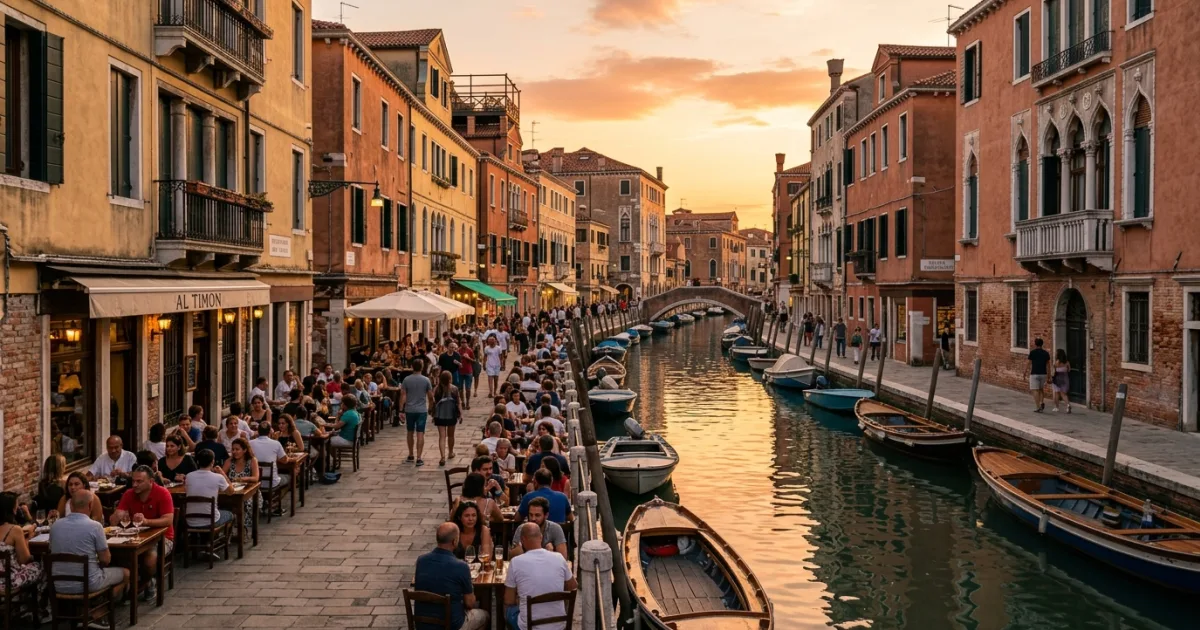
Cannaregio stretches from the bustling Santa Lucia train station all the way to the northern edges of the city, facing the Venetian Lagoon. It is a district of contrasts: the wide, busy Strada Nova provides a fast walking route across the city, while just a few streets away, quiet, parallel canals offer absolute tranquility. Historically, this area was home to working-class Venetians and manufacturing, which gives it a more grounded, lived-in feel compared to the palatial grandeur of the Grand Canal.
A major highlight of the sestiere is the Campo del Ghetto Nuovo. As the oldest Jewish Ghetto in the world, it holds profound historical significance. Visitors can take guided tours of the hidden synagogues and visit the Jewish Museum. Beyond history, Cannaregio is arguably the best neighborhood in Venice for food lovers. The Fondamenta della Misericordia and Fondamenta dei Ormesini are lined with lively bars and restaurants where the Venetian tradition of the 'aperitivo' is celebrated nightly by locals and savvy travelers alike.
Reasons to Visit
- Experience an authentic, residential side of Venice away from the massive tourist crowds.
- Explore the historic Jewish Ghetto, the first in the world, rich with history and culture.
- Indulge in the best 'bacari' (wine bars) in Venice, enjoying cheap and delicious cicchetti.
- Admire stunning, lesser-known churches like Madonna dell'Orto, featuring masterpieces by Tintoretto.
- Enjoy beautiful, unobstructed sunset views over the lagoon from the Fondamente Nove.
Things to Avoid
- Avoid sitting down at cafes on the main Strada Nova if you are on a budget; prices are higher here than on the side streets.
- Do not block the narrow bridges or streets while taking photos; locals use these as their daily commuting routes.
- Avoid eating at restaurants with large menus translated into ten languages and pictures of the food—these are usually tourist traps.
- Do not feed the pigeons or seagulls, as it is illegal and encourages aggressive bird behavior.
Local Transportation Tips
Cannaregio is highly walkable, and walking is often the fastest way to get around. However, if you need to travel longer distances or have heavy luggage, the ACTV vaporetto (water bus) system is excellent. Lines 1 and 2 run along the Grand Canal bordering the district, while lines 4.1, 4.2, 5.1, and 5.2 run along the northern edge (Fondamente Nove and Tre Archi). The neighborhood is also conveniently located right next to the Santa Lucia railway station, making it an ideal base for day trips.
Travel Etiquette
- Always greet shopkeepers with a 'Buongiorno' or 'Buonasera' when entering and leaving.
- When walking, keep to the right side of the narrow streets and bridges to allow locals to pass.
- Do not eat your lunch sitting on the steps of churches, bridges, or public monuments; it is frowned upon and can result in a fine.
- Dress modestly when entering churches (shoulders and knees covered).
- When ordering at a busy bacaro, be assertive but polite, and pay when you order or when you are ready to leave, depending on the bar's custom.
Recommended Age Group
Cannaregio offers a diverse experience that appeals to many, though its physical layout requires some consideration.
- Babies (0-2 years): Neutral. While the quiet streets are nice, navigating a stroller over the numerous stepped bridges can be exhausting. A baby carrier is highly recommended.
- Kids (3-12 years): Recommended. Children will love the boat rides, gelato shops, and open squares (campi) where they can run around safely away from cars.
- Teens (13-19 years): Recommended. The vibrant atmosphere, rich history, and highly photogenic canals make it an engaging destination for teenagers.
- Adults (20-64 years): Recommended. Perfect for adults looking to explore history, architecture, and the incredible local food and wine scene.
- Seniors (65+ years): Neutral. The lack of cars is great, but the uneven cobblestones and mandatory bridge-climbing can be challenging for those with mobility issues.
Accessibility Level: Medium
- Venice is notoriously difficult for wheelchair users due to its hundreds of stepped bridges. However, Cannaregio has some accessible routes.
- The area around the Santa Lucia train station and the Strada Nova offers long stretches of flat, bridge-free walking.
- The city provides a map of accessible routes and sometimes installs ramps on key bridges during the Venice Marathon or other major events.
- Vaporetti (water buses) are wheelchair accessible, allowing you to bypass some of the more difficult walking routes.
Did You Know?
Did you know that the word 'ghetto' actually originated in Cannaregio? In 1516, the Venetian Republic restricted the city's Jewish population to a specific area of Cannaregio that was formerly the site of a copper foundry. The Venetian word for foundry is 'geto' (pronounced with a hard 'g'), which eventually evolved into the word 'ghetto' used worldwide today.
Cool Statistics
- Cannaregio is the most populated sestiere in Venice, home to over 13,000 residents.
- The Jewish Ghetto in Cannaregio was established in 1516, making it over 500 years old.
- The famous Renaissance painter Tintoretto lived in Cannaregio and is buried in the Madonna dell'Orto church.
- The district covers an area of 1.5 square kilometers, making it the second largest in Venice.






Buy a compatible power adapter for your trip