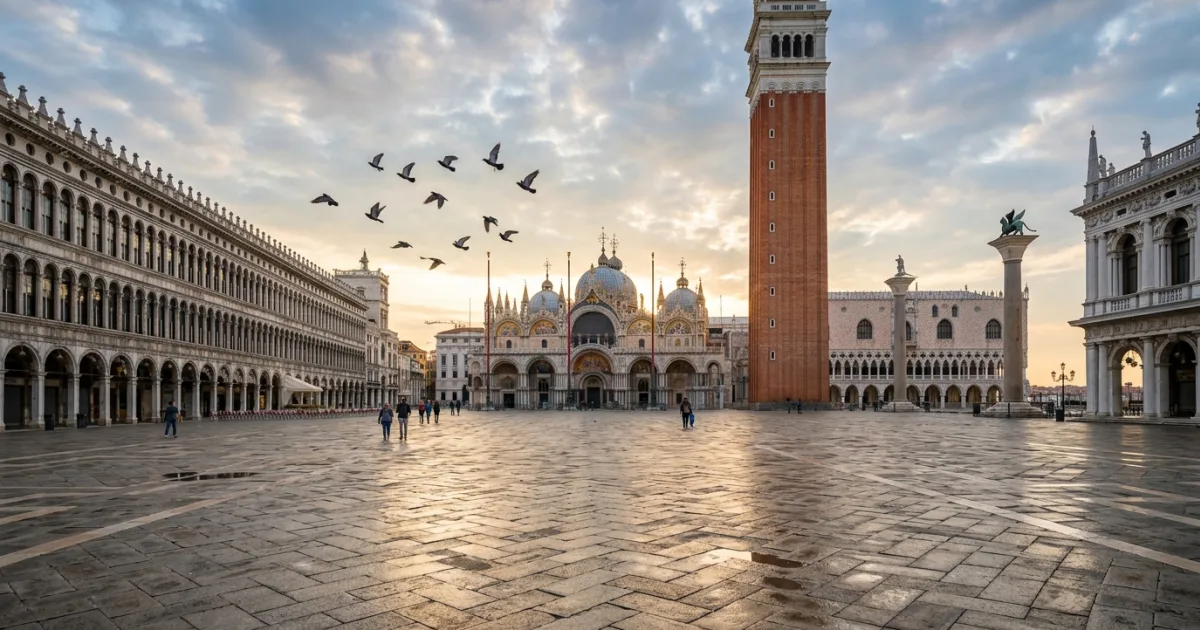
San Marco is the undisputed crown jewel of Venice, a neighborhood that encapsulates the grandeur and historical might of the Venetian Republic. At its core lies Piazza San Marco, famously described by Napoleon as 'the drawing room of Europe.' Here, the stunning Byzantine domes of St. Mark's Basilica stand in striking contrast to the Gothic elegance of the Doge's Palace. The towering Campanile offers sweeping views of the terracotta rooftops and the shimmering lagoon beyond.
While the main square is a magnet for tourists, the true charm of San Marco reveals itself when you wander off the beaten path. Just a few streets away from the luxury boutiques of Calle Larga XXII Marzo, you can find quiet campi (squares), historic theaters like La Fenice, and hidden bacari serving up local wine and cicchetti. Despite the crowds, the neighborhood's architectural splendor and romantic atmosphere make it an unforgettable destination.
Reasons to Visit
- Architectural Masterpieces: Home to St. Mark's Basilica, the Doge's Palace, and the Bridge of Sighs.
- World-Class Museums: Explore the Correr Museum and the Marciana Library.
- Luxury Shopping: Browse high-end Italian designer boutiques and exquisite Murano glass shops.
- Historic Cafés: Experience the timeless elegance of Caffè Florian or Caffè Quadri in the main piazza.
- Cultural Hub: Attend an opera at the legendary Teatro La Fenice.
Things to Avoid
- Eating on the Main Thoroughfares: Restaurants with multi-lingual menus and staff ushering you inside are usually overpriced tourist traps.
- Feeding the Pigeons: It is strictly illegal to feed the pigeons in Piazza San Marco and can result in a hefty fine.
- Sitting on Steps or Bridges: Venice has strict rules against picnicking or sitting on monuments, steps, and bridges to maintain pedestrian flow and respect the heritage.
- Buying Counterfeit Goods: Purchasing fake designer bags from street vendors is illegal and can lead to massive fines for the buyer.
Local Transportation Tips
San Marco is entirely pedestrianized, meaning walking is the primary mode of transportation. To travel longer distances or cross the Grand Canal, you can use the 'vaporetto' (public water bus). The main vaporetto stops for the neighborhood are San Marco (San Zaccaria) and San Marco (Vallaresso). For a quick and cheap crossing of the Grand Canal where there are no bridges, look for a 'traghetto'—a large gondola rowed by two gondoliers that costs just a few euros.
Travel Etiquette
- Keep to the right when walking through narrow streets and over bridges to allow locals to pass.
- Do not stop abruptly in the middle of a busy bridge to take photos.
- Dress appropriately when visiting churches; shoulders and knees must be covered.
- Respect the local environment by disposing of trash properly and not dragging heavy wheeled suitcases over historic bridges late at night.
Recommended Age Group
San Marco offers a rich cultural experience, but its unique geography requires some consideration for different age groups.
- Babies (0-2 years): Neutral. Navigating the crowded streets and numerous stepped bridges with a stroller can be highly challenging, though the main piazza is flat.
- Kids (3-12 years): Recommended. Children will be fascinated by the gondolas, the vast open space of Piazza San Marco, and the intriguing history of the Doge's Palace.
- Teens (13-19 years): Recommended. The area offers highly photogenic landmarks, engaging historical tours, and plenty of shopping opportunities.
- Adults (20-64 years): Recommended. Adults can fully appreciate the rich architectural heritage, fine dining, and romantic ambiance of the district.
- Seniors (65+ years): Neutral. While the cultural offerings are exceptional, the extensive walking required and frequent bridges with stairs may pose mobility challenges.
Accessibility Level: Low
- Piazza San Marco itself is flat and accessible for wheelchair users.
- Many of the surrounding streets and bridges have stairs, making navigation difficult for those with limited mobility.
- The city provides some accessible vaporetto lines and has installed ramps on certain key bridges, but comprehensive accessibility remains a challenge.
- St. Mark's Basilica and the Doge's Palace offer accessible entrances and elevators for visitors with disabilities.
Did You Know?
Did you know that the Campanile (bell tower) of St. Mark's is actually a reconstruction? The original tower, which stood for centuries, suddenly collapsed into a pile of rubble in 1902. It was meticulously rebuilt 'dov'era e com'era' (where it was and how it was) and reopened in 1912.
Cool Statistics
- Piazza San Marco: It is the only square in Venice officially called a 'piazza'; all others are known as 'campi'.
- St. Mark's Basilica: Features over 8,000 square meters of golden mosaics.
- Doge's Palace: Served as the seat of the Venetian government for nearly 1,000 years.
- Acqua Alta: The square is the lowest point in Venice, sitting just 80 centimeters above sea level.






Buy a compatible power adapter for your trip