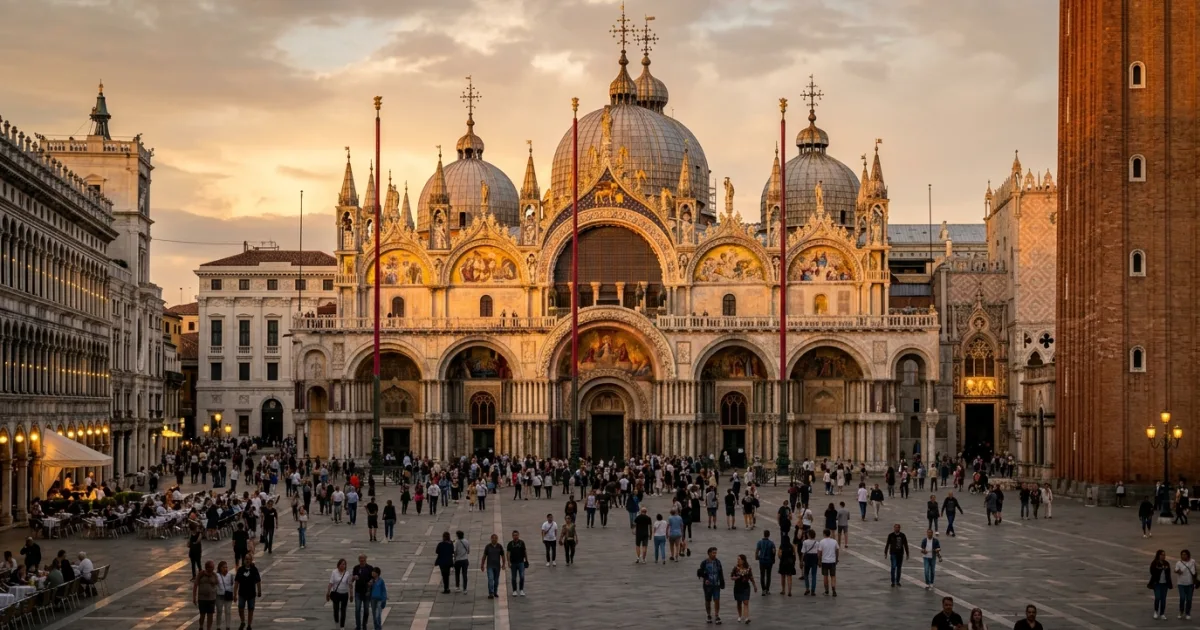
Originally founded in the 9th century to house the stolen relics of St. Mark the Evangelist, the current structure of St. Mark's Basilica largely dates back to the 11th century. Its design was heavily influenced by the Church of the Holy Apostles in Constantinople, reflecting Venice's strong ties to the Byzantine Empire. The interior is a mesmerizing display of wealth, featuring over 85,000 square feet of mosaics crafted from gold leaf sandwiched between layers of glass, earning it the nickname 'Chiesa d'Oro' (Church of Gold).
Beyond the main floor, the St. Mark's Museum upstairs offers a closer look at the mosaics and houses the original Triumphal Quadriga—four magnificent bronze horses looted from Constantinople during the Fourth Crusade. The Pala d'Oro, located behind the main altar, is universally recognized as one of the most refined and accomplished works of Byzantine enamel, studded with 1,300 pearls, 300 emeralds, 300 sapphires, 400 garnets, and 100 amethysts.
Reasons to Visit
- Witness the breathtaking golden mosaics that cover the interior domes and walls.
- See the Pala d'Oro, an unparalleled masterpiece of Byzantine jewelry and enamelwork.
- Step out onto the Loggia dei Cavalli for panoramic views of St. Mark's Square and the Doge's Palace.
- Explore the rich history of the Venetian Republic through its most important spiritual and political monument.
Things to Avoid
- Avoid visiting during peak midday hours in the summer when lines can stretch for hours.
- Do not bring large backpacks or luggage, as you will be turned away at the door.
- Avoid wearing shorts, short skirts, or sleeveless tops to ensure you meet the dress code requirements.
- Do not attempt to take photos inside the main church area, as guards will intervene.
Local Transportation Tips
St. Mark's Basilica is located in the heart of Venice and is entirely pedestrian-accessible. The nearest Vaporetto (water bus) stops are San Zaccaria and San Marco Vallaresso, serviced by lines 1, 2, and 5.1/5.2. From either stop, it is a short, scenic walk to Piazza San Marco.
Travel Etiquette
- Maintain a respectful silence while inside the basilica, as it is an active place of worship.
- Adhere strictly to the modest dress code.
- Follow the designated walking paths and do not touch the ancient marble walls or mosaics.
- Remove hats upon entering the church.
Recommended Age Group
St. Mark's Basilica offers a profound historical experience, though its environment caters differently to various age groups.
- Babies (0-2 years): Neutral. Strollers are not permitted inside the basilica and must be left at the baggage deposit, making it challenging for parents carrying infants.
- Kids (3-12 years): Recommended. The shimmering gold mosaics and grand scale can be visually stimulating, though parents must ensure children remain quiet.
- Teens (13-19 years): Recommended. Offers excellent educational value regarding medieval history, art, and architecture.
- Adults (20-64 years): Recommended. Perfect for history buffs, art lovers, and architecture enthusiasts looking to explore Venetian heritage.
- Seniors (65+ years): Recommended. The main floor is accessible, though accessing the upstairs museum and terrace requires navigating steep, narrow stairs.
Accessibility Level: Medium
- A wheelchair-accessible entrance is available at the Porta dei Fiori on the left side of the basilica.
- The ground floor is mostly accessible, though some areas have uneven flooring due to the ancient marble.
- The upstairs museum, Loggia, and Pala d'Oro have limited accessibility and require navigating stairs.
- Service animals are permitted with proper documentation.
Did You Know?
Did you know that the famous bronze horses on the facade of St. Mark's Basilica are actually replicas? The original ancient sculptures, which date back to classical antiquity and were brought to Venice in 1204, are kept safely inside the basilica's museum to protect them from environmental damage.
Cool Statistics
- Over 8,000 square meters of golden mosaics cover the interior.
- The Pala d'Oro contains nearly 2,000 precious gems and stones.
- The basilica features more than 500 columns dating from the 3rd to the 13th century.
- It officially became the cathedral of Venice only in 1807; before that, it was the Doge's private chapel.






Buy a compatible power adapter for your trip