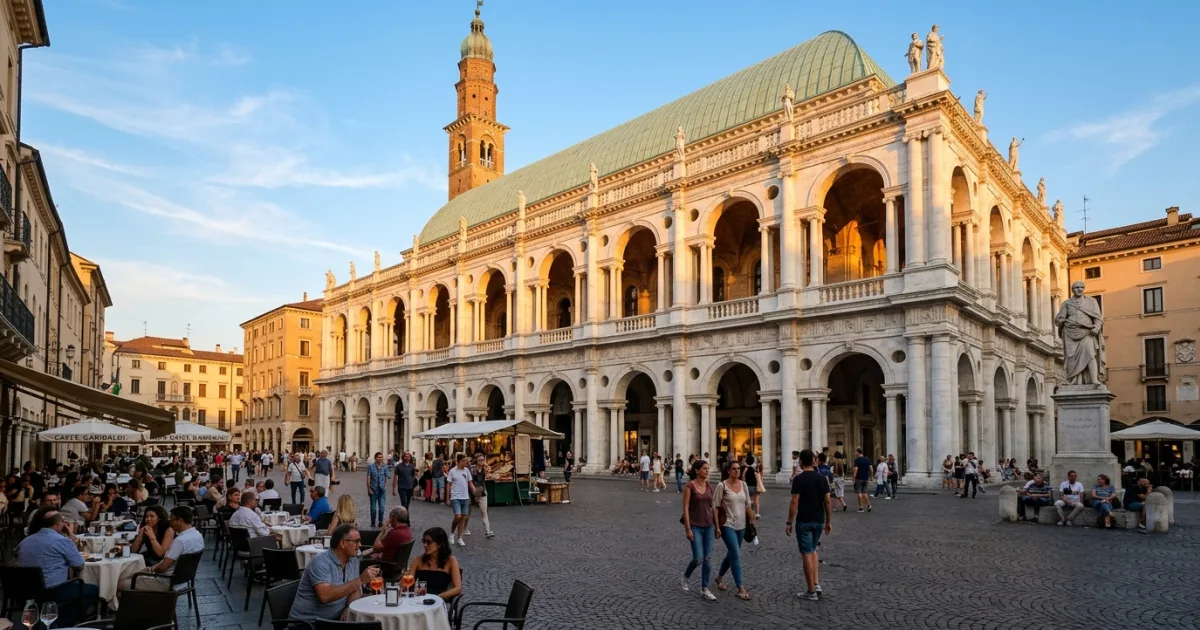
The Basilica Palladiana is not a religious building, despite its name. In ancient Roman terms, a 'basilica' was a civic building where justice was administered and business was conducted. Originally constructed in the 15th century as the Palazzo della Ragione, the building suffered a partial collapse. In 1549, a young and relatively unknown architect named Andrea Palladio won the commission to reconstruct it.
Palladio's ingenious solution was to encase the existing Gothic structure in a two-story shell of white marble loggias. He utilized the Serlian motif—an arch flanked by two rectangular openings—which allowed him to mask the irregular proportions of the original medieval building. The striking copper roof, shaped like an inverted ship's hull, crowns the structure and is a defining feature of the Vicenza skyline. Today, the Basilica stands as a monument to Renaissance ingenuity and is the focal point of civic life in Vicenza.
Reasons to Visit
- Architectural Masterpiece: Witness firsthand the genius of Andrea Palladio and the birthplace of Palladian architecture.
- Rooftop Views: Enjoy unparalleled panoramic views of Vicenza's historic center and the Berici Hills from the expansive terrace.
- Cultural Exhibitions: The vast upper hall frequently hosts world-class art, history, and architecture exhibitions.
- Vibrant Atmosphere: Located in Piazza dei Signori, it is the perfect backdrop for enjoying an aperitivo and watching city life unfold.
Things to Avoid
- Visiting on Mondays: Like many Italian cultural sites, the Basilica is often closed on Mondays. Always check current opening hours.
- Missing the Terrace: If visiting in summer, do not skip the rooftop terrace; it is one of the highlights of the building.
- Rushing the Experience: Take time to walk around the entire perimeter to appreciate the architectural details and the varying light on the marble.
Local Transportation Tips
Vicenza is a highly walkable city, and the Basilica Palladiana is located right in the pedestrianized historic center. It is approximately a 10 to 15-minute walk from the Vicenza train station. For those driving, parking is available in designated lots outside the restricted traffic zone (ZTL), from which you can easily walk or take a short local bus ride to Piazza dei Signori.
Travel Etiquette
- Maintain a respectful volume, especially when viewing exhibitions inside the main hall.
- Do not lean on or touch the historic marble columns and statues.
- Dress comfortably but neatly; while it is not a church, Italians appreciate a smart-casual dress code in city centers.
- When enjoying the piazza, dispose of any gelato cups or trash in designated bins to help maintain the UNESCO site's cleanliness.
Recommended Age Group
The Basilica Palladiana offers a rich historical and visual experience that appeals to a variety of age groups, though it is particularly engaging for older visitors.
- Babies (0-2 years): Neutral. Stroller access is possible via the elevator, but the historical nature of the site offers little direct engagement for infants.
- Kids (3-12 years): Neutral. The large open spaces of the piazza and the terrace might be fun, but the architectural focus may not hold the attention of younger children for long.
- Teens (13-19 years): Recommended. Great for photography enthusiasts and teens interested in history, art, and European culture.
- Adults (20-64 years): Recommended. Ideal for architecture lovers, history buffs, and those looking to enjoy the rooftop bar and cultural exhibitions.
- Seniors (65+ years): Recommended. The building is equipped with an elevator, making the upper hall and terrace highly accessible without the need to climb steep stairs.
Accessibility Level: Medium
- The Basilica Palladiana is equipped with a modern elevator that provides access to the upper loggias, the main hall, and the rooftop terrace.
- The surrounding Piazza dei Signori is flat and paved, making it easily navigable for wheelchair users and those with limited mobility.
- Accessible restrooms are available on-site for visitors.
- Service animals are generally permitted, though it is advisable to confirm specific exhibition rules in advance.
Did You Know?
Did you know that the term 'Palladian architecture' originates directly from the architect of this building, Andrea Palladio? His style, heavily influenced by classical Roman principles of symmetry and proportion, went on to inspire buildings worldwide, including the United States Capitol and the White House.
Cool Statistics
- Original Construction: 15th century (Palazzo della Ragione).
- Palladio's Renovation: Began in 1549 and was completed in 1614, long after his death.
- UNESCO Status: Inscribed as a World Heritage site in 1994 along with other Palladian villas in the Veneto.
- Roof Design: The distinctive copper roof is shaped like an inverted ship's hull and was reconstructed after being destroyed by bombing in World War II.






Buy a compatible power adapter for your trip