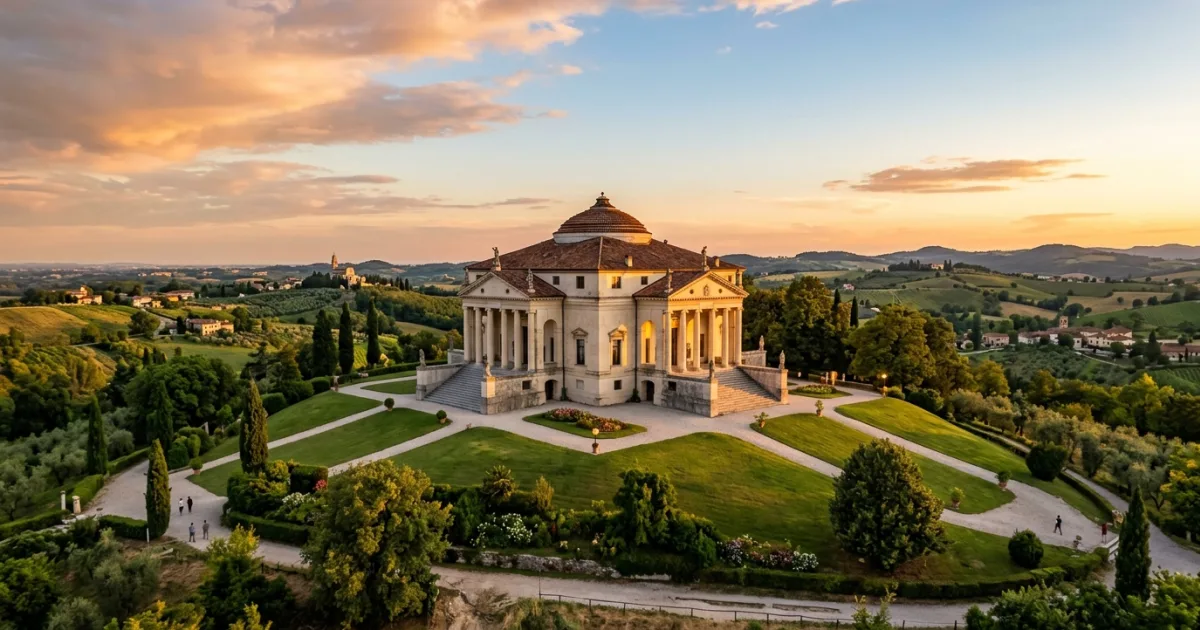
Villa La Rotonda stands as the ultimate expression of Andrea Palladio's architectural genius. Commissioned by Paolo Almerico, a papal prelate, upon his retirement to Vicenza in 1565, the building was designed not as a working farm like many other villas, but as a suburban retreat for meditation and study. Its design is perfectly symmetrical, based on a square plan with a central circular hall topped by a dome, a feature previously reserved for religious buildings. The four identical facades, each with a classical portico accessed by a broad flight of steps, were oriented to catch the sun and provide distinct, framed views of the surrounding landscape.
Inside, the villa is just as breathtaking, adorned with elaborate frescoes by Alessandro and Giovanni Battista Maganza, and later by Louis Dorigny. These artworks depict religious and mythological scenes that complement the grandeur of the architecture. The property was eventually completed by Vincenzo Scamozzi after Palladio's death, and later acquired by the Capra family, hence its alternative name, Villa Almerico Capra. Today, it remains privately owned by the Valmarana family but is graciously opened to the public, allowing visitors to step back into the height of the Italian Renaissance.
Reasons to Visit
- Experience the most famous and influential work of Renaissance architect Andrea Palladio.
- Admire the perfect mathematical symmetry and classical proportions of the building's exterior.
- View the stunning interior frescoes that decorate the central dome and surrounding rooms.
- Enjoy the peaceful, manicured gardens and the picturesque views of the Veneto countryside.
- Explore a key site that contributed to the city of Vicenza being named a UNESCO World Heritage site.
Things to Avoid
- Avoid visiting on Mondays or Tuesdays without checking the schedule, as the villa is often closed early in the week.
- Do not attempt to take photos inside the villa; respect the strict no-photography rule to protect the art.
- Avoid wearing high heels, as the gravel paths and stone steps can be difficult to navigate.
- Don't rely solely on taxis for the return trip; ensure you know the local bus schedule or are prepared for a walk.
Local Transportation Tips
Reaching Villa La Rotonda from the center of Vicenza is straightforward. The most scenic option is a 30-minute walk from the Vicenza train station, passing through the historic city and along the Riviera Berica. Alternatively, local bus line 8 departs from the city center and drops visitors a short walk from the villa's entrance. Taxis are available at the train station, and if you are driving, there is limited parking available near the site.
Travel Etiquette
- Maintain a quiet and respectful demeanor, as the villa is both a historic monument and a private residence.
- Stay on the designated paths while exploring the gardens to protect the landscaping.
- Do not touch the walls, frescoes, or statues inside the villa.
- Dress modestly and comfortably, keeping in mind the cultural significance of the site.
Recommended Age Group
Villa La Rotonda offers a serene and educational experience, though its appeal varies by age group.
- Babies (0-2 years): Neutral. While the outdoor gardens are pleasant, strollers are difficult to maneuver on the gravel paths and cannot be taken inside the historic villa.
- Kids (3-12 years): Neutral. The strict rules against touching and running inside the villa might make it challenging for younger children, though they may enjoy the open outdoor spaces.
- Teens (13-19 years): Recommended. Older children studying history, art, or architecture will appreciate the profound significance of Palladio's work.
- Adults (20-64 years): Recommended. Ideal for architecture lovers, history buffs, and cultural travelers seeking a deep dive into the Renaissance.
- Seniors (65+ years): Recommended. The site is relatively compact and offers a relaxed pace, though visitors should be mindful of the gravel paths and the steps leading up to the porticos.
Accessibility Level: Medium
- The exterior grounds feature gravel paths which may present some difficulty for manual wheelchairs.
- Access to the main floor of the villa requires climbing a flight of stone steps; there is no elevator or ramp access to the interior.
- Visitors with limited mobility can still enjoy the stunning exterior architecture and the surrounding gardens.
- Accessible restrooms are not readily available on the immediate grounds, so plan accordingly before arriving.
Did You Know?
Villa La Rotonda's design was so revolutionary and perfect in its proportions that it inspired hundreds of buildings worldwide, including Thomas Jefferson's Monticello in the United States and the Chiswick House in London.
Cool Statistics
- Year construction began: 1567
- Number of identical facades: 4
- Distance from Vicenza city center: 2.5 kilometers
- Year designated as a UNESCO World Heritage site: 1994






Buy a compatible power adapter for your trip