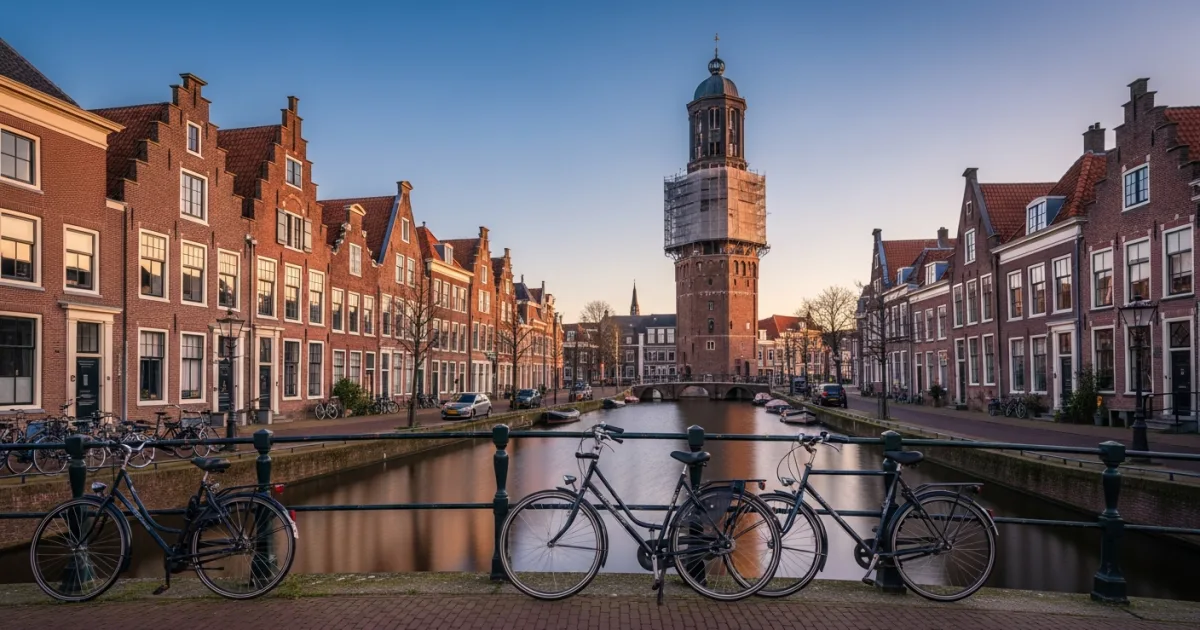
Leeuwarden operates as the administrative center of Friesland, encompassing a land area of 84.10 square kilometers. The city's demographic profile includes a significant student population of over 20,000, attending institutions such as NHL Stenden University of Applied Sciences. Historical records indicate continuous settlement since the 10th century, with the city's wealth expanding during the 16th and 17th centuries due to maritime trade and agriculture. The Blokhuispoort, a former penitentiary constructed in 1499, now functions as a cultural incubator housing the city library, artist studios, and commercial enterprises. Water management remains a critical infrastructural component, with a network of grachten (canals) regulating water levels and providing navigable routes for recreational vessels.
Reasons to Visit
- The Oldehove: This 1529 brick tower leans 1.99 meters from its vertical axis and offers a 183-step climb to a 40-meter observation deck.
- Fries Museum: The facility houses over 170,000 artifacts detailing Frisian history, including the sword of freedom fighter Pier Gerlofs Donia.
- Princessehof Ceramics Museum: Located in an 18th-century palace, the collection features Ming dynasty porcelain and works by M.C. Escher, who was born in the building.
- Blokhuispoort: A 15th-century prison complex repurposed into a 14,000-square-meter cultural center with libraries, hostels, and dining venues.
- Canal Network: Over 10 kilometers of navigable urban waterways allow for electric boat tours and stand-up paddleboarding through the historic center.
Things to Avoid
- Walking in designated bicycle lanes: Red-paved paths are strictly for cyclists; pedestrians face a high risk of collision and potential fines.
- Assuming all locals speak only Dutch: West Frisian (Frysk) is an official co-language in the province, and English proficiency exceeds 90% among the general population.
- Relying solely on cash: Over 85% of local transactions utilize contactless debit or credit cards (Maestro/V-Pay/Mastercard/Visa), and some businesses operate entirely cash-free.
- Unsecured bicycle parking: Bicycle theft accounts for the majority of local property crime; utilizing dual locks and official parking facilities (fietsenstallingen) is necessary.
Local Transportation Tips
The Leeuwarden railway station processes approximately 10,000 passengers daily, serving as the primary transit hub for Arriva and NS (Nederlandse Spoorwegen) trains. Urban mobility relies heavily on cycling, supported by over 150 kilometers of dedicated bicycle infrastructure within the municipality. Arriva operates a fleet of electric city buses covering 12 primary routes, with fares payable via the national OV-chipkaart system or contactless bank cards. Pedestrian navigation is highly efficient in the 1.5-square-kilometer historic center, where motorized traffic is heavily restricted.
Travel Etiquette
- Punctuality: Dutch culture values exactness; arriving more than 5 minutes late for appointments or reservations is considered unprofessional.
- Direct Communication: Locals employ a straightforward conversational style that prioritizes clarity over diplomatic phrasing, which should not be misinterpreted as rudeness.
- Tipping: Service charges of 15% are legally included in all hospitality bills; rounding up the total or leaving a 5-10% gratuity is customary only for exceptional service.
- Greeting: A standard handshake is appropriate for initial introductions, while three alternating cheek kisses are reserved for close acquaintances.
Recommended Age Group
Leeuwarden provides a highly accessible and culturally dense environment suitable for various demographics.
- Babies (0-2 years): Neutral. Cobblestone streets in the historic center present minor challenges for standard strollers, though public facilities generally offer adequate changing stations.
- Kids (3-12 years): Recommended. The Natuurmuseum Fryslân provides interactive, bilingual exhibits specifically engineered for children aged 4 to 12, including a simulated underwater safari.
- Teens (13-19 years): Recommended. The Blokhuispoort cultural center and the city's extensive street art routes offer highly visual, independent exploration opportunities.
- Adults (20-64 years): Recommended. The concentration of specialized museums, historic architecture, and culinary venues aligns perfectly with adult cultural tourism preferences.
- Seniors (65+ years): Recommended. The flat topography, comprehensive public transit system, and high density of accessible museums facilitate comfortable navigation for older visitors.
Accessibility Level: Medium
- The Leeuwarden municipality mandates wheelchair accessibility for all public buildings constructed after 2003.
- The historic center features 85% flush-curb intersections, though 17th-century cobblestone paving on streets like the Kleine Kerkstraat may cause vibration for manual wheelchair users.
- The Fries Museum and Princessehof Ceramics Museum provide complimentary manual wheelchairs, elevator access to all floors, and tactile exhibits for visually impaired guests.
- Arriva city buses are equipped with automated deployment ramps and designated priority seating areas for mobility devices.
Did You Know?
Leeuwarden served as the birthplace of Margaretha Geertruida MacLeod, better known as the exotic dancer and convicted World War I spy Mata Hari, who was born in the city in 1876.
Cool Statistics
- The Oldehove tower leans at an angle of 2 degrees, displacing its top by 1.99 meters from the center.
- Leeuwarden's municipal boundaries contain exactly 617 registered national heritage sites (Rijksmonumenten).
- The city hosted 5.3 million visitors during its tenure as the European Capital of Culture in 2018.
- The Fries Museum's collection encompasses 170,000 individual objects representing regional history.
- The Elfstedentocht ice-skating race, which begins and ends in Leeuwarden, covers a total distance of 199 kilometers.






Buy a compatible power adapter for your trip