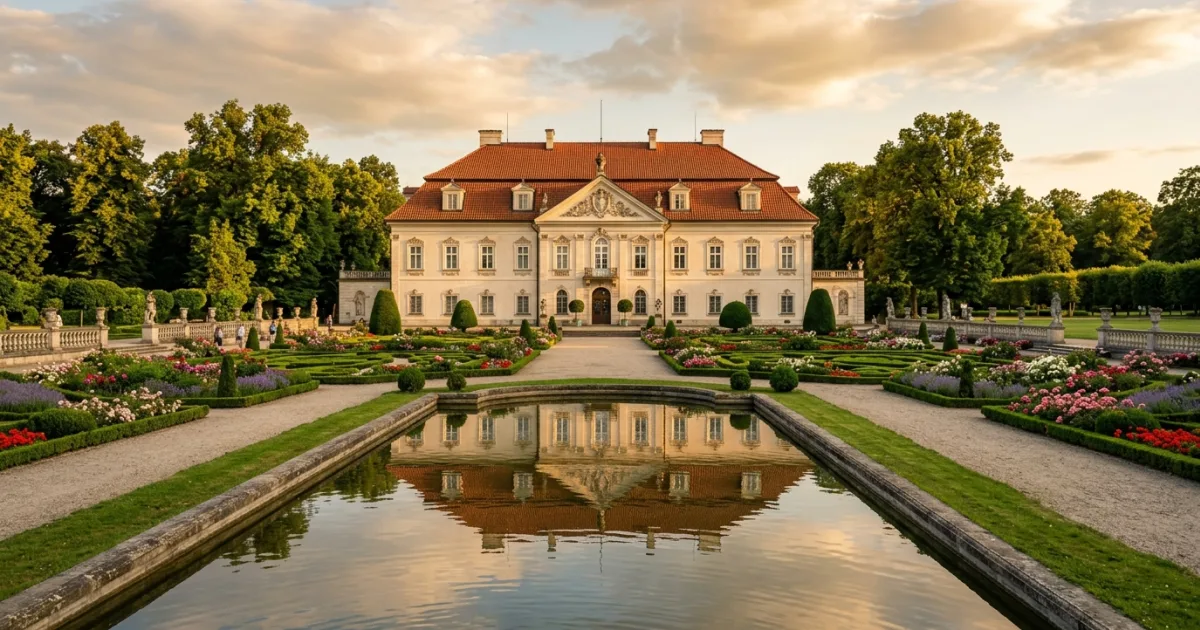
Nieborów stands as an enduring tribute to the grandeur of Poland's aristocratic golden eras. Located roughly 70 kilometers southwest of Warsaw in the Łódź Voivodeship, this tranquil settlement centers on an estate acquired by Cardinal Michał Stefan Radziejowski in the late 1600s, who commissioned the premier Baroque master Tylman van Gameren to design the two-story residence. In 1774, the estate passed into the hands of Prince Michał Hieronim Radziwiłł and his cultured wife Helena Przeździecka-Radziwiłłowa, under whose stewardship the estate blossomed into a premier salon of European enlightenment thought, arts, and political discourse.
Unlike many historic residences in Poland that were destroyed during World War II, Nieborów Palace miraculously survived the conflict virtually unscathed, complete with its original library, painted ceilings, period furniture, and ancestral art collections. Transferred under the custodianship of the National Museum in Warsaw in 1945, the property remains an exquisitely authentic historic house museum. Strolling through its French formal parterres or driving a few minutes down the poplar-lined road to Princess Helena’s sentimental Arkadia Park offers a rare, intact window into the layered philosophies of eighteenth-century landscape design.
Reasons to Visit
- Tylman van Gameren Architecture: Marvel at an intact seventeenth-century Baroque palace featuring preserved period interiors, ornate tiled stoves, and classical stuccowork.
- Dual Landscape Masterpieces: Contrast the rigid geometry of the French Baroque garden at Nieborów with the wild, melancholic beauty of the English romantic park at nearby Arkadia.
- Living Majolica Heritage: Visit the historic 1881 pottery workshop on the estate grounds where artisans continue to produce traditional hand-painted ceramics.
- Atmospheric Escape: Experience peaceful Polish village life far removed from metropolitan stress, surrounded by the protected meadows of Bolimów Landscape Park.
- Film and Television Legacy: Walk through scenic palace halls and courtyards that have served as sets for numerous classic European historical cinema productions.
Things to Avoid
- Avoid rushing through the estate in under two hours; allocate enough time to include Arkadia Park, which deserves unhurried contemplation.
- Avoid visiting exclusively on summer holiday weekends if you dislike crowds, as Warsaw day-trippers arrive in substantial numbers.
- Avoid wearing high heels or slick-soled footwear, as palace floors require protective covers or flat shoes, and the gardens feature gravel and dirt paths.
- Avoid skipping the Majolica workshop behind the palace, which many travelers inadvertently bypass when focusing only on the main residence.
Local Transportation Tips
Nieborów is most conveniently explored by private vehicle or bicycle. The village sits just off the A2 motorway between Warsaw and Łódź, making driving effortless. For public transport users, regular trains run from Warsaw Centralna or Łódź Fabryczna to the town of Łowicz (10 km away). From Łowicz station, local PKS regional buses or taxis complete the journey to Nieborów in roughly 10 to 15 minutes. Within the village, all major sights including the palace, brewery ruins, and majolica workshop are comfortably walkable.
Travel Etiquette
- Keep your voice low and turn off camera flashes when touring inside the palace museum rooms to protect antique fabrics and artwork.
- Stay on designated pathways in both the formal French parterres and the Arkadia romantic park; stepping across planted flowerbeds is strictly prohibited.
- When greeting locals in shops or guesthouses, a polite 'Dzień dobry' (Good day) is customary before placing an order or asking questions.
- Dress respectfully when stepping into village churches or memorial chapels, ensuring shoulders and knees are modestly covered.
Recommended Age Group
Nieborów provides a multi-generational cultural experience, appealing strongest to those who appreciate architecture, history, and contemplative landscape strolls.
- Babies (0-2 years): Recommended. Outdoor parklands provide flat, shaded strolls ideal for prams, though palace interiors require leaving strollers at the cloakroom.
- Kids (3-12 years): Neutral. Children will enjoy the wide grassy spaces and mythical follies in Arkadia, but fragile palace interiors require strict supervision.
- Teens (13-19 years): Neutral. Teens with an eye for photography or European history will find Arkadia fascinating, though there are minimal high-octane activities.
- Adults (20-64 years): Recommended. Perfect destination for romantic weekends, architectural appreciation, quiet nature walks, and cultural heritage exploration.
- Seniors (65+ years): Recommended. Flat garden walking trails, abundant benches, relaxed pacing, and accessible historic collections make this an exceptional destination for mature travelers.
Accessibility Level: Medium
- The ground-floor garden paths in Nieborów are largely flat gravel, generally manageable for sturdy wheelchairs and mobility scooters.
- Access to the upper state rooms of the Baroque palace requires ascending historical staircases; elevator facilities are restricted due to heritage preservation laws.
- Arkadia Park features packed-earth and grass pathways which can become soft and muddy after prolonged rain, requiring caution for visitors with limited mobility.
- Designated disabled parking bays and wheelchair-accessible restrooms are available near the main ticket office and visitors' center.
Did You Know?
Nieborów Palace's survival through World War II is credited to Professor Stanisław Lorentz, director of the National Museum in Warsaw, who successfully negotiated protective measures during the German occupation, preventing the looting and demolition suffered by many other Polish estates.
Cool Statistics
- The estate’s monumental linden (lime tree) avenues were planted back in the 1770s under the personal direction of Prince Michał Hieronim Radziwiłł.
- Arkadia Park contains over 10 distinct classical and romantic architectural pavilions, including a Roman Aqueduct reproduction and the Temple of Diana.
- The palace library contains thousands of rare seventeenth- and eighteenth-century volumes, including an original 16th-century print of the Nuremberg Chronicle.






Buy a compatible power adapter for your trip