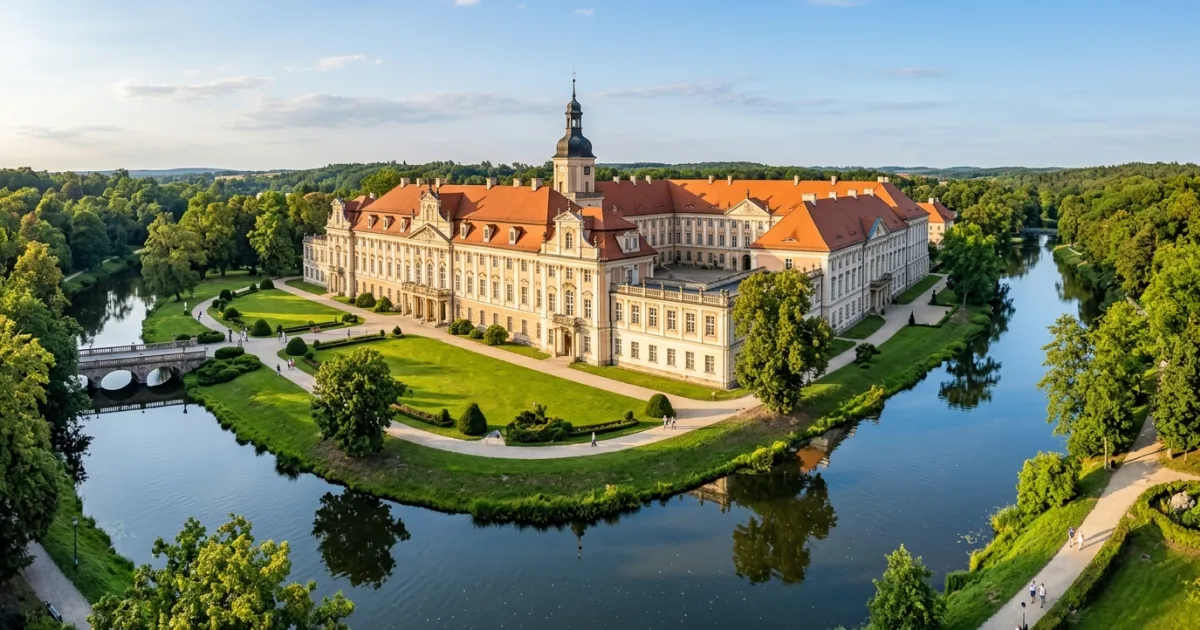
Zagan boasts a storied past that spans over seven centuries of political and cultural evolution. As the capital of the historic Duchy of Zagan, the town was governed by prominent European figures, including Albrecht von Wallenstein, Johannes Kepler, and the Dukes of Talleyrand-Périgord. Their enduring legacy is visible in the town's monumental architecture, most notably the four-wing Ducal Palace, constructed in the classic Italian Baroque style with an interior courtyard and an extensive landscape park designed in the nineteenth century.
In the twentieth century, Zagan became internationally famous due to Stalag Luft III, an air force prisoner-of-war camp built by the German Luftwaffe. In March 1944, a covert escape committee led by Squadron Leader Roger Bushell engineered an elaborate escape route via tunnel 'Harry', enabling 76 Allied prisoners to escape. Today, travelers can visit both the aristocratic quarters of the town center and the moving historical forest memorials, making Zagan a deeply rewarding cultural destination.
Reasons to Visit
- Explore the magnificent 17th-century Baroque Ducal Palace and its sprawling riverside English landscape park.
- Walk the solemn grounds and replica tunnels at the Stalag Luft III Prisoner of War Camp Museum.
- Discover the historic Post-Augustinian Monastery Complex featuring late-Gothic vaulting and a library with rare frescoes.
- Experience an authentic, unhurried Polish heritage destination free from mass-market commercialism.
Things to Avoid
- Avoid assuming everything is open on Mondays; several regional museums keep reduced hours or remain closed.
- Do not rely entirely on cashless payment methods in smaller bakeries and mom-and-pop shops.
- Avoid straying off cleared pathways when touring the forested zones surrounding the former wartime camp sites.
Local Transportation Tips
Zagan's central historic district is compact and exceptionally walkable, making motor transport unnecessary for exploring the palace and old town. To reach the Stalag Luft III Museum, located approximately two kilometers south of the town center, travelers can take a short local bus ride, hire a taxi, or complete a flat 25-minute walk from the central railway station.
Travel Etiquette
- Greet shopkeepers and museum staff with a polite 'Dzień dobry' upon entering and 'Do widzenia' when leaving.
- Dress modestly with covered shoulders and knees when entering active Catholic churches and historical monasteries.
- Maintain respectful quietness while exploring the Stalag Luft III memorial grounds and cemeteries.
Recommended Age Group
Zagan's focus on deep military history, architecture, and tranquil walking grounds shapes its suitability across different traveler generations.
- Babies (0-2 years): Neutral. Park paths accommodate rugged strollers, but historic cobbles and older heritage interiors present navigation hurdles.
- Kids (3-12 years): Neutral. Children will enjoy the wide open spaces of the palace park, but solemn wartime historical exhibits require mature supervision.
- Teens (13-19 years): Recommended. The world-famous real-life 'Great Escape' history provides a compelling and vivid historical education for young adults.
- Adults (20-64 years): Recommended. Ideal for travelers passionate about military history, European architecture, and quiet cultural tourism.
- Seniors (65+ years): Recommended. Flat terrain, uncrowded streets, and accessible historic highlights offer a peaceful and manageable pace.
Accessibility Level: Medium
- The grounds of the Ducal Palace park feature mostly flat gravel pathways accessible to wheelchairs and mobility devices.
- The Stalag Luft III Museum visitor building provides step-free access, though outdoor forest trails may be uneven during damp weather.
- Historic monastic vaults and tower viewpoints include narrow stone staircases without elevator access.
Did You Know?
Renowned German astronomer Johannes Kepler lived and worked in Zagan from 1628 until his death in 1630 under the patronage of Imperial General Albrecht von Wallenstein, publishing several important astronomical ephemerides while residing in the town.
Cool Statistics
- 76 Allied airmen escaped through tunnel 'Harry' on the night of March 24–25, 1944.
- The Ducal Palace park encompasses over 40 hectares of protected natural green space.
- Zagan was the capital of an autonomous Silesian duchy established as early as 1274.






Buy a compatible power adapter for your trip