Lazienki Park represents the pinnacle of Polish Enlightenment design and landscape gardening. Established under Poland's last monarch, Stanisław August Poniatowski, the park was conceived as a summer residence celebrating arts, philosophy, and botanical harmony. Spanning 76 hectares, the park contains four distinct gardens: the 18th-century Royal Garden, the 19th-century Romantic Garden, the Modernist Garden, and the Chinese Garden complete with authentic wooden pavilions and red lanterns.
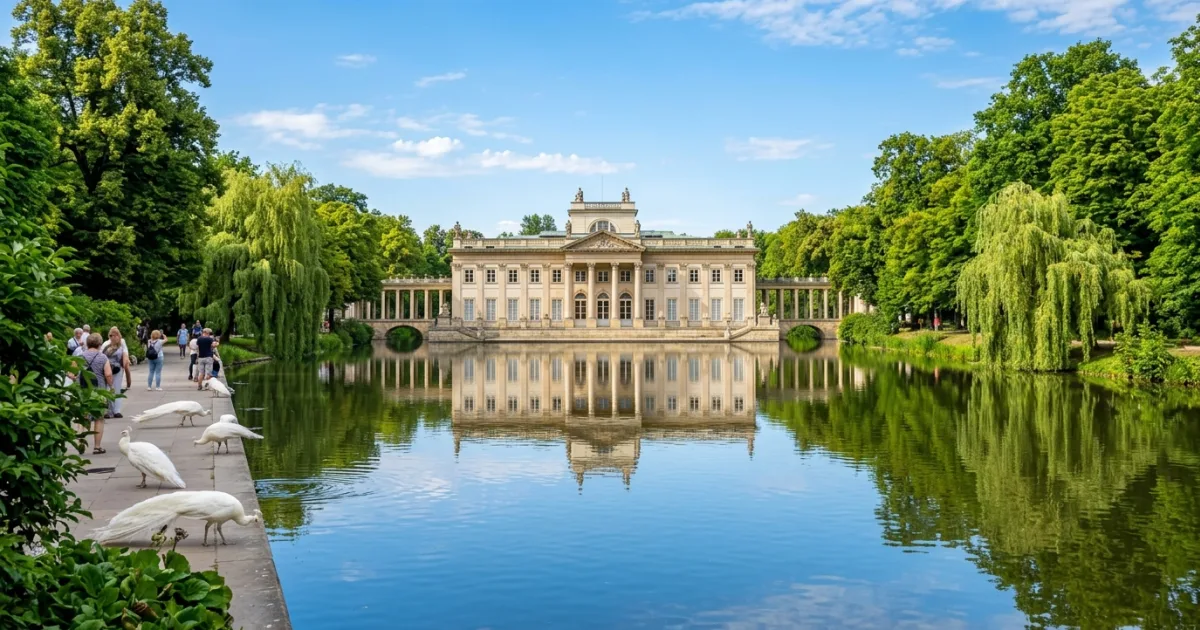
Beyond its botanical wealth, Lazienki functions as an open-air museum complex housing the Palace on the Isle, the Old Orangery with its rare surviving 18th-century court theatre, the Myslewicki Palace, and the White Pavilion. Majestic white and blue peacocks freely wander along neoclassical stone balustrades, while wild carp swim in the canals. It remains one of Europe's most intact historic monarchical park ensembles, largely spared the total structural destruction that afflicted the rest of Warsaw in 1944.
Reasons to Visit
- Palace on the Isle: An architectural masterpiece rising directly from the waters of a scenic lake, housing royal painting galleries.
- Sunday Chopin Concerts: Prestigious pianists perform classical repertoire under the monument for public audiences free of charge throughout summer.
- Historical Royal Theatres: The Old Orangery features the Royal Theatre, one of Europe's few authentic surviving 18th-century wooden court playhouses.
- Rich Urban Wildlife: Encounter friendly red squirrels that take nuts directly from your hand, accompanied by royal peacocks.
- Seasonal Atmospheric Shifts: Spectacular golden autumn foliage and romantic misty waterways in spring provide world-class photographic scenery.
Things to Avoid
- Avoid bringing bicycles, scooters, or skates, as they are prohibited at the entry gates and security will fine violators.
- Do not bring dogs into the park; pets are entirely barred to safeguard resident wildlife.
- Avoid feeding bread to the peacocks and aquatic birds; use plain seeds or unsalted nuts for squirrels instead.
- Don't rush through in under an hour; the grounds cover 76 hectares and require at least half a day to explore thoroughly.
Local Transportation Tips
Lazienki Park is easily accessible by public transit from central Warsaw. Numerous bus lines (including lines 116, 166, 180, and 503) run from the Royal Route and Warsaw Central Station directly to stops along the park's perimeter, such as 'Łazienki Królewskie' and 'Plac Na Rozdrożu'. The nearest metro stations are Politechnika (M1) and Centrum Nauki Kopernik (M2), both a short bus ride or 15-minute walk away.
Travel Etiquette
- Maintain a peaceful and hushed atmosphere, particularly around historical monuments and during live musical recitals.
- Keep off protected ornamental flowerbeds and respect marked conservation boundaries.
- Smoking is prohibited across the park's historic grounds and museum zones.
- Do not attempt to touch or chase the peacocks, ducks, or swans.
Recommended Age Group
Lazienki Park offers an enriching and accessible escape for all age demographics thanks to wide gravel trails, abundant nature, and rich cultural programming.
- Babies (0-2 years): Recommended. Wide, level paths accommodate strollers comfortably, with shaded glades ideal for peaceful rest.
- Kids (3-12 years): Recommended. Children delight in spotting peacocks, watching swans, and feeding wild red squirrels with nuts.
- Teens (13-19 years): Recommended. Picturesque bridges, neoclassical palaces, and garden walkways provide great photography and quiet study corners.
- Adults (20-64 years): Recommended. Outstanding neoclassical art, history exhibitions, peaceful promenades, and world-class live piano recitals.
- Seniors (65+ years): Recommended. Abundant park benches, level terrain, and a tranquil atmosphere make it exceptionally suited for mature visitors.
Accessibility Level: Medium
- The park features primarily flat, wide gravel and asphalt pathways suitable for wheelchairs and motorized scooters.
- Wheelchair ramps are available at key museum entrances including the ground floor of the Palace on the Isle and Old Orangery.
- Accessible public restrooms are strategically located near main entrance gates and the Old Orangery.
- Designated disabled parking bays are situated near the Agrykola and Parkowa street entrances.
Did You Know?
During World War II, the occupying forces drilled holes into the walls of the Palace on the Isle intending to blow it up with dynamite, but the demolition was never carried out, preserving the outer structure from total destruction.
Cool Statistics
- Spans 76 hectares (188 acres) of protected parkland in central Warsaw.
- Contains over 20 historic buildings, monuments, and neoclassical pavilions.
- Host to Chopin recitals that have taken place continuously every summer since 1959.
- Home to over 5,000 trees, some dating back more than 200 years.






Buy a compatible power adapter for your trip