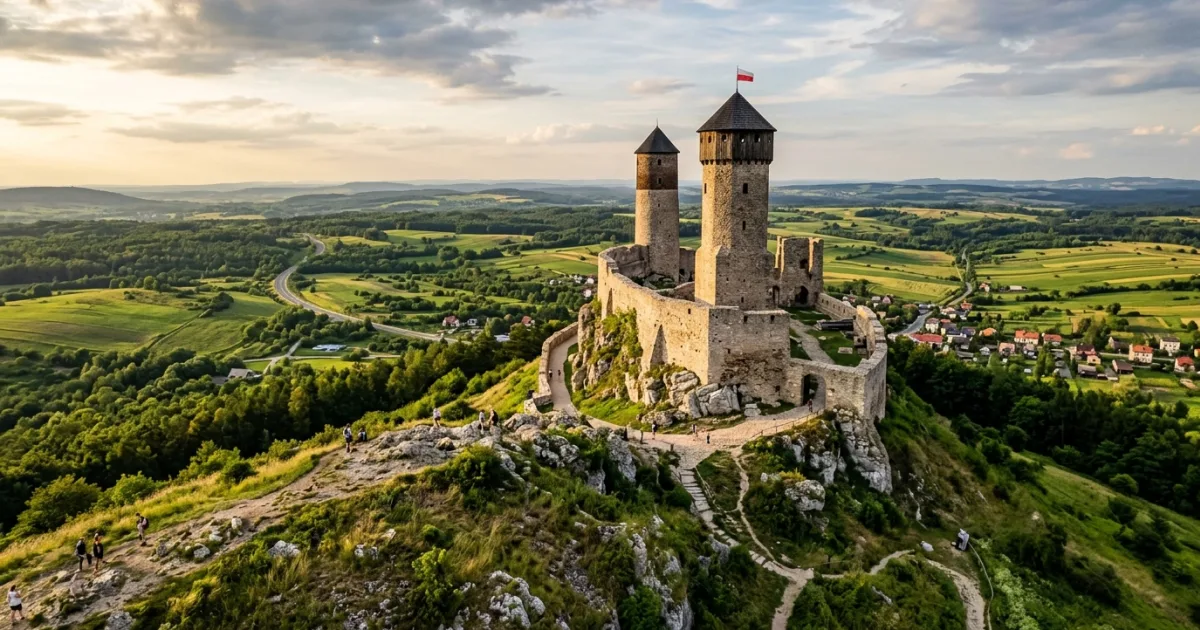
Checiny occupies an exceptional geographical crossroad in the Świętokrzyskie region, resting among the oldest geological mountain formations in Europe. Human settlement on Castle Hill dates back centuries before stone fortifications arose, capitalizing on the natural elevation that commands the river valleys and trading corridors linking Krakow to Sandomierz and northern Poland. The Royal Castle attained peak strategic importance during the 14th and 15th centuries under the Piast and Jagiellonian dynasties, serving as a gathering point for royal armies before the pivotal Battle of Grunwald in 1410 and housing the royal treasury.
Today, the town seamlessly balances its formidable medieval footprint with forward-looking educational institutions like the European Centre for Geological Education (ECEG), operated by the University of Warsaw. Wandering down from Castle Hill, travelers encounter the 14th-century Church of St. Bartholomew, the Franciscan monastery complex founded by King Casimir the Great in 1368, and the Niemczówka tenement house, which preserves vaulted Renaissance cellars and centuries of municipal history. With its blend of living heritage, dramatic stone masonry, and peaceful natural surroundings, Checiny offers an authentic glimpse of historic Poland away from mainstream urban congestion.
Reasons to Visit
- Royal Castle in Checiny: Explore monumental medieval fortifications, scale defensive towers, and witness live historical reenactments.
- Raj Cave (Jaskinia Raj): Marvel at thousands of pristine calcite stalactites in one of Poland's most strictly conserved natural karst caverns.
- Panoramic Mountain Vistas: Admire sweeping viewpoints overlooking the Świętokrzyskie landscape, ancient limestone quarries, and forested ridges.
- Geological Heritage: Discover millions of years of earth history across local educational reserves and the modern European Centre for Geological Education.
- Historic Polish Architecture: Walk quiet cobblestone lanes lined with Renaissance masonry, vaulted cellars, and 14th-century religious foundations.
Things to Avoid
- Avoid attempting to visit Raj Cave without advance reservations, especially on summer weekends when visitor capacity is routinely booked solid.
- Avoid wearing smooth-soled shoes, flip-flops, or high heels, as the steep paths and castle masonry can be extremely slick.
- Avoid rushing through Checiny solely as a highway photo-stop; the town's monastery, Renaissance manor, and walking trails warrant several hours.
- Avoid parking in unauthorized residential zones near the lower castle path; use designated municipal lots at the base of Castle Hill.
Local Transportation Tips
Checiny's core sights, including the market square, Niemczówka house, and Castle Hill, are easily navigated on foot. Suburban bus line 31 operates frequent daily connections between central Kielce and Checiny's main stop near the historic square. Regional taxis and rideshares operate from Kielce, offering convenient transfers to nearby outlying attractions like Raj Cave and the open-air Ethnographic Park in Tokarnia.
Travel Etiquette
- Maintain respectful decorum and quiet voices when touring active places of worship, including the Church of St. Bartholomew and the Franciscan monastery.
- Never touch calcite formations inside Raj Cave; human skin oils permanently inhibit fragile stalactite growth.
- Keep pet dogs on a leash in public town areas and heed castle grounds regulations regarding animal access.
- Acknowledge shopkeepers and ticket staff with a polite 'Dzień dobry' upon entering, which is standard Polish courtesy.
Recommended Age Group
Checiny caters exceptionally well to history enthusiasts, outdoor lovers, and school-age travelers, though terrain challenges require consideration for certain visitors.
- Babies (0-2 years): Neutral. Pushing strollers up the steep, cobbled paths to Castle Hill is strenuous, though the lower town square is stroller-friendly. A baby carrier is essential for the castle ruins.
- Kids (3-12 years): Recommended. Children thrive exploring the expansive castle grounds, interactive knight displays, archery zones, and the subterranean wonderland of Raj Cave.
- Teens (13-19 years): Recommended. Older youth appreciate the dramatic high-vantage photography spots, medieval weaponry demonstrations, and local geology trails.
- Adults (20-64 years): Recommended. Perfect balance of active hill walking, authentic regional dining, rich military history, and natural cave exploration.
- Seniors (65+ years): Recommended. Excellent cultural sights and scenic panoramas, provided visitors take their time ascending Castle Hill and utilize sturdy walking poles on stone stairs.
Accessibility Level: Medium
- Castle Hill involves a steep, uphill walk over uneven cobblestones and gravel; the upper castle ruins and tower lookouts are not wheelchair accessible due to historic stone steps.
- Raj Cave features paved interior walking paths and lighting suited for visitors with mild mobility challenges, though motorized wheelchairs cannot be accommodated inside narrow passages.
- Checiny's lower market square and select ground-floor restaurants offer flat, step-free access for manual wheelchairs and mobility scooters.
Did You Know?
In 1968, the imposing ruins of Checiny Castle served as the dramatic filming location for director Jerzy Hoffman's legendary Polish historical epic 'Colonel Wolodyjowski' (Pan Wołodyjowski). Film crews constructed a massive wooden mock-up of the fortress of Kamieniec Podolski right beside the medieval stone towers, drawing international cinematic renown to the quiet Świętokrzyskie hillside.
Cool Statistics
- 1306: The approximate year of the earliest confirmed written record referencing the Royal Castle of Checiny.
- 360 meters: Elevation above sea level of Castle Hill (Góra Zamkowa), towering above the surrounding countryside.
- 47,500: Estimated number of fragile calcite speleothems preserved inside the protected chambers of nearby Raj Cave.
- 15 kilometers: Short distance separating Checiny from Kielce, the voivodeship capital.






Buy a compatible power adapter for your trip