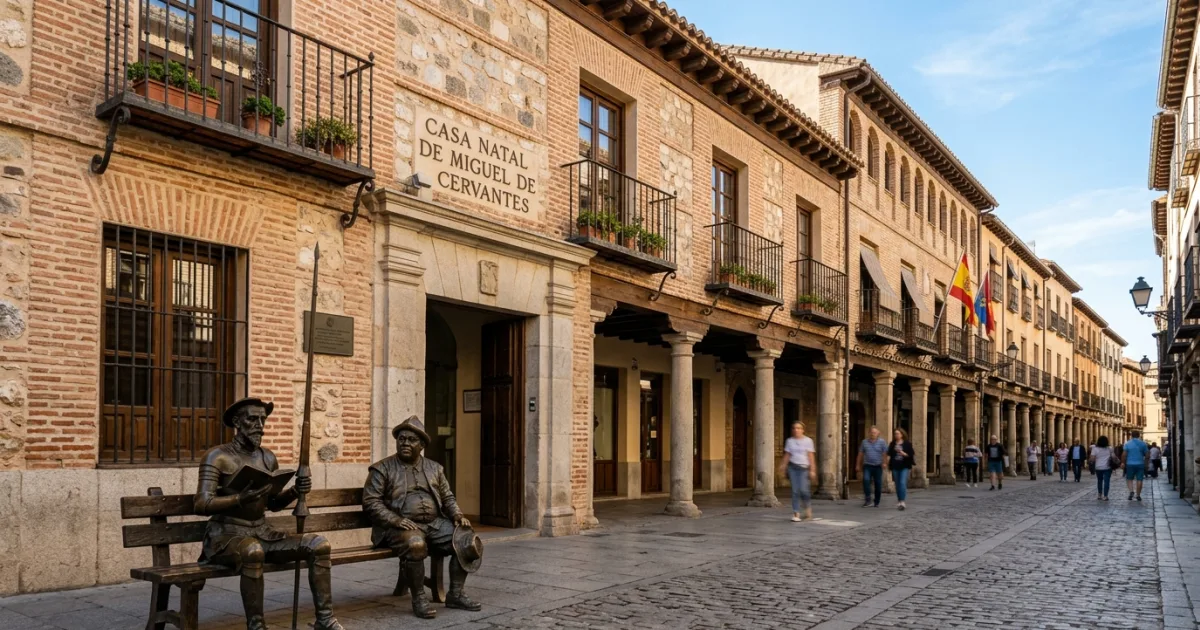
The museum is strategically located on Calle Mayor, the longest arcaded street in Spain, which has retained its commercial and social importance since the Middle Ages. Inside the house, the rooms are arranged around a beautiful central courtyard with Renaissance columns, a typical architectural feature of wealthy homes of the era. Visitors can walk through the apothecary, the dining room, the ladies' estrado (sitting room), and the bedrooms, all meticulously decorated to reflect the lifestyle of the Cervantes family.
In addition to the permanent recreation of the living quarters, the museum frequently hosts temporary exhibitions, workshops, and theatrical readings that bring the world of Don Quixote to life. The institution also serves as a research center, preserving an extensive library of Cervantine literature. Sitting next to the bronze statues of Don Quixote and Sancho Panza outside the front door has become a beloved tradition for travelers from around the globe.
Reasons to Visit
- Stand in the exact location where the most important writer in the Spanish language was born.
- Experience a highly accurate recreation of a 16th-century Spanish noble home.
- View rare, historical editions of Don Quixote translated into numerous languages.
- Enjoy free admission to a world-class literary and historical site.
- Take a memorable photo with the life-sized statues of Don Quixote and Sancho Panza.
Things to Avoid
- Avoid visiting during the mid-day siesta hours (typically 2:00 PM to 4:00 PM) if you plan to shop nearby, as many local stores close, though the museum usually remains open.
- Don't touch the antique furniture or artifacts inside the museum rooms.
- Avoid driving directly into the historic center; parking is scarce and streets are pedestrianized.
Local Transportation Tips
Alcalá de Henares is highly walkable, and the museum is located in the pedestrian-only historic center. If arriving from Madrid, the best option is the Cercanías commuter train (Line C-2 or C-7) from Atocha or Chamartín stations, which takes about 40 minutes. From the Alcalá de Henares train station, it is a pleasant 15-minute walk to the museum.
Travel Etiquette
- Maintain a quiet and respectful demeanor inside the museum, as it is a site of historical and literary reverence.
- Do not use flash photography, as it can damage the historical artifacts and rare books.
- When dining at nearby tapas bars, it is customary to wait to be seated or politely ask the bartender for space at the counter.
Recommended Age Group
The Birthplace of Miguel de Cervantes offers a fascinating historical experience that appeals to a wide range of ages, though the depth of appreciation varies.
- Babies (0-2 years): Neutral. While babies are welcome, strollers may be difficult to navigate through the narrow historic corridors and stairs.
- Kids (3-12 years): Recommended. Children enjoy the visual recreation of the old house and taking photos with the statues outside, though the historical context may go over their heads.
- Teens (13-19 years): Recommended. A great educational stop, especially for teens studying Spanish language, literature, or European history.
- Adults (20-64 years): Recommended. Adults will fully appreciate the architectural beauty, the rare book collections, and the deep historical significance of the site.
- Seniors (65+ years): Recommended. The ground floor is easily accessible and offers a rich cultural experience, though stairs are required for the upper level.
Accessibility Level: Medium
- The ground floor of the museum, including the central courtyard and several main rooms, is accessible to wheelchair users.
- Access to the upper floor requires climbing a historic staircase; there is no elevator available due to the building's protected heritage status.
- Seating is available in the courtyard area for those who need to rest during their visit.
Did You Know?
Miguel de Cervantes' father, Rodrigo de Cervantes, was a barber-surgeon. The museum features a recreation of his workroom, complete with the medical and surgical instruments typical of the 16th century, offering a fascinating glimpse into the medical practices of the time.
Cool Statistics
- The museum was officially opened to the public in 1956 after extensive restoration.
- Calle Mayor, where the house is located, is the longest arcaded street in Spain, stretching over 390 meters.
- Don Quixote has been translated into over 140 languages and dialects, making it one of the most translated books in the world after the Bible.









Buy a compatible power adapter for your trip