Constructed in the second century BC by the Meroë King Adikhalamani and expanded by later Ptolemaic and Roman rulers, the Temple of Debod originally stood south of Aswan along the banks of the Nile. When the construction of the Aswan High Dam threatened to submerge the monument alongside Abu Simbel and Philae, the Spanish archaeological team provided critical salvage assistance. In gratitude, Egypt donated the temple to Spain in 1968, leading to its transport and reconstruction in Madrid, where it opened to the public in 1972.
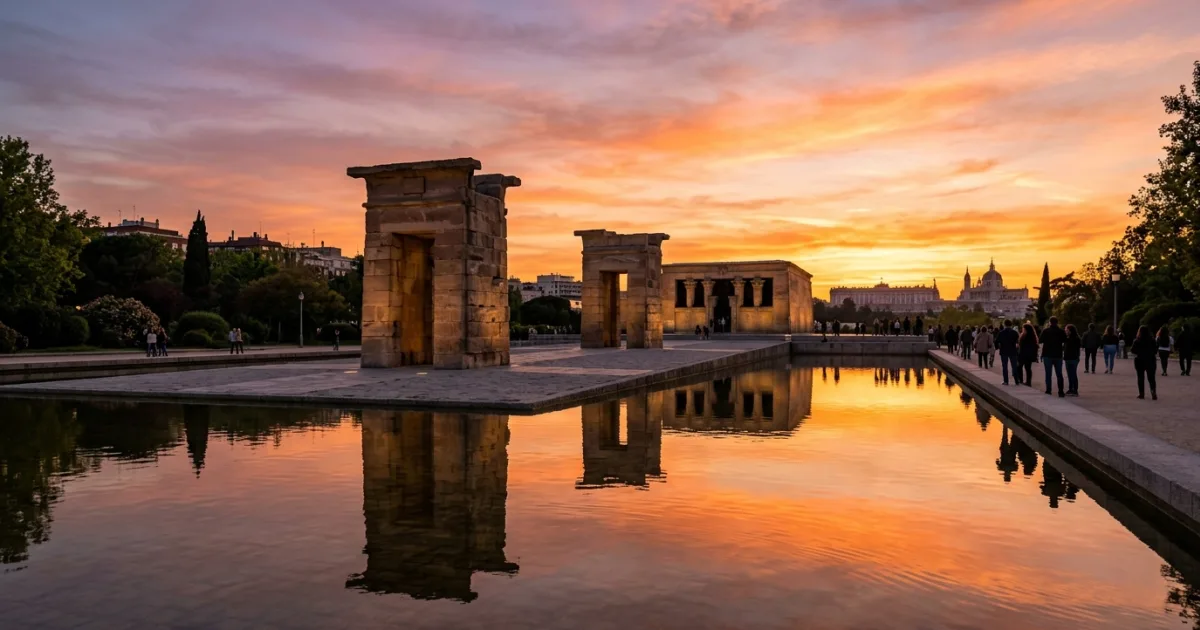
Perched on the bluff of the former Cuartel de la Montaña, the temple was aligned with its original east-to-west astronomical orientation. Within its ancient sandstone walls, visitors discover the Chapel of the Reliefs, preserved hieroglyphs honoring the gods Amun and Isis, and an upper-level scale model showcasing the submerged Nubian temples. Beyond its deep historical gravitas, Debod serves as an urban terrace where travelers and Madrileños gather to witness day dissolve into vibrant shades of violet and crimson over western Madrid.
Reasons to Visit
- Marvel at an authentic 2,200-year-old Egyptian temple preserved in the heart of Spain.
- Experience what is widely acknowledged as the single best free sunset overlook in all of Madrid.
- Explore intricate original hieroglyphic reliefs and Hellenistic-Roman stone carvings up close.
- Enjoy tranquil strolls through the pine trees, grassy slopes, and rose gardens of Parque de la Montaña.
- Conveniently located within a 10-minute walk of Plaza de España, Gran Vía, and the Royal Palace.
Things to Avoid
- Avoid arriving at sunset if you wish to see the interior; queue times can stretch up to an hour due to the 30-person capacity rule.
- Do not climb, lean, or sit on the ancient stone gateways or the perimeter walls.
- Avoid visiting in the dead heat of July or August afternoons between 14:00 and 17:00 when the open stone esplanade reflects intense heat.
- Do not leave personal belongings unattended on park benches or picnic blankets while photographing the monument.
Local Transportation Tips
The Temple of Debod is easily reached via public transit. The nearest Metro stations are Plaza de España (Lines 3 and 10) and Ventura Rodríguez (Line 3), both located a five- to eight-minute walk away. City buses (lines 25, 39, 46, 74, 75, and 138) stop along Calle Princesa and Calle Ferraz directly adjacent to the park.
Travel Etiquette
- Keep voices lowered to an indoor volume when walking inside the temple sanctuary and chapel chambers.
- Flash photography, tripods, and bulky filming equipment are strictly prohibited inside the monument.
- Clean up all packaging and waste after enjoying outdoor park picnics on the surrounding lawns.
- Smoking and consuming alcohol are prohibited within the immediate stone monument enclosure.
Recommended Age Group
The Temple of Debod provides an enriching, safe, and easily accessible experience for a broad range of travelers.
- Babies (0-2 years): Neutral. The surrounding park paths are stroller-accessible, but the interior monument has narrow doorways, stone thresholds, and tight quarters unsuitable for bulky strollers.
- Kids (3-12 years): Recommended. Children enjoy seeing a real ancient Egyptian temple up close, learning about pharaohs, and running on the open lawns of Parque de la Montaña.
- Teens (13-19 years): Recommended. A premier social photography destination with dramatic architectural angles, stunning golden-hour backdrops, and proximity to Gran Vía's shops.
- Adults (20-64 years): Recommended. Outstanding fusion of archaeological significance, romantic sunset views, and relaxed picnic spaces close to central Madrid.
- Seniors (65+ years): Recommended. Flat, wide park paths, ample shaded benches, and gentle gradients from Calle de Ferraz make it very approachable for mature visitors.
Accessibility Level: Medium
- The exterior esplanade, viewpoints, and park pathways feature paved, step-free access from Calle de Ferraz.
- Interior temple entry has small steps, narrow historical corridors, and thresholds that present challenges for standard motorized wheelchairs.
- Accessible public restrooms are located near the park kiosk and adjoining cafeteria facilities.
- Tactile scale models and interpretive Braille elements are available inside the interpretive exhibit spaces.
Did You Know?
When the temple was reconstructed in Madrid, stone masons and archaeologists placed an anachronistic missing-stone technique: restored bricks without carvings were intentionally left blank or stamped with subtle marks so visitors and scholars could readily distinguish original Nubian stone from modern restorations.
Cool Statistics
- Built around 200 BC, making it over 2,200 years old.
- Dismantled into approximately 1,350 numbered stone blocks before transport.
- Weighs roughly 1,000 metric tons of imported Nubian sandstone.
- Dedicated principally to the ancient Egyptian deity Amun of Debod and goddess Isis.









Buy a compatible power adapter for your trip