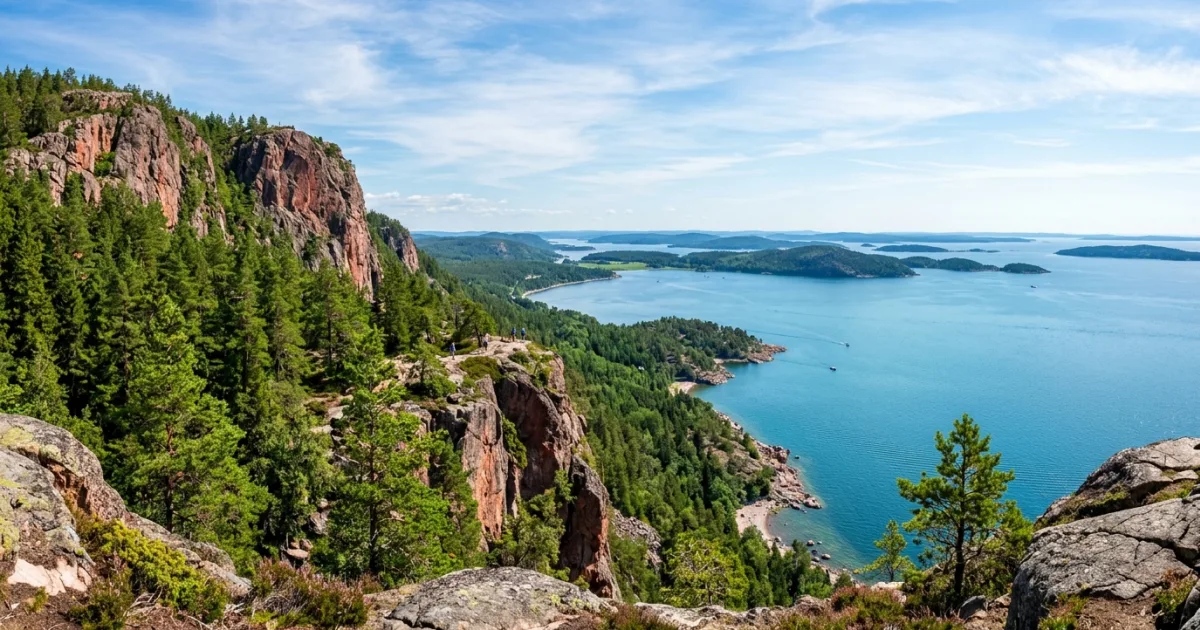
Hoga Kusten, situated along Sweden's northeastern seaboard in Västernorrland, represents one of Europe's most distinct natural landscapes. The region's geological topography is driven by rapid post-glacial rebound, lifting the coastline out of the Baltic Sea at a rate of approximately eight millimeters per year. This constant elevation reveals exposed granite sea cliffs, perched boulder fields, and ancient forested crests that offer breathtaking panoramic vistas across deep maritime inlets.
Beyond geology, the area preserves centuries of coastal culture. Traditional red-painted timber fishing villages such as Skeppsmalen and Barsta contrast against the rugged backdrop of Skuleskogen National Park. Hikers traverse old-growth spruce woodlands to witness the Slåttdalsbacken chasm, while climbers challenge themselves on Mount Skuleberget's vertical cliff faces. Well-maintained infrastructure, uncrowded trails, and deeply rooted culinary heritage make Hoga Kusten a premier destination for slow, restorative nature travel.
Reasons to Visit
- Experience the highest post-glacial shoreline in the world within an officially recognized UNESCO World Heritage region.
- Trek the dramatic Slåttdalsbacken canyon and pristine primary forests of Skuleskogen National Park.
- Scale Northern Europe's largest Via Ferrata installation up the sheer red granite face of Mount Skuleberget.
- Sail or ferry to the tranquil car-free islands of Ulvön and Trysunda to witness preserved 17th-century fishing settlements.
- Savor authentic northern Swedish culinary heritage, including artisanal wood-fired tunnbröd and freshly smoked Baltic seafood.
Things to Avoid
- Do not underestimate trail ruggedness; steep granite boulders become slick during sudden rain showers, demanding proper trekking footwear.
- Do not rely on cash; nearly all businesses, transport operators, and ticket boots strictly require electronic card payments.
- Do not open cans of Surströmming indoors; proper local custom requires opening them submerged in water outdoors due to the pungent brine.
- Avoid hiking without updated offline topographic maps, as cell coverage can drop inside dense inland ravines.
Local Transportation Tips
Navigating Hoga Kusten is most efficiently accomplished by automobile, as scenic points and trailhead entries are dispersed along the E4 motorway and secondary rural roads. During midsummer, the Världsarvsbussen (World Heritage Bus) operates regular routes connecting central rail stations in Kramfors and Örnsköldsvik directly to key trailheads in Skuleskogen. Island transit is managed by scheduled archipelago passenger ferries departing from docks at Ullånger, Docksta, and Köpmanholmen out to Ulvön and Trysunda.
Travel Etiquette
- Respect Allemansrätten by following the 'Leave No Trace' principle, ensuring all waste is carried out and flora remains undisturbed.
- Comply strictly with fire ban regulations (eldningsförbud) during dry summer periods; only light campfires in designated national park metal hearths.
- Remove shoes or wipe footwear thoroughly when entering local guesthouses, private homes, and select rustic lodges.
- Keep noise levels low on wilderness trails and in shared camping sectors to preserve the tranquil natural ambiance.
Recommended Age Group
Hoga Kusten appeals strongly to active adventurers and self-reliant nature enthusiasts, though certain trail difficulties dictate age suitability.
- Babies (0-2 years): Not Recommended. Rugged granite trails, steep vertical ascents, and uneven boulder fields are incompatible with standard strollers and present safety challenges for heavy child carriers.
- Kids (3-12 years): Neutral. Children with outdoor experience will enjoy coastal beaches, short forest loops, and boat trips to car-free islands, but long multi-day treks will prove too demanding.
- Teens (13-19 years): Recommended. Excellent destination for active teenagers who enjoy sea kayaking, exploring deep chasms, camping outdoors, and tackling the Via Ferrata climbing routes.
- Adults (20-64 years): Recommended. Perfect terrain for wilderness hiking, trail running, coastal road trips, and engaging with authentic Scandinavian culinary traditions.
- Seniors (65+ years): Neutral. Older travelers with good mobility can enjoy scenic viewpoints, archipelago ferry excursions, and gentle coastal heritage walks, while backcountry trails require high agility.
Accessibility Level: Medium
- The Skuleskogen National Park South Entrance features a wooden boardwalk allowing wheelchair access out to the edge of the coastal forest and wetlands.
- Major archipelago passenger ferries provide ramp access for manual wheelchairs, though historic harbor docks may feature uneven cobblestones and gravel paths.
- The Naturum Höga Kusten visitor center at the foot of Skuleberget is fully step-free, complete with accessible restrooms and dedicated parking stalls.
- Most wilderness trails feature exposed roots, steep granite steps, and narrow passages that are inaccessible to wheeled mobility devices.
Did You Know?
Mount Skuleberget's peak once formed an isolated, tiny islet sitting completely out at sea. Due to the rapid tectonic uplift following the retreat of the heavy Weichselian ice sheet, that same seabed has risen almost 300 meters, leaving fossil-strewn shorelines stranded hundreds of meters up the mountainside.
Cool Statistics
- 286 meters: The total post-glacial land uplift recorded, the highest known on Earth.
- 8 millimeters: The rate at which the land continues to rise out of the sea every single year.
- 128 kilometers: The full trail length of the High Coast Trail (Höga Kusten-leden), segmented into 13 distinct stages.







Buy a compatible power adapter for your trip