Perched high above the River Thames inside the lush borders of Greenwich Park, the Royal Observatory is one of the world's most historically consequential scientific establishments. Founded under royal warrant in 1675, it was conceived to resolve the deadly navigational problem of finding longitude at sea. Here, John Harrison engineered his revolutionary H4 marine timekeeper, forever changing maritime safety and securing Britain's global trade routes.
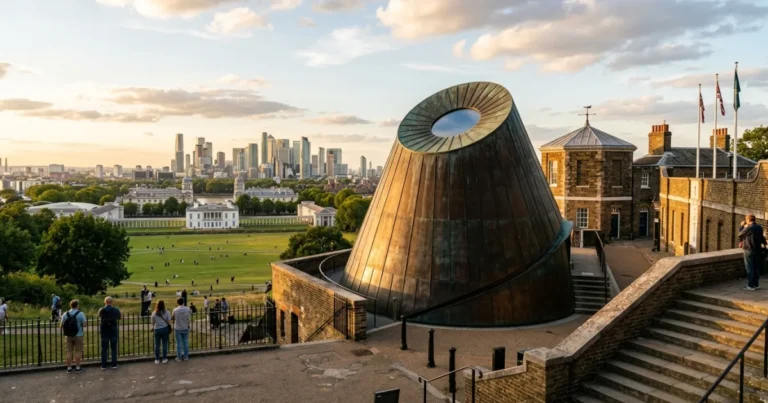
Today, the complex functions as a UNESCO World Heritage site under Maritime Greenwich, blending historical apartments with modern science galleries. Guests can stand with one foot in each hemisphere across the world's Prime Meridian, inspect the 28-inch Great Equatorial Telescope, and experience cutting-edge astrophysics presentations within the Peter Harrison Planetarium. The venue offers exceptional historical immersion coupled with some of the finest vista points in Greater London.
Reasons to Visit
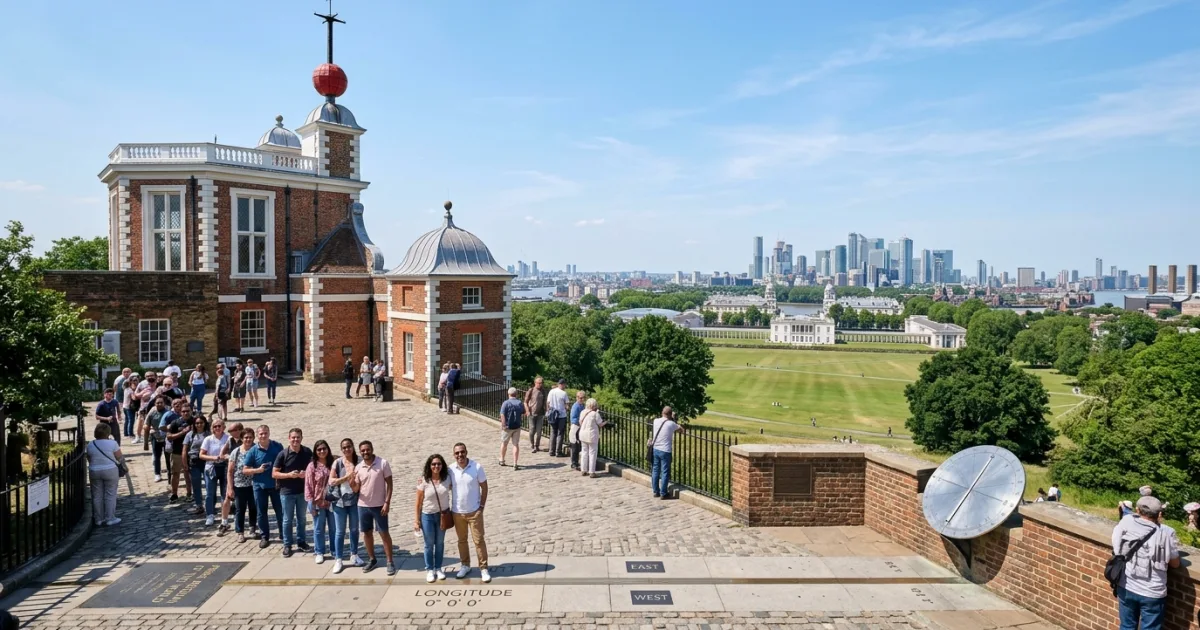
- Stand directly on the Prime Meridian Line (Longitude 0°), the baseline for global cartography and world time zones.
- Witness the historic 1:00 PM drop of the bright red Time Ball atop Sir Christopher Wren's Flamsteed House.
- Inspect the original Harrison marine clocks (H1 through H4) that solved the historic longitude dilemma.
- Enjoy the Peter Harrison Planetarium, London's only public full-dome planetarium.
- Capture unobstructed, world-class views of the Queen's House, Old Royal Naval College, and Canary Wharf skyscrapers.
Things to Avoid
- Avoid arriving without pre-booked time slots on sunny weekend afternoons when ticket queues snake out into the park.
- Do not skip the historical clockwork exhibits inside Flamsteed House; they contain the world's most significant horological collection.
- Avoid taking private minicabs up into the pedestrian core of the park where vehicular access is restricted.
- Avoid rushing down the hill immediately after seeing the courtyard; explore the Great Equatorial Telescope tucked inside the rear dome.
Local Transportation Tips
The observatory is accessible by several scenic and convenient transit methods. The most popular route is taking the DLR (Docklands Light Railway) to Cutty Sark for Maritime Greenwich, followed by a picturesque 10-minute walk through Greenwich Park. Alternatively, ride Thames Clippers riverboats to Greenwich Pier for an atmospheric arrival by water. Southeastern rail connects London Bridge directly to Greenwich Station in under 10 minutes. For those wishing to bypass the uphill walk, buses 53 and 386 stop near Blackheath, providing level access into the south entrance of the park.
Travel Etiquette
- Maintain orderly queuing while waiting for photographs on the brass Prime Meridian Line.
- Keep voices low and silence mobile devices when stepping inside the Peter Harrison Planetarium auditorium.
- Adhere to photography guidelines; flash photography and tripods are restricted inside historical galleries and clock exhibits.
- Keep to paved pedestrian paths in Greenwich Park to protect natural turf and delicate deer sanctuary zones.
Recommended Age Group
The Royal Observatory provides an engaging experience across generations, though uphill access requires planning for very young travelers.
- Babies (0-2 years): Neutral. Cobblestone courtyards and historical stairwells restrict large strollers, though pushchair parking and paved park grounds are available.
- Kids (3-12 years): Recommended. Interactive space science displays, the thrill of standing across two hemispheres, and visual planetarium programs captivate school-age children.
- Teens (13-19 years): Recommended. Excellent educational context for physics, history, and photography, set against scenic skyline views.
- Adults (20-64 years): Recommended. A premier cultural attraction offering deep historical immersion in horology, navigation, and architecture.
- Seniors (65+ years): Recommended. Excellent seating inside exhibits and planetariums, though mobility-impaired visitors should consider the flatter transit approach via Blackheath.
Accessibility Level: Medium
- Step-free access is available to the Meridian Courtyard, Peter Harrison Planetarium, Astronomy Centre, and cafe.
- Flamsteed House is a Grade I listed 17th-century building with narrow winding staircases that prevent full wheelchair access to upper domestic floors.
- Accessible restrooms are located in the Astronomy Centre and beside the courtyard.
- Registered assistance dogs are welcomed across all galleries, courtyards, and planetarium areas.
- Wheelchair-accessible taxis can drop passengers at the Blackheath Avenue gates directly adjacent to the main building.
Did You Know?
Before the international adoption of the Greenwich Meridian in 1884 at the International Meridian Conference in Washington D.C., nearly every maritime nation calculated their charts using their own capital's meridian, including Paris, Cadiz, and Saint Petersburg. Greenwich won the international vote primarily because over 72% of the world's commercial shipping was already reliant on British nautical charts.
Cool Statistics
- Longitude: Exactly 0° 00' 00"
- Year Established: 1675 by King Charles II
- Telescope Aperture: 28 inches (the largest of its kind in the UK)
- Elevation: 46 meters (151 feet) above the River Thames
- Time Ball drop frequency: Every single day at 13:00 GMT/BST since 1833










Buy a compatible power adapter for your trip